




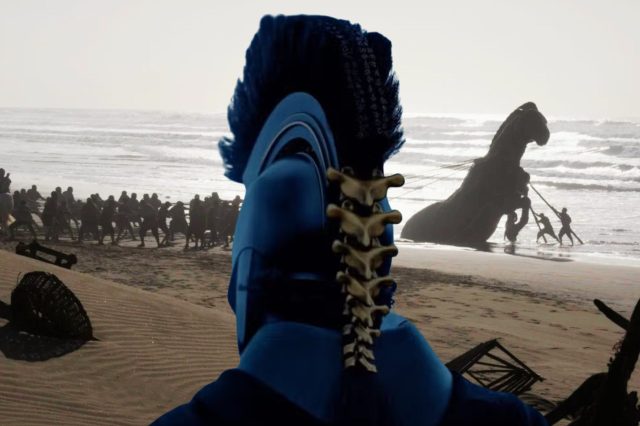
“We have given Agamemnon a server farm and a few AI agents and called it progress.” (Universal Pictures)





Christopher Nolan’s The Odyssey has returned Homer’s epic to the center of popular culture, a feat that must be welcomed. Many have asked me to review the film. I declined. Being Greek gives me no privileged vantage point from which to comment on a work that belongs to everyone, that has traveled across centuries and languages to settle in the imaginations of strangers. So, for now, I shall pick up on some of Homer’s, and Nolan’s, themes to revisit contemporary developments that keep me up at night.
From our dwindling highbrow publications, to our proliferating social media, everyone is fixated on the clash between the technooptimists and the technophobes. Is efficiency more important than justice? Will AI liberate or enslave us? These debates take us around in circles, reinforcing entrenched faiths rather than shedding new light. To reflect on these matters, we can do worse than revisit the ancients, who knew a thing or two about capturing the essence of things.
At the heart of Homer’s Iliad, beats the story of a long strike. In 18 of its 24 books, Achilles, the Greeks’ finest fighter, has downed his weapons; refusing to leave his tent to join the fray, he’s incensed with his boss, Agamemnon, the King of the Achaeans. His wrath erupted after a visit from Odysseus bearing the King’s decree to confiscate loot from an earlier skirmish with the Trojans. It is Homer’s way of introducing Odysseus to us not so much as the cunning hero, but as messenger — a lackey of an authoritarian King. Only when the Trojans slay Achilles’ best mate, Patroclus, does he set revenge against the Trojans above his miff with Agamemnon, end his strike, rise from his tent, and return to the battlefield.
At that point, Achilles’ mother, Thetis, beseeches Hephaestus — the only useful Olympian, the god of manufacturing — to craft new armor for her boy. Hephaestus, who owes a debt to Thetis for having cared for him when he was cast out of Olympus, gets to work in his volcanic forge. From that fiery darkness he creates a stunning set of weapons: a shield, a helmet, a breastplate, and greaves. The shield is the centerpiece, elaborately engraved with scenes of earthly life, war, peace, the cosmos, and human labor: a reflection of the human world. This is no mere metalwork; it is divine craftsmanship, imbued with power that no mortal smith could fashion. It is a god’s gift, not a product of human labor or intelligence, as if to remind us that true gifts are priceless.
Cut to Odysseus 10 years later. Achilles is now dead, but has done much to make Troy’s sacking possible, even if Odysseus provided the final push with his horse ruse — another gift that brought ruin to a great city. In his film, Nolan depicts Odysseus on his arduous journey home as a man exercised by regrets, haunted by guilt over the way he treated the defeated Trojans, tortured by an understandable survivor’s guilt; the unshakeable burden of having watched all his comrades perish, one by one, while he alone reaches Ithaca’s shores. But there is one episode that could have saddled Odysseus’ moral burden with further, deserved, guilt which Nolan leaves out; a tale that Ovid appended to the canon to trouble a man already full of ghosts.
Once Troy was obliterated, as imagined by Ovid in his Metamorphoses, the Greek victors had to settle an internal dispute between Odysseus, their strategist, and Ajax, their most formidable ground soldier. Namely, who would sail home with Achilles’ divine armor? Unable to mediate, the Greek chieftains convened a tribunal; a contest not of swords but of words in which the prize was far more than a set of weapons.
Ajax’s argument was simple. He had fought more, bled more, killed more. He could handle the heavy arms better. He never hid behind ruses or deceit. Unlike Odysseus, who had feigned madness to avoid enlisting, Ajax had answered the call gladly. Achilles’ armor should be his by dint of sheer, unembellished valor; and the requisite skill at handling it.
Odysseus stunned the chieftains by conceding that Ajax was braver and more useful in the heat of hand-to-hand battle. But then he pivoted away from bravery and justice toward efficiency. “Who served the Greeks best?”, he wondered aloud. He was the one who reconciled quarrelling chieftains, infiltrated Troy as a spy, conceived the Trojan Horse ploy. Strength without cunning, he intimated, is brute force. His intelligence, not Ajax’s muscle, had brought victory.
When the tribunal awarded Achilles’ arms to Odysseus, Ajax fell on his sword, inconsolable and incapable of enduring the shame. His corpse a fine addition to all the other regrets Odysseus might agonize over as his journey home, in Nolan’s telling, turned him from a sure-footed, clinical agent to an introspective, self-doubting but more relatable character; a man who carries the weight of others’ fate as if they were lead sewn into the lining of his cloak.
What possible resonance does this have for the modern world? Well, there are several insights to be gleaned. First, it highlights how we attribute value. Today, the Ajax-Odysseus dispute would have been settled not by tribunal, not by a contest of moral arguments, but at a lavish auction organized by Sotheby’s or Christie’s. That this would not raise an eyebrow is indicative of how the frantic commodification of everything has robbed us of a capacity to appreciate value as something irreducible to the depth of one’s wallet.
A second insight is that the clash between Ajax’s appeal to justice and Odysseus’s appeal to efficiency still rages. No sooner does someone propose wealth taxes, to restore a modicum of the fairness that our societies have ditched, than the defenders of the wealthy pose Odysseus’s question: “Who serve the Treasury best by staying in the country? The ultra-rich or the paupers, who are not going anywhere anyway?”
A third insight comes from closer inspection of the bone of contention in Homer’s and Ovid’s stories. What was the loot whose confiscation so enraged Achilles? Her name was Briseis, a Trojan woman whom the Greeks had abducted, along with others, before presenting her as a prize, a slave, to Achilles. It was when Agamemnon had to give up one of his own slave women to appease the god Apollo, that he took Briseis — thus driving Achilles to down his weapons. Homer wants us to feel Achilles’s rage at this theft of his possession — which might as well have been an amphora of fine wine, as a living, breathing, terrified woman.
Are we much better? Before congratulating ourselves on how primitive the Greeks were, we would do well to cast a critical eye on our lot. Besides the rise of a manosphere relentlessly reviving every patriarchal notion of women as a form of property, frenetic commodification has led us to the ridiculous belief that water is just another commodity, students are customers, electricity markets are a good idea, fake carbon markets are an efficient way to decarbonize the atmosphere and so it goes on.
And then there is the other bone of contention: Achilles’ armour. The tribunal was a charade. The verdict was never truly in question, despite Ovid’s attempts to portray it as a cliffhanger. Agamemnon and the chieftains had already decided, very much like today when fair hearings, and rowdy Parliamentary debates, are staged over outcomes already decided elsewhere. The gods gave the armor; the powerful allocated it. Does this sound familiar? Maybe I am reading too much into Ovid and Homer, but humor me.
Before us, we have a pile of capital goods forged by Hephaestus. No mortal effort produced them. They descended from Olympus, as gifts which grant the mortals who seize them powers utterly disproportionate to how they earned them. In the case of Achilles’s weaponry, they were divinely produced means of destruction. On other occasions, like when Prometheus gifted us fire, the gods’ gifts were produced means of production. In both cases, mortals fought each other to the death over who would possess them.
Now, back to our future. Let’s swap Hephaestus’ weaponry for cloud capital: the algorithms behind Amazon’s Alexa and, more recently, the large language models behind AI bots. Unlike Achilles’ armor, these magical tools are forged not by divine labor but by our collective labor: every purchase we make, every sentence we write, every image we tag, every link we click, every correction we offer to a chatbot that has trained us to train it. We have forged the armor, collectively. But we don’t wear it. It is allocated — entirely outside any market, any election, any auction — by the handful of firms that own the algos and the data-centers. The Cloudalists, as I call them, are today’s Agamemnons issuing edicts from their towering heights while we stand outside the tent, waiting for a hearing that will never come.
Under old-fashioned capitalism, exploitation at least wore the market’s clothing. You sold your labor-power in a marketplace that resembled, formally, an exchange between equals — even if that formal freedom curdled the moment you walked through the factory gate and discovered yourself, per Marx’s vampire, drained “while there remains a single sinew to be exploited”.
Ovid’s tribunal was the window-dressing of a decision Agamemnon had already made, in the same way that presenting Deliveroo riders as free-wheeling “associates” window-dresses their precarity as freedom-to-choose, entrepreneurship even. Technofeudalism, our current system, dispenses with even that fiction. There is no market for what Amazon’s algorithm decides to show you, no market for what your feed decides you should feel today. There is only the edict — Agamemnon’s “you must submit to my wish” — now issued by a recommendation engine instead of a king, and dressed, absurdly, in the language of personalization. We have not left Homer’s tent; we have just given Agamemnon a server farm and a few AI agents and called it progress.
And here freedom’s oldest trick resurfaces. Freedom, I have long argued, cannot be defined simply as a fenced off realm from which any kind of domination is excluded. Mainly because that is to ignore who built the fence and how its erection was, itself, a form of subjugation. And Silicon Valley has perfected this fence. You are “free” to close the app, free to decline the cookies, free to walk away from the platform that now hosts your friendships, your customers, your entire social existence — free, that is, the way the desert traveler is free to refuse the only vendor selling water. That is not freedom; that is a serfdom cloaked in the language of choice. Market exchange has given way to digital fiefs, and the lords of those fiefs do not negotiate.
Which brings us to the household Odysseus is fighting to reclaim. Nolan says he wants us to take from his Odyssey the terror and dignity of the nostos — the long, humiliating, cunning fight to claw back what is yours after the world has decided, in your absence, to help itself. While Odysseus is away, the suitors do not merely court Penelope; they consume the estate, slaughter the herds, drink the wine and treat another man’s accumulated wealth as ownerless simply because its owner is not in the room to object. That is precisely what has happened to our property, to our commons — to our texts, our attention, our joint creative and intellectual output. We built the household. We stepped out, distracted, and have returned to find it being devoured. The suitors are not thieves in the night; they are the platforms we invited in, and they have made themselves at home.
Odysseus offers two weapons for this fight, both of which I have long admired. First, cunning over force: he survives the Cyclops by calling himself “Nobody” — an identity strategically withheld — at the precise moment our economy demands the opposite, that we surrender our identities in granular, harvestable detail to systems that profit from knowing us better than we know ourselves. Second, opting for an external restraint, rather than relying on willpower: he resists the Sirens not by trusting his own resolve but by choosing to be bound to his ship’s mast — a form of restraint imposed from without because reason alone cannot counter a sufficiently seductive song. The infinite scroll is our Sirens’ song. No one wins that contest through willpower; you win it, if at all, through binding yourself to something immovable outside your self: regulation, collective action, a mast lashed by public power rather than private terms-of-service. The individual is powerless against the algorithm; only the collective, bound together, stands a chance.
Which brings me to the lesson buried in that old, half-forgotten insight that, in every exploitative society, any regime of allocation needs a story that makes coercion look fair and reasonable. Homer and Ovid gave the ancient world its story; the market gave capitalism one; now, the algorithm is busy writing technofeudalism’s. The task in front of us is not to win Achilles’ armor by out-arguing Odysseus. Nor is it to secure our right, as Achilles attempted, to keep others enslaved. It is to notice, finally, that the contest was rigged right from the moment Agamemnon decided upon the referees — and to sail home anyway. For the household is still ours, if we have the cunning to reclaim it and the courage to bind ourselves to the mast against the songs that would lure us to our ruin.
Yanis Varoufakis is an economist and former Greek Minister of Finance. He is the author of several best-selling books, most recently Raise Your Soul! A personal history of resistance.
 yanisvaroufakis