




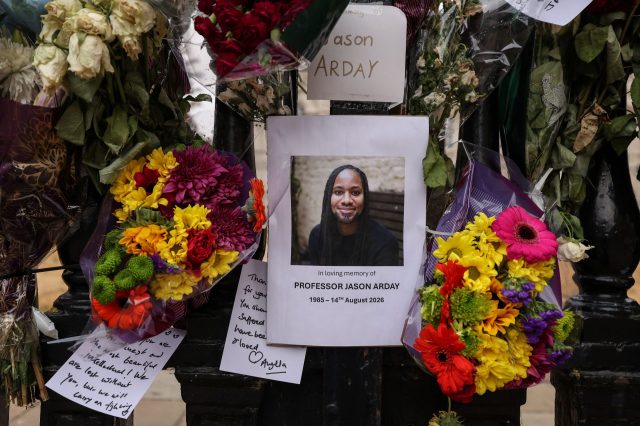
A picture of Jason Arday along with floral tributes attached to a fence around Senate House in Cambridge. (Chris Radburn/AFP/Getty)





Why are delusions so contagious? This is a question I have been asking myself since the terrible news of Jason Arday’s death. Some people seem intent on sustaining the fictional worlds he created for himself, even now.
Journalist Peter Jukes is still claiming the former professor really did run “all those marathons”; and that the plagiarism charges relate only to “a couple of citation errors” in his PhD. To maintain this, Jukes is apparently inspecting wafer-thin slices of evidence — an old press report here, a potentially partisan internal university investigation there — while carefully bypassing reams of more relevant material.
Others are maintaining Arday’s own accusation that his minority ethnicity was the only plausible reason for all the press interest. They are obsessing over the fact that a disgruntled race scientist first exposed the scandal, ignoring the detailed findings of more neutral journalists since. They also disregard a blindingly obvious alternative explanation: Arday was presented as a national treasure by the establishment, entirely because of his astonishing backstory and publication record. This meant that the unraveling of that story, and those publications, were always going to be big news.
It’s true that we can’t know for sure whether a white Oxbridge professorial chair who boasted of incredible feats, advised governments, hosted BBC series, and acted as a judge on the Pride of Britain Awards would get identical amounts of coverage, were serious cracks in his career edifice then revealed. It seems likely, though, if only because of intense public fascination with the mad shit that goes down at universities. Millions of young people are, or recently have been, students, acquiring huge debts along with all those fancy long words. Most of them have financially implicated parents. Oxford and Cambridge are supposed to be an intellectual pinnacle. Why wouldn’t the country be gripped by the strange tale of a dreaming professor among the dreaming spires?
To avoid such conclusions, you would have to retcon Arday’s earlier life, omitting all the plaudits and depicting him as a minor boffin whom no one ever heard of before Nathan Cofnas wrote about him. Equally, to keep believing that the press attention was a “racist feeding frenzy” — recent words of Cambridge University Chancellor, Chris Smith — you have to forget that blackness was constantly brought into the conversation by Arday and his various backers in happier times, as a defining feature of his inspiring ascent (“world’s youngest ever black Cambridge professor” and all that). Once you acknowledge that context, it becomes reasonable to wonder whether the later mentions of Arday’s race by critics simply parrot the earlier mentions by fans. Or perhaps commentators are illustrating a wider thesis: that it is a bad idea to let impressions of a person’s abilities be swayed by facts about their skin color, black or white. Admittedly, this is a Right-wing position now, to the great shame of the Left; but it only counts as viciously racist if you are nuts.
In death as in life, then, misleading narratives are being built around Jason Arday. There is a sense of people staring doggedly at small sections of the picture, while averting their eyes from the complicated whole. Some of them are presumably sticking with his version of things out of grief or loyalty; but others seem determined to keep him in the symbolic realm for murkier reasons, erasing huge chunks of actual biography in the process.
From those on the other side, there have also been gleeful distortions of the truth. One is a tendency to depict the man as a deeply cynical fraudster. There is a boringly predictable urge here to demonize the ideological enemy to the max. Yet according to posthumous testimonies from acquaintances, Arday was kind, friendly, enthusiastic, and a bit eccentric; not someone sociopathic at all. His heroic anecdotes about overcoming difficulty — by now amply described elsewhere — were so silly and easily disprovable, the details wandering so wildly from one interview to the next, it beggars belief there was any kind of devious masterplan at work. Indeed, it is this version of Arday that indicts his employers and publishers. Had he been a smooth and accomplished conman, undetectably working the system, they would be more easily excused now.
Before Arday’s resignation, I wrote a piece charging university managers and others with having ignored his unfitness for an academic role, and so using him in a way that was not ultimately in his interests, though it was in theirs. I still believe this; but now concede that it, too, is part of a bigger picture. Bending the truth was a habit of mind that probably made him horribly vulnerable to the destruction of his imaginary worlds. He told stories about himself like his life depended on it — in research, in interviews, in motivational speeches — and there are hints of shame in the desperate way he tried to suppress the discovery of his plagiarism using lawyers and the police. Perhaps colleagues of Arday suspected that a dose of reality would hurt him, and found it too hard to point the self-deceptions out.
Most of us have met an adult who can’t stop inventing. It is rude and humiliating to confront someone like this about it, and especially when you sense that they require the fantasies — and your pretend belief in them — to carry on. I’ve done it once in my life, and it was very uncomfortable. On another occasion, I have smiled and nodded along. In some jobs or friendships, you can ignore the fact a person can’t stop spinning incredible yarns, because there are no obvious downsides to doing so; it doesn’t interfere with anything else that matters. Part of Arday’s tragedy was that his incredible yarns were not only humored by colleagues (one assumes); some of them were treated as central to his professional biography, and he kept rising higher and higher on the strength of the remarkable impression being conveyed. In a profession whose main mission requires epistemic reliability, it was only a matter of time before disaster would strike.
There is a case, then, for saying that English middle-class embarrassment contributed to Jason Arday’s downfall. Had his colleagues been the sort to call out fibs in the work canteen, perhaps he might have survived. To finally have reality pointed out so clinically by journalists from Left to Right, in full view of everyone who had ever adulated him, must have been a devastating experience. Those who had previously helped sustain him in his illusions could shuffle away from the spotlight. He could not.
There were other factors too, of course. It is daft to think that there is a simple causal or moral path that led to Arday’s untimely death; and the search for a scapegoat now unfolding on both sides of the culture war feels absurdly punitive and crass. It is one thing to ask who was responsible for Arday’s employment in an elite university, or his memoir deal; or indeed, to ask who or what caused him to resign so miserably. It is another thing to confidently assign blame for his suicide as a point-scoring exercise against characters you already hate. Those casually flinging this verdict around are not serious people. They themselves like comforting delusions too much.
Delusions are contagious, I think, because the more that people play fast and loose with facts, in a university or anywhere else, the less incentive there is for others to play by the rules. Sometimes it is easier and more profitable to float off into a world you constructed rather than stick with the real thing. Arday was an extreme case, but there is plenty of it about.
There is, though, another lesson to be drawn here, about the difficulty of delivering truth to a person who is radically self-deceived. Sometimes it is just easier to become half-deluded too. Institutions nominally dedicated to knowledge — universities, media organizations, publishing houses — are full of people captivated by second-hand fantasies, excluding coherent thought. We need to help them face reality.
