




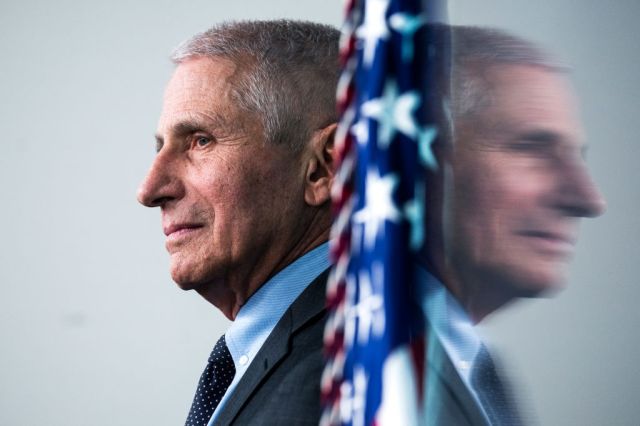
A senior advisor to Anthony Fauci pled guilty last week. Credit: Getty





For six years, there was no accountability for Covid. How did the pandemic happen? Why was the response so economically, socially, and medically destructive? No one, it seemed, would be held accountable. Then, from near the top of the public-health establishment came a guilty plea. And Anthony “Tony” Fauci himself — the former national virus guru likely most responsible for Covid and the worst of the response — has established a defense fund to fend off legal threats.
This is great news. But America and the world can’t celebrate unreservedly — because Fauci himself is unlikely to face criminal jeopardy, owing to a sweeping preemptive pardon granted him by President Joe Biden. Yet that doesn’t rule out other forms of accountability for Fauci, such as civil torts. A deeper reckoning, moreover, may shed light on the creepy, long-running nexus between biological research and America’s national-security state.
Last week, Dr. David Morens — a senior adviser to Fauci during the Covid years at the National Institute of Allergy and Infectious Diseases, or NIAID, part of the National Institutes of Health — pleaded guilty to charges that he conspired with two other people to hide evidence and defy public-records laws. The evidence in question: emails between Morens (and other government-linked scientists) and the British zoologist Peter Daszak, the president of the EcoHealth Alliance, a nonprofit that used US government grant money to fund so-called gain-of-function research at the Wuhan Institute of Virology, according to a report from the House subcommittee on the pandemic.
Gain-of-function research involves combining different viruses to create dangerous hybrids, justified on the grounds of better understanding future infectious diseases. At least one US intelligence agency — the CIA — has already concluded that the novel coronavirus likely leaked from a Chinese lab doing just such work. And it is also reasonable to at least suspect that the US government’s funding of the EcoHealth Alliance was part of intelligence efforts to keep tabs on Chinese research.
According to the Department of Justice, Morens and two unnamed co-conspirators agreed “in writing to intentionally hide their communications from public view by corresponding using Morens’s personal gmail account, rather than his official NIH email account.” This was done, as the conspirators themselves made clear, to evade the transparency requirements of the Federal Records Act and the possibility of future exposure under the Freedom of Information Act, or FOIA.
Among other things, Morens and his conspirators were trying to hide details related to a NIAID grant that helped fund experimentation with bat coronaviruses at the Wuhan Institute of Virology, or WIV, in China. One of these bat coronaviruses may have been a precursor to the Covid-19 virus, which likely escaped from the WIV in 2019.
Many of the incriminating communications have been posted online by the oversight committee of the US House of Representatives. Numerous emails implicate Fauci himself in the effort to evade public-records and transparency laws. For example, an email from Morens to a group of fellow scientists, including Daszak, dated April 21, 2021, contains the following: “PS. I forgot to say there’s no worry about FOIAs. I can either send stuff to Tony on his private gmail or hand it to him at work or at his house. He is too smart to let colleagues send him stuff that could cause trouble.”
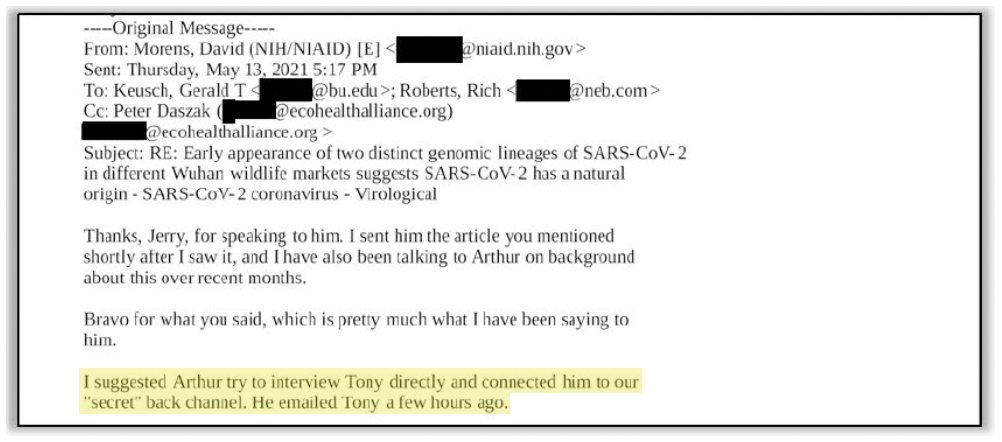
Another email, from May 13, 2021, to the same group of scientists discusses having a friendly journalist “interview Tony [Fauci] directly and connect him to our ‘secret’ back channel. He emailed Tony a few days ago.” This suggests rather routine illegal use of private communication systems to coordinate official pandemic messaging, an effort in which Fauci himself was involved.
Daszak — widely suspected but not confirmed to be one of the unnamed conspirators — appears in many of the emails in which avoiding transparency is mentioned. An email dated April 21, 2021, from Daszak to a group of five other government-employed or -connected scientists, reads in part: “Please feel free to share any docs that I’ve sent to you, with Tony [Fauci]. Hopefully you can do that in a way that avoids [the Freedom of Information Act], and if not possible, just show him stuff on screen share on Zoom.”
In another email, Morens, referring to Fauci, tells Daszak; “If he needs further info, it might be best to connect you two, in an off-the-record manner. Would that be OK? We are getting FOIA’d nonstop, so it’s most important that Tony [Fauci] not have anything on the record that could come back to bite.” Daszak responded: “Totally agree. Tell him I’m happy to speak with him at any time and will do so in a way that’s not FOIA-ble.”
In an email from November 18, 2021, Morens says: “Please pass this on to Peter [Daszak], and I ask you both that NOTHING gets sent to me except to my gmail, and make sure that what gets sent to my gmail doesn’t have a cc [carbon copy] to another government employee who could be FOIA’d.” There are many more statements of the kind in the public record, thanks to House investigators.
The scientists’ obsession with secrecy, their fear of public scrutiny, tells us much about the politics of this pandemic. These people are fundamentally authoritarian. They despise democracy. They epitomize the arrogance of scientism: the worldview that treats science not as a means to gather certain kinds of facts, humble in the face of what it doesn’t know and subject to future revision — but as a total worldview, offering definitive answers to all questions, including the nonscientific, and elevating the expert himself to the status of a demigod.
Their research was reckless. They suspected trouble. And they tried to hide it.
Peter Daszak and EcoHealth Alliance are important in themselves and also because of the larger dynamics they reveal in the history of Covid’s origins. According to Dr. Andrew G. Huff, a former vice president of EcoHealth Alliance-turned-whistleblower, the nonprofit was heavily involved with a USAID program called PREDICT, which ran from 2009 to 2019, and billed itself as an early warning system for zoonotic pathogens that might emerge from nature.
Parallel to PREDICT, Fauci’s NIAID also wrote a grant for $8 million directly to EcoHealth Alliance so that it could help fund research into bat coronaviruses being conducted by Shi Zhengli, a senior scientist at the Wuhan institute. This research seems to have included gain-of-function enhancements on some of the bat viruses that may have made them more dangerous to people.
To be charitable, if collecting intelligence on China’s infectious disease research was the plan, the US government did manage to get inside the Wuhan Institute of Virology, which was then one of China’s top virology labs. Less charitably, the government did so by using US taxpayer money to fund dangerous research in a sprawling and poorly run lab. While the Wuhan Institute of Virology did have Biosafety Level 4 laboratories in 2019, it also had numerous less secure facilities in the same building; some of the bat-virus research is alleged to have occurred in these lower-safety level labs.
In this light, the pandemic can be seen as the ultimate iatrogenic disaster. In an effort to combat pandemics, a secret arm of the government may well have funded research that inadvertently produced the very thing it was trying to prevent: a massive, deadly, economy-crashing pandemic.
It isn’t too far-fetched to imagine that the Trump administration, and especially health secretary Robert F Kennedy Jr., are now deeply ambivalent about the nature of the government’s likely efforts to keep track of other countries’ bioweapon research. On the one hand, if such spywork is funding dangerous research in order to get inside foreign laboratories, it can lead to unintended consequences … like a global pandemic. On the other, rival states and private actors do, in fact, conduct dangerous biological research that the US government might want to be apprised of.
A better way to mitigate the whole problem would be to refurbish the international treaty against biological weapons. That treaty, which outlaws offensive-oriented biological research and was highly effective in an earlier age, has a gaping loophole that allows high-tech biological research to continue as long as it is done in the name of medicine, public health, and biodefense. In other words, the great powers are still making the active ingredients in would-be weapons, but they are not making or testing delivery systems, nor do they deploy pathogens to the battlefield. However, as highly dangerous biological research advances, those old constraints become less important.
To understand how and why, it helps to revisit history. From the end of World War II until the early 1970s, the US government, along with most of its large allies and peer competitors, maintained offensive-oriented biological-weapons programs. During the pandemic, liberal journalists went out of their way to scoff at any mention of “bioweapons,” as if such a thing had never existed. But it did, and it is all a matter of public record.
However, by the late 1960s, American military leaders had turned against these so-called germ bombs, seeing biological warfare as dangerously unpredictable and dangerously accessible. In fact, the US brass referred to biological warfare as “the poor man’s nuke.” A number of accidents, including the mass poisoning of a herd of sheep in the American West, had led to public outcry from not only hippies, but heartland squares as well.
When Richard Nixon arrived at the White House in January 1969, he was met by large and persistent peace vigils demanding an end to US biological-warfare programs. Ten months later, in November 1969, Nixon announced the “unprecedented” unilateral end of America’s biological-weapons program. Quickly thereafter, the United States launched international negotiations aimed at ending bioweapons programs everywhere. In 1972, the Biological Weapons Convention was agreed to. All signatory states were compelled to end their offensive research and to destroy their offensive biological weapon stockpiles by March 1975.
The treaty has mostly been a success. But there was that one loophole. States could continue doing research on dangerous pathogens as long as this was for the creation of “defensive medical countermeasures.” For a long time, this loophole meant little, in part because the barriers to such research were so high. However, by the early aughts, with the advent of the CRISPR gene-editing technology, dangerous tampering with pathogens became much easier and more common.
As more parties began tampering with pathogens, intelligence agencies around the world became increasingly eager to understand what their adversaries were doing. It is this drive that may have led to America’s probable efforts to access the premier virology lab of Washington’s main rival, China.
Diplomacy brought an end to offensive-bioweapons research among the major powers of the planet. But it left open the defense loophole. Real accountability, and a real reckoning with Covid, could, among other things, clear the path for diplomacy between the world’s great powers to amend the 1972 convention, so that the treaty effectively regulates the dangerous and increasingly accessible technologies of the 21st century.
The need to update the 1972 treaty has grown particularly acute in just the last year. Aided by artificial intelligence, synthetic biology is developing faster than ever, and in very dangerous ways. In July, researchers at the University of Minnesota created the first ever artificial life form, a one-celled organism, capable of limited division and replication, called the SpudCell. It is, as yet, unable to evolve or divide over many generations, which is why scientists don’t consider it fully alive. But that could change.
Less complicated and far more dangerous was news in early August that scientists had created a series of viruses that had been designed by AI. Hopes for medical breakthroughs were raised, but so were safety concerns about new synthetic diseases running out of control.
As Dr. Huff, the EcoHealth Alliance whistleblower, told me over the phone: “Universities in all the G20 countries have the capacity to create totally synthetic viruses. We no longer have to go poking around in nature to find dangerous viruses and then do gain of function on them. It’s now possible to create dangerous viruses from scratch.”
We need sunlight and lots of it on the history of Covid’s origins. This is not just about punishing a group of creepy insiders — though they certainly deserve it — it’s also about reining in and restructuring biodefense research of all sorts.
It’s easy to feel squeamish about discussing these matters. The facts, though well-documented, sound conspiratorial and haven’t broken through to the mainstream press, and therefore might hurt your credibility at the next dinner party. But that attitude is adolescent and painfully upper middle class. Now is the time to face the facts, no matter where they lead. A real reckoning on Covid is the first step towards effectively demanding that our governments refurbish the Biological Weapons Convention and take other steps so as to prevent another biomedical disaster.
The alternative may well be masks, lockdowns, censorship, online schooling, shuttered churches, vaccine passports, and exhortations to snitch on neighbors who fail to comply — in short, mass hysteria and authoritarian overreach all over again.