




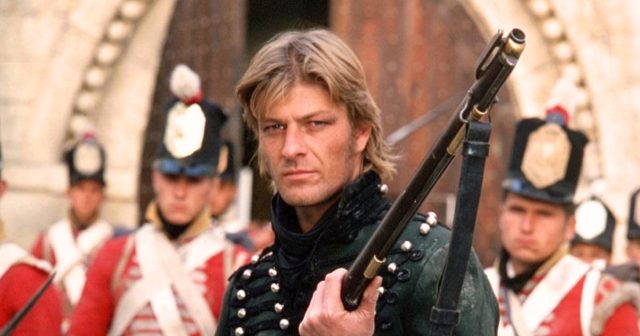





Whatever the merits of Christopher Nolan’s Odyssey, and Matt Damon’s portrayal of Odysseus as a suburban American dad, weary and stricken with guilt over his role in the Great War on Troy, it is hard not to feel something central to Homer has been lost in the decades since Sean Bean’s 2004 portrayal of the Greek trickster hero. Devious, cynical, “a complicated man” uncomplicatedly at ease with violence in the service of his noble patron, Bean’s Odysseus derives directly from his earlier role as the modern British adventurer, ITV’s Sharpe.
Based on Bernard Cornwell’s novel series, a commercial assembly line with no relation to literature, as the author happily admits, the Nineties cycle of feature-length dramas equally cannot be termed cinema. But if Sergei Bondarchuk’s great Soviet war epics War and Peace and Waterloo, in all the grand and inhumane scale of their production, reveal something intrinsic to the nature of Mother Russia, could something similar not be said of their homelier and more ramshackle British analog? With performances that seem to embrace their pantomime quality, and risible pitched battles between armies of a few dozen men apiece, the series — the most expensive drama terrestrial TV budgets could then sustain — have a charmingly amateurish air. Later British stars — Liz Hurley, Daniel Craig — and character actors such as Pete Postlethwaite and Julian Fellowes, crop up expectedly, hamming it up with glee. Never shy of veering into camp absurdity, low comedy, or of sending itself up, even as it aspires to epic grandeur, the series is stamped with a very particular type of Britishness, earnest and self-mocking in equal measure. No wonder, 30 years on, Sharpe retains its appeal.
Just as Nolan’s casting choices diverge, no doubt, from the archaic Greek imagination, so did the television hero take on a life apart from that intended by the author. Cornwell’s Sharpe, a black-haired Cockney, has now been fully subsumed by Bean’s portrayal as a gruff and hawk-like Yorkshireman — a last-minute casting decision made, at ruinous expense, due to the actor Paul McGann’s injury on set in Ukraine. But Bean became Sharpe, just as Troy’s Odysseus later bore his stamp. As Cornwell would write, Bean “really did take over Sharpe. I hear Sean’s voice when I write Sharpe,” with the author eventually tacking a Yorkshire backstory onto his Londoner hero to flatter his audience’s desires. Such is the craft of the bard who spins his tales for fame and gold. Before his first writing attempt, Cornwell stripped apart CS Forester’s Hornblower novels for the basic building blocks of plot, creating a formula that could be reliably leaned upon with the minimum of artistic exertion. Like more celebrated epic cycles, then, ITV’s Sharpe is the work of multiple authors, working within a common register. So dependable, and elastic, had the formula become that the TV series could soon diverge from the books almost entirely, as its scriptwriters appealed to their own personal muses.
For primetime TV entertainment on a low-rent commercial channel, a surprising amount of tonal experimentation could ensue from this production-line dynamic. So, the screenwriter Nigel Kneale, of Quatermass fame, would thrust Sharpe into the strange and unsuccessful horror-Western of Sharpe’s Gold, in which the hero fends off an Aztec sacrificial cult in conquistador armor; or the writer Patrick Harbinson would invent, from thin air, the Loachian social drama of Sharpe’s Justice, with its flinty Yorkshire mill-owners repressing their striking workers with foppish and callous local yeomanry. Perhaps the most artistically satisfying of the entire series, 1996’s Sharpe’s Regiment, scripted by the playwright Charles Wood, possesses an uncanny, dreamlike quality, enhanced by the flat Essex marshland landscapes that owe so much to David Lean’s Great Expectations. Its performances are so outlandishly strange, its portrayal of the harshness and class-based humiliations of the redcoat’s life so bleak, that the episode feels less like a primetime TV drama than a Sixties absurdist satire: and indeed, it comes as no surprise to learn that Wood had scripted both the 1968 anti-war satire The Charge of the Light Brigade and the BBC’s acclaimed and grueling Falklands drama Tumbledown. If the pre-Blair Nineties were, as I often think, the last gasp of postwar British society before its great transformation into today’s UK, then in Sharpe we see that lost civilization working out its concerns, almost unconsciously, through a determinedly populist medium.
Surprisingly under-remarked by Sharpe enthusiasts is the series’ obsessive working-out of Britain’s pained relationship with Ireland, a theme returned to again and again like a tongue probing a rotting tooth. This political subplot makes sense given the unusual backstories of both Cornwell himself and the writer of the majority of its episodes, Eoghan Harris. Sharpe was born “one wet winter’s day in Belfast”, remembers Cornwell, who at the height of the Troubles “gloried in the grand title of Head of Current Affairs Television for the BBC in Northern Ireland”. It is not hard to discern the imprint of time and place on the author, birthing his hero at his desk “as the rain fell steadily beyond the window and the grey clouds hung low over that strangely beguiling city”.
It is no coincidence, surely, that the villainous Colonel Girdwood of Sharpe’s Regiment, traumatized by his experience of being “ambushed by Black Irish as a young officer” and neurotically obsessed with the “Irish filth, Irish scum” inhabiting “that cess-bog”, shares his uncommon name with the main British Army barracks in North Belfast — a location with which the younger Cornwell would have been depressingly familiar. But then, 30 years ago, Irish concerns intruded more forcefully on England than today. It comes as a shock, such is the English capacity for historical amnesia, to remember that the series’ Nineties run spanned the IRA’s renewed mainland bombing campaign from Warrington and Bishopsgate, through the Manchester and Docklands bombings, to the Good Friday Agreement that froze the conflict. Sharpe is, in its own superficially trivial way, as much a cultural artifact of that carefully forgotten era as the Cranberries’ song “Zombie”.
After all, the series takes pains to put forward a particular political conception of the relationship between the two islands. While Wellington’s army in Spain was indeed heavily composed of Irishmen, the sympathetic Irish characters who populate the series — exiled priests, Wild Geese in Spanish service, or Anglo-Irish aristocrats with dubious lilting brogues — are writerly moral choices. Anti-Irish sentiment expressed by a character is a sure sign of a ne’er-do-well; the relationship between Sharpe and his loyal Irish sidekick Sergeant Patrick Harper (played by Daragh O’Malley) is, on the other hand, the emotional core of the series. Taken together, the repeated Hibernian allusions ultimately coalesce into a particular political plea for amicable coexistence.
Harper’s name is directly lifted from a Republican friend of Cornwell’s in Belfast, whose family, the author writes, “was not fond of the British, nor did they have cause to be”. Irish rebellion is understandable, the writerly logic runs, the product of English neglect and misgovernance: nevertheless, Bean’s gruff Yorkshireman and O’Malley’s bellicose, sentimental Celt can still come together in pursuit of a common, greater good. Or, as the exiled Irish priest in Sharpe’s Sword puts it, as he reluctantly deploys his wits towards Wellington’s service, and humbles a caddish English traitor: “I’m Irish. John Bull’s a bad neighbor. But Bonaparte’s a bully and so are you.” It is a curiously 19th-century vision of Irishness, of sentimental patriotism and rebellious grumblings nevertheless tempered, in the end, by British military service and loyalty to the Crown. Such Redmondism endures today, not least in people like Andy Burnham.
As for Sharpe, all this surely owes as much to the quixotic politics of the screenwriter Harris as to Cornwell himself. When not writing martial TV entertainments for British mass audiences, Harris was an influential and controversial staple of Irish political commentary; an activist for Sinn Féin before the 1970 split within the party, and in the IRA between its Provisional and Official/Workers Party factions. Indeed, Harris says he was once asked to join the IRA by the Republican icon Seamus Costello (who later founded the INLA), an appointment blocked by the IRA’s chief of staff Cathal Goulding. “Forget that,” Goulding apparently said. “Your job is to write pamphlets and work out the ideologue side.” While working for Ireland’s state broadcaster RTE, it has been claimed that Harris smuggled pro-Workers Party and anti-Provisionals sentiment into programming at the same time Cornwell was toiling away for the BBC across the northern border. With the violent self-certainty that characterized his turbulent career, Harris rejected Irish Republicanism’s tradition of violence as a form of “fascism” likely to precipitate Yugoslavia-like ethnic cleansing in Northern Ireland, taking up the cause of Ulster Unionists and in the process becoming “the ultimate Republican apostate”.
Writing the Ulster Unionist Party leader David Trimble’s Nobel Prize acceptance speech the year after the Sharpe series ended, Harris’ popular screenwriting and his concurrent anti-Republican activism reflected two aspects of his own ideological whole. Not for him the squeamishness against military glory that characterized British liberal mores of the time. As he declared in the official ITV companion to the series, “Left liberalism was all over the British film industry at that time… Having somebody stand in front of the Union Jack and shout “‘Stand! Stand!, Stand!” would make most English-born writers deeply uneasy. I was the perfect man for the job because I have no such hang-ups. Being Irish I could wave the Union Jack and be proud of honor and courage, without feeling I had to defend myself at a Hampstead dinner party.” If Sharpe represents a certain kind of Britishness, it is one filtered through a very quixotic Irish perspective, that of the anti-Republican, patriotic Home Ruler, a stance still observable, as a current, among a very specific sub-type of Irish conservative. It is hardly an exaggeration, then, to view Sharpe as one of the final, popular works of the Anglo-Irish canon.
But, Irish ambiguities and Harris’ tangled politics aside, as ITV’s manly and populist answer to the BBC’s contemporaneous and genteel Regency costume dramas, Sharpe more overtly speaks to British audiences. Sharpe is, canonically, a working-class hero, made doubly so by his Northern accent: indeed, you do not need to be Andy Burnham to suspect that the nation would not have taken quite so readily to his intended Cockney incarnation. He is not especially patriotic, and like his literary creator has taken up his calling for purely mercenary and self-improving ends. His antagonists are more often craven and incompetent toffs than Frenchmen, who are, with the exception of the pantomime villain Ducos, almost always fundamentally decent. Indeed, having declared “I’ve done without Yorkshire more than 20 years and I don’t want it now”, Sharpe — like his creator — eventually abandons Britain for good to live abroad with his foreign wife. Much of the hero’s resentment towards authority, and to the petty meanness and restrictions of his own country, can be derived from Cornwell’s own experiences. The illegitimate child of a Canadian airman, Cornwell was adopted by an Essex family adhering to the puritanical Peculiar People sect, and escaped his childhood unhappiness in historical and martial fantasies of his own dreaming.
Here, it is not hard to discern the influence of the Commando, Victor, and Warlord comics of postwar British boyhood in Sharpe’s DNA. Pitched battles are few, fortunately for the directors’ budgets. Instead, Sharpe is sent out on missions of his own, always pulling off victories against overwhelming odds, and defeating enemies who are cads and rotters as well as strategic adversaries. Ducos, the French spymaster, endlessly polishing his spectacles while devising cruel fates for our hero, is simply the cold and sneering German commandant of British boyhood fare. Just as Orwell observed that the Edwardian Boys Own comics of imperial derring-do, which made up his own childhood reading, strove to impart Victorian public school moral codes to a less privileged readership, so do we see their last vestigial survival in Sharpe, who inhabits the moral world of The Four Feathers rather than Flashman. “While other boys were reading Wizard and Rover, I was engrossed in huge leather-bound volumes of the Boy’s Own Paper, 1890 to 1900,” Harris has remarked. “Mentally, I spent my childhood on the North West Frontier.” If, as Orwell stated, “boys’ fiction above all, the blood-and-thunder stuff which nearly every boy devours at some time or other, is sodden in the worst illusions of 1910,” then Sharpe represents the last, unbroken and unapologetic strand of the genre, a golden Edwardian summer never to meet its 1914 (or in Harris’s case, 1916).
Just as folk art, and the bardic register preserves, in fossilized form, the styles and mores of earlier times, so did Sharpe’s unashamed quest for mass popularity preserve the essence of this lost Britain. For all the class grievances that run through the series, Sharpe is a fundamentally conservative corpus of work. The great failing of his superiors, in military rank as well as social class, is not that they possess stern and self-denying moral codes: but that they fail to live up to them. Even a foppish traitor, like James Purefoy’s character in Sharpe’s Sword, can at least redeem himself with a final act of suicidal heroism. Sexual politics, too, are more conservative than the hero’s many dalliances would initially suggest. Bodices are ripped only by villains; Sharpe himself is strangely cold-blooded, the often-awkward and hesitant object of female wiles rather than a Regency rake. Betrayed by his silly and faithless wife, Sharpe’s only enduring and fully requited love throughout the series is his platonic relationship with Sergeant Harper. “As a writer, I’m much more interested in relationships between men than between men and women,” Harris would later declare. “His emotional life is with the regiment, not with the women, and he’s committing adultery every time he turns to them. This is the classical view of what a man’s role is… It’s not a fashionable view, and I make no apologies for that.”
Patrick Harper is, then, Sharpe’s Patroclus, the emotional and battlefield companion of Sean Bean’s moody warrior, sulking in his tent before the walls of Badajoz. Cornwell later reworks this martial pairing of Saxon and Gael in his Last Kingdom series, a set of novels explicitly focused on England’s state formation and the relationships between the constituent peoples of these islands, his purposeful addition to our insular civilization’s founding myths. If Nolan’s Odyssey is overshadowed by the contemporary culture war surrounding it, then Sharpe’s edges are perhaps smoothed over by relegating it to the TV nostalgia of less complicated times. Nolan reworks ancient archetypes to serve today’s American concerns, just as Sharpe, with tighter budgets for Britain’s straitened circumstances, did three decades ago for us. As formulaic as a bard’s stock phrases, conceived as popular entertainment rather than high art, there is a certain political as well as aesthetic value, beyond mere guilty pleasure, in rewatching Sharpe as the mythic hero of that lost and irrecoverable land: John Major’s Britain. The past is a foreign country, we realize, contrasting today’s ITV dross with the first wailing electric guitar notes of Sharpe’s theme tune, as boyishly stirring now as it ever was. They do things differently there.
