









August 21 2026 - 4:00pm
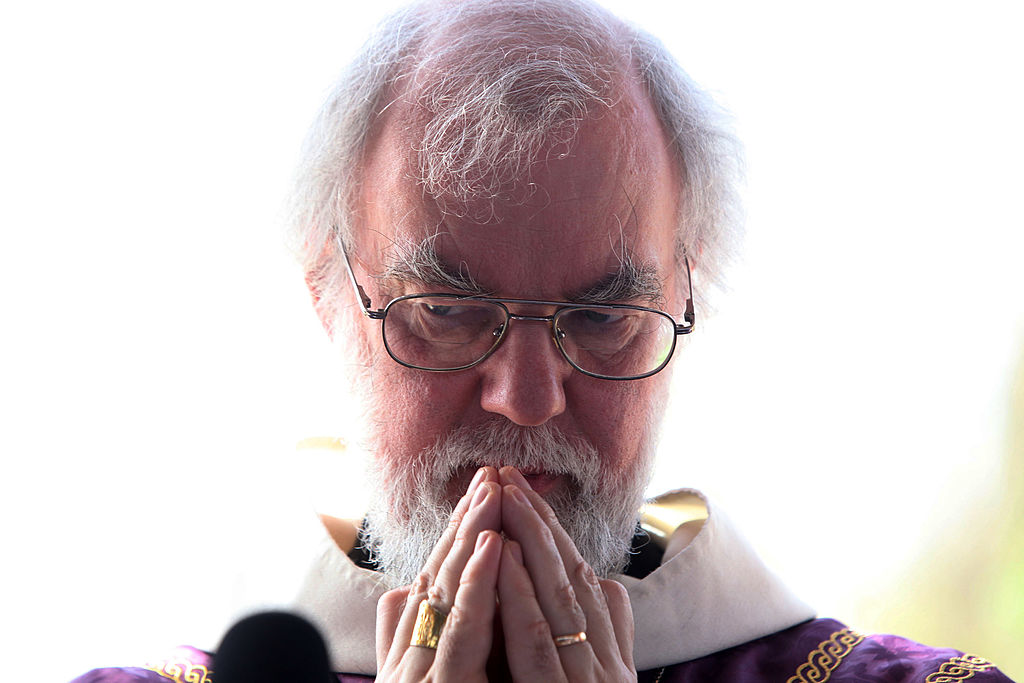
The former Archbishop of Canterbury, Dr Rowan Williams, has told the New Humanist that Reform UK leader Nigel Farage is misusing Britain’s Christian heritage “to channel anti-Muslim feeling”. He added that he has “some awkward questions” for Tommy Robinson about how his claimed conversion to Christianity in prison squared with “public rhetoric designed to produce hostility and violence”.
Concerns about cynical manipulation of Christianity for political advantage are warranted, even from those who don’t share Dr Williams’s perspective as an out-and-proud “hairy Lefty”. Yet rather than simply damning this new enthusiasm for Christianity on the hard Right to the largely atheist readers of the New Humanist, might he be better advised to put his concerns to Farage and Robinson directly?
For example, if Mr Robinson’s jailhouse conversion is sincere, then he will have to engage with the hardest sayings of Jesus Christ about loving one’s enemies, turning the other cheek, and forgiving others if one wishes God to forgive them. And, like other Christians, he will have to grapple with the challenging personal and theological implications of how often he fails to live up to those ideals. As for Reform UK, the party’s God supremo, James Orr, is married to a Church of England priest, Helen, herself a bishop’s daughter — common ground that could start a conversation.
Constructive engagement may also be warranted because there does seem to be something of a vibe shift in attitudes to faith that extends well beyond the hard Right. There is a cohort of British center-left politicians who wear their faith on their sleeve in a way that would have been unimaginable in the Nineties and 2000s, when Alastair Campbell famously declared, “We don’t do God”. Wes Streeting, David Lammy, and Lib Dem leader Ed Davey all spring to mind.
Indeed, recent years have seen an increase in adult conversions not only in the Church of England and English Catholicism, but also in the Church of Sweden and French Catholicism. One can reject Farage’s “green scare” tactics about the growing Muslim population and still wonder whether this unheralded return to Christianity owes something to what young Western Europeans have observed in the Muslims they go to school and work with: a faith secular modernity has not managed to hollow out in the way it has Western Christianity.
Williams’s own Christianity is one that is enthusiastically Leftish and cautiously liberal, but quite traditional in terms of liturgy and absolutely orthodox on the creedal statements of Christianity. A generation or so ago, this tendency saw itself as not only the inevitable future of Western Christianity, but also the best vehicle for re-evangelizing Britain. Yet it has been in dramatic retreat in recent decades and has clearly failed to capture most people’s imagination. Only a minority of new converts to Christianity have headed there. The future of any institution belongs to those who show up.
Latin America’s liberation-theology Catholics were another progressive Christian tendency that assumed they represented the future. In fact, they were elbowed aside by the prosperity-gospel neo-Pentecostals. Dr Williams may worry that a form of Christianity that is somewhat less polished and considerably more tribal than he is comfortable with will be the one that once again fills the nation’s pews. That may be a prospect he is right to worry about; but without engaging in an adult way with those on the Right newly claiming to be Christian, how can he know?