




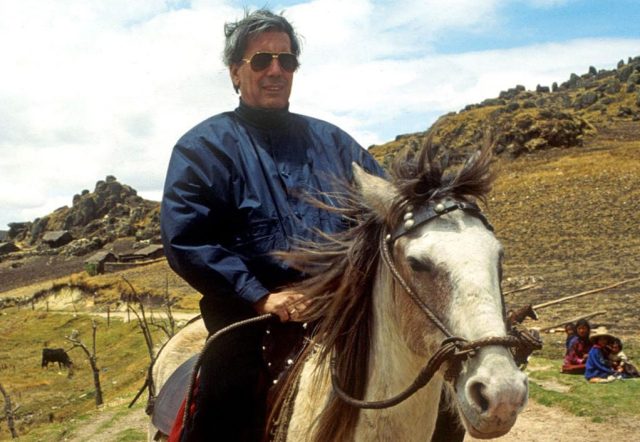
Mario Vargas Llosa during his presidential campaign in Peru. (Jaime Razuri/AFP/Getty)





Mario Vargas Llosa was 10 years old when his mother revealed to him, on a walk along the riverside promenade of the Peruvian city of Piura in early 1947, that his father was not dead, as his entire extended family had always pretended. The man was alive, and they were going to reunite with him — now.
He later described the episode as like something out of a soap opera. But at the time, it was far from entertaining: it was the beginning of a decade-long nightmare. After spending his early childhood pampered by his mother’s extended family, the respectable and haphazardly social-climbing Llosas, he moved to Lima, where he suffered under a controlling domestic regime imposed by his father, with only his mother for company.
For Gerald Martin, the author of an impressive new biography, Mario Vargas Llosa: A Life, his parents’ reunion was the hinge point of the Nobel Prize-winning novelist’s life. This brutal end to his innocence left him with an inexhaustible supply of resentment — and a magnified set of Oedipal complexes — which he spent a lifetime converting into fiction.
Judging by his worldly success, the results were tremendous. When Vargas Llosa died last year, it was with a full trophy cabinet, including the Nobel in literature. The Spanish-language world’s best-known public intellectual, he was the last survivor of the great “Boom” generation of Latin American literature, and the sole member of that cohort who lived to see his politics triumphant across the globe. Revolutionary Cuba, having commanded the loyalty of Cortázar and García Márquez, stands today at death’s door — while the Right-wing politicians Vargas Llosa endorsed in his final years have charged to power in Argentina, Chile, and Peru.
Yet there is a strange hollowness to Vargas Llosa’s victory — first of all, in politics. Even as figures such as Javier Milei (who earned the writer’s endorsement) triumph across Latin America and the world, Vargas Llosa seems to be nowhere, in death no longer useful as a prestigious cheerleader. Far from reflecting Vargas Llosa’s gentlemanly version of neoliberal politics, the Argentine president, with his sideburns and his calibrated displays of mania, is the perfect embodiment of the “society of the spectacle” Vargas Llosa so decried toward the end of his life — and of the distortion of the latter’s neoliberal politics into ever more carnivalesque shapes.
Literary posterity, too, has so far been less kind than the prize juries Vargas Llosa rarely struggled to impress. His old rivals are read more widely and fondly, their political stances, having passed into history, lending them the romantic sheen of the lovable loser. Will death reverse all the victories Vargas Llosa enjoyed in life?
That would be a fittingly melodramatic coda to the telenovela of his life — one in which Vargas Llosa could play the merciless social climber whose journey to the top, like those of the dictators in his novels, left an ever-rising tally of victims in his wake.
His ascent began with his adolescent search for a means of escape from the house of his teetotaling, self-made father — efforts which actually afforded him a wider understanding of Peruvian society than middle-class life in Lima would have otherwise lent him. These included years at the Leoncio Prado military boarding school outside Lima, with a racially diverse student body drawn from across Peru; a stint in the communist underground while an undergraduate at San Marcos University; and work at a local newspaper covering the city’s underworld of seedy nightclubs and brothels — a rare encounter with bohemia in his outwardly abstemious life.
These experiences were fastidiously strip-mined for material across his early novels, starting with his 1963 debut, The Time of the Hero, a murder mystery set in the boarding school. But despite his student organizing stint, Vargas Llosa “was never a genuinely convinced leftist”, writes Martin. “All his gut instincts moved in the opposite direction.”
Still, in those years a Latin American writer had to support Cuba to have any hope of success. Everyone understood then — though many have since forgotten — that Cuba was the political-social-moral motor that launched the great Latin American Boom, even if it was the United States that underwrote the wild commercial success of its leading authors.
So Vargas Llosa made several trips to pay his dues to the cultural brokers of the revolutionary island, visits paid with ever-growing reluctance, Martin argues, until he was able to cut his ties in 1971, when the poet Heberto Padilla was imprisoned by the Cuban government for counter-revolutionary writing. Vargas Llosa helped organize the furious denunciations from Left-wing writers and intellectuals in the rich world, which all but ended a period during which the European Left had extended its hand in friendship to the revolutionary government that had brought communism to within 90 miles of the United States.
But breaking with Cuba also meant breaking with the Latin American Left, and with his fellow Boom writers, who remained sympathetic to Havana to varying degrees. Vargas Llosa would never again receive a warm welcome in Latin American universities and other literary spaces where the Left held sway, a fact that would feed his resentment and, many of his defenders claim, drive him further toward the free-market Right.
By this point, Vargas Llosa had already made a similarly dramatic break in his personal life, divorcing his aunt in 1964 in order to marry his cousin. He had married his uncle Lucho’s sister-in-law, Julia, in 1955, only to leave her for his daughter, Patricia, in 1965, after falling for her while she was staying at Mario’s and Julia’s apartment in Paris. And there was more melodrama to come. On the boat back to Lima to set up his life there, accompanied by Patricia and their three children, Vargas Llosa started an affair with a fellow passenger and left his family to travel with her to the Caribbean. The romance burned out within months, but not before it set in motion the most famous punch in literary history.
Patricia returned without Mario to Barcelona, where she accepted a ride home one night from Gabriel García Márquez. When Patricia later mentioned the encounter to Mario, it left her husband seething with resentment. Loath as he would ever be to admit it, he had a controlling tendency and a jealousy reminiscent of the father whom he detested so deeply.
When Vargas Llosa and García Márquez next crossed paths, at a film premiere in Mexico City, Vargas Llosa yelled something — was it “for what you said to Patricia” or “what you did to Patricia”? — and floored him with a sucker punch. The two never spoke again. Martin reconstructs the scene and forensically weighs up the motivations, but like the mysteries in Vargas Llosa’s novels, we never get a definitive answer.
Whatever the motive, it was a gesture that belonged in the macho world of the Leoncio Prado of Vargas Llosa’s youth. Wasn’t The Time of the Hero supposed to be an indictment of that? Martin suggests the punch was Vargas Llosa playing the part of the sore loser, grasping that he had lost his long-running battle with García Márquez for first place among writers of the Boom. His next great loss would not occasion a more generous response.
By 1989, the year of the fall of the Berlin Wall, Vargas Llosa had decided he was going to be a candidate for president in his native Peru, which had returned to democracy after a military dictatorship. But democracy had failed to deliver on its promise, a sentiment that would become ever more widespread in Latin America over the decades to come.
Vargas Llosa’s platform promised salvation through the kind of deep cuts to state services that then represented something close to a consensus in the rich world. Having embraced the neoliberal gospel of the Eighties with gusto, and guided by Hayek and Thatcher, he was going to free Peru from the failed utopias of the past.
Everyone told him not to — even his friend, the Mexican writer Octavio Paz. But Vargas Llosa, white and upper-class, a debonair cosmopolitan running for office in a country rancorously divided between white Lima and the poor, largely indigenous-descended inhabitants of the Amazon and the Andes, went ahead. So sure of victory, he saw no reason to wait until after the election to publish an erotic novel, In Praise of the Stepmother — a book that was better received in Paris than in Ayacucho. What Peruvians “could understand in the book disgusted them and what they could not understand humiliated and affronted them”, Martin writes.
Vargas Llosa chose to run in a coalition with two of the old politicians that Peruvians wanted to throw out, ignoring, for one thing, his promise to clean up Peru’s dirty system. He justified this decision by claiming there was not time to build a political machine of his own — not without getting in the way of his plans for his next novel, he might have added. It was a choice many political outsiders would emulate in the decades to come. Though Vargas Llosa’s novels prove he could pay close and respectful attention to the heavily indigenous population of the Peruvian Amazon, he could never entirely dismiss his disdain for the country’s Andean indigenous majority. Such attitudes were clear for anyone to see in his public appearances, helping to sway the election’s result — and were confirmed, in case anyone doubted it, in the talk in his memoir about the “savagery” of crowds of mestizo Peruvians whom he called “indistinguishable” from animals.
Vargas Llosa lost in a landslide to the “darkest of horses”, the Japanese-descended engineer Alberto Fujimori, a win that represented the dawn of a new global era in politics — the age of the Right-wing populist outsider — that would herald both maximum victory for Vargas Llosa’s neoliberal ideals and their warping into ghastly shapes.
To cope with his defeat, Vargas Llosa became Spanish. From 1991 to 2023, he wrote a column, “Touchstone”, for Spain’s El País. Vargas Llosa’s role was as a respectable Right-wing voice in this authoritative center-Left outlet. He offered his services more broadly to a country eagerly at work renovating its reputation after Franco, and reasserting its cultural influence over Latin America. Mario was there to help lend moral support to Spain against Catalan separatists and Latin American indigenists, for which he was soon rewarded with literary prizes, citizenship, and even a marquisate. He soon cast aside his long-suffering wife Patricia for a late-in-life romance with the socialite Isabel Preysler, the ex-wife of Julio Iglesias.
Through Vargas Llosa’s prime years, Martin spins a yarn worthy of his subject, sometimes withholding a bombshell detail until the moment of maximum effect, a tactic he seems consciously to borrow from Vargas Llosa himself. Martin’s politics, which place him in sympathy with the Latin American Left on which Vargas Llosa turned his back, are never hidden in this book, but they do not seem to color his judgment until near the end of the book, where he downplays the frankness with which Vargas Llosa, in his late novel, Harsh Times, addresses the calamitous impact in Guatemala of the misguided US-engineered coup against Jacobo Árbenz in 1954.
For all its insight into his works and life, at the end of this thousand-page biography Vargas Llosa remains, as Martin admits, “an immense conundrum”. In a few short pages in the New York Review of Books, the veteran journalist Alma Guillermoprieto got perhaps closer to the mark, having taken the measure of Vargas Llosa soon before he became a candidate. “I had the impression of a profoundly inhibited man”, she writes, “someone who had spent a lifetime learning that he had a right to be himself, and who, despite his effort, was still trying very hard to behave as was expected of him, to please, to avoid giving offence.”
What did the real Mario believe? Even the received story about the political message of Vargas Llosa’s literature is something of a red herring. His Nobel Prize was awarded for “his trenchant images of the individual’s resistance, revolt, and defeat” against the forces of dictatorship and unfreedom. But what is arguably his greatest novel, Conversation in the Cathedral, is a story about the stony and structural corruption and unaccountability of the ruling elite of a viciously unequal country. It takes place under a dictatorship, but could just as easily have taken place during one of Peru’s periods of democracy. And it is not really about the “individual” struggles of its protagonists, who are aware these can only end in the “defeat” the Nobel committee speaks of, even saying so explicitly in the novel’s first and last sentences.
Vargas Llosa’s legacy may in fact end up being secured by the fact that his novels are to the Left of him (as the Uruguayan writer Mario Benedetti first said), but not in a narrowly political sense. The first Vargas Llosa novel I read, Harsh Times, impressed me with its demonstration of his gifts as a storyteller and his deep understanding of how politics works in Latin America and elsewhere. But its non-chronological structure seemed to disguise a deeper simplicity and even vulgarity: this was basically a classed-up political thriller, which used all the same exploitative tactics as a Dan Brown novel. The scripted dialog did violence to the real truth of human relationships the way works in such genres often do.
There is much to admire in Vargas Llosa’s more concertedly “serious” earlier works, and several of his later works, especially their social and political perception and frankness: virtues that will last. But I have never quite shed that first impression of him as a writer. There are, it is almost fair to say, no individuals at all in his work, no characters in the higher sense, just ones delivered straight from central casting.
Even in Conversation in the Cathedral, his vaunted formal devices (“communicating vessels” and “Chinese boxes”, he called them) are basically transparent. You can take an anti-Bildungsroman, a political thriller and a Peruvian take on Madame Bovary and riffle-shuffle them together, but that does not make you William Faulkner. The harsh truth — and Vargas Llosa loved harsh truths — is that he is closer to socially attuned but formally pedestrian writers such as Norman Mailer or John Steinbeck than to being a 20th-century, Third World successor to Flaubert or Balzac.
Martin believes that he fell short principally because Vargas Llosa did not truly love his country. And to this obstacle can be added a more serious one: the emotional, psychological and indeed simply human deficiencies of his literature. Martin mentions the “Flaubertian” high points — moments of profound emotional force — in Conversation: the deaths of the protagonist’s father and his wife. These are powerful passages indeed, but across 700 pages, they are the only two that deserve that adjective.
One of the most striking revelations in Martin’s biography was not anything scandalous about Vargas Llosa’s personal life; it was the fact that several of the scenes from Conversation in The Cathedral, which seemed like cliched inventions, were actually real episodes from his life — most memorably, Santiago’s infatuation with a Left-wing student and the ensuing romantic disappointment that leads him away from the organized Left. These passages read like a fifth-rate historical novel about the 20th-century Latin-American university Left: “I’m a Communist.” “Are you really a Communist?” “Actually I am and I’m not. Because where can you find Communists around here?” He thinks: did I fall in love then and there?
How could such an apparently formative personal experience become such lifeless literature? How could a great writer be such an emotional brick wall? Perhaps the simple truth is that Mario Vargas Llosa, having lived a soap opera of a life, could not have hoped to write in any other way.
Nick Burns is associate editor at The Hedgehog Review and was previously editor at Americas Quarterly.
 NickBurns