




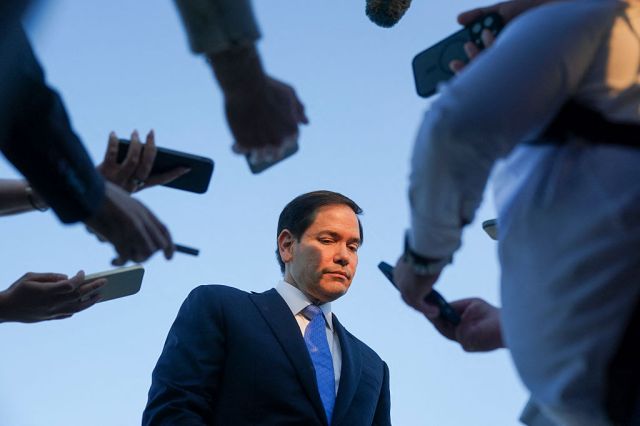
“Little Tony” never forgot his promise to his grandfather. (Nathan Howard/Pool/AFP/Getty)





Pedro Víctor García had enough grandchildren to start a baseball team, but he had a favorite: Little Tony. There was something special about Tony. Unlike the others, he listened to his stories. When Pedro smoked cigars on the porch in Miami, Tony would sit at his feet and hang on his every word. He wanted to know about the old country. Cuba was just on the other side of the Straits of Florida, no more than 250 miles away, yet it was another universe entirely. A dictatorship run by that commie thug Fidel.
And so Pedro told Tony his life story: his rustic childhood in Villa Clara, his polio diagnosis, his days in Havana, his stint as a lector in a cigar factory, reading adventure novels to the cigar rollers. Pedro also told Tony about the greatness of the United States. One day, sitting on the porch, Tony made a promise to his grandfather: when he grew up, he would “lead an army of exiles to overthrow Fidel Castro and become president of a free Cuba”.
Even after Little Tony had become US Secretary of State Marco Antonio Rubio, he never forgot that promise. In his memoir An American Son (2012), in which he reminisces about that Miami porch, he describes Pedro as his “tutor”. And it seems he is still trying to make him proud. Since January, the Trump administration has been closing in on Cuba. It has tightened its embargo and sent the US navy to circle the island like a shiver of sharks. The US Justice Department has also indicted former leader Raúl Castro for murder. As always, the Cuban people are bearing the brunt of the US campaign of maximum pressure. Blackouts take place daily, and food and medicine are hard to come by. And as always, the pinchos grandes are comfortable in their fortified mansions, with their back-up generators and well-stocked fridges.
Against this dramatic backdrop, rumors abound that the US will invade. “Other presidents have looked at this for 50, 60 years,” Trump mused back in May, “and it looks like I’ll be the one that does it. So, I would be happy to do it.” Rubio’s message has been much the same of late. “I don’t think we’re going to be able to change the trajectory of Cuba,” he said, “as long as these people are in charge.”
Whether this is fighting talk or just bluff is anyone’s guess. Given the Iranian quagmire, Trump and Rubio might choose instead to play the long game with Cuba. “What we’re trying to teach them is there are no escape valves,” Rubio told Axios last week. “One of the things we’ve lost in American foreign policy is the concept of patience and persistence. My level of confidence is that when this administration is over, at a minimum, Cuba will be on an irreversible glide path toward a different future.” The future Rubio envisions is pretty clear: he wants to bring down the communist leadership and privatize the economy. And he is prepared to wait. It’s difficult, however, to imagine Cuba resisting for that much longer.
For Trump, getting the better of Cuba is a crucial part of his Donroe Doctrine. After getting rid of Nicolás Maduro in Venezuela, he wants to further US dominance in the Southern Hemisphere. Despite its tiny size, Cuba carries huge symbolic significance. It was the outpost of the Soviet Union during the Cold War and today is a Chinese ally. American presidents since John F. Kennedy have tried to oust the communist regime. Not one has even come close. To pull it off would be legacy-defining. After Trump’s humiliating climbdown in Iran, he needs a win to restore his tough-guy image — and Cuba makes for easy prey.
For Rubio, however, this is personal. He has been harboring a grudge against Cuba’s leaders since childhood, biding his time. Dale tiempo al tiempo, as the Latin American proverb goes. Give time to time. Now, at last, he may be nearing his grand finale. In a video message in Spanish to the Cuban people, Rubio promised “a new path between the US and a new Cuba”. He added, “The only thing standing in the way of a better future are those who control your country.”
Their country is also Rubio’s, although he has never set foot there. He was born in Miami in 1971, 12 years after the revolution which saw Fidel Castro sweep into power in Havana. Castro promised to free the island from the rule of Fulgencio Batista, a military strongman backed by the US. But it soon became obvious that Castro had no interest in democracy. In 1961, he came out as a Marxist-Leninist and aligned with the Soviet Union. Between 1959 and 1973, more than 600,000 Cubans emigrated to the United States. Castro called them gusanos (worms). They called themselves exiles. The vast majority settled in Miami, congregating south of downtown in a cheap neighborhood now known as Little Havana. Soon there were Cuban eateries and Cuban barber shops and Cuban jewelry stores. Castro’s kid sister, who hated him, even opened a pharmacy there.
Rubio grew up not far from Little Havana. Although he lived between the ages of eight and 13 in Las Vegas, where his father worked as a hotel bartender, he is a true product of Cuban Miami. He liked to tell people that his parents fled Cuba in 1959, the year of the revolution. This origin story fueled his rise in the Republican Party of Florida and later in national politics. In 2009, during his run for the Senate, he tweeted: “Thank you USA for welcoming my parents 50 years ago.” Two years later, Rubio told an interviewer that “the direction we’re going in Washington, DC, would make us more like the rest of the world, and not like the exceptional nation that my parents found when they came here from Cuba in 1959.”
Except that’s not quite how it happened. In 2011, two American reporters, Manuel Roig-Franzia and Alex Leary, broke a big scoop: Rubio’s parents had actually settled in Miami in 1956, three years before the revolution. At the time, Castro was in Mexico plotting the revolution. This means the Rubios left Cuba in search of the American dream, rather than to escape communism. In Miami’s exile community, pre-Castro economic migrants are derided as verduleros (vegetable street vendors).
One can guess why Rubio preferred to say his parents arrived in 1959: it surely made for a better, neater story. Critics who insisted he lied purely for “political gain” were missing the point. His attempt at self-mythology tells us a lot about how he sees himself and his political mission. It seems Rubio has internalized his community’s history. Three years naturally makes a big difference to journalists, but I imagine they make little psychological difference to a Cuban kid growing up in Miami.
“Look, that’s not the way it was discussed in our family or by many people in the exile community,” Rubio explained after the story broke in 2011. “It’s more about the loss of their home country.” In the minds of Cuban exiles, their native island is akin to the promised land. “Next year in Havana!” is a popular slogan in Miami, a riff on the Jewish phrase, “Next year in Jerusalem!”, pronounced during Passover.
Besides, Rubio’s grandfather, Pedro, did leave Cuba after Castro’s takeover. He had actually first moved to the US in 1956 to be closer to his daughters, according to Roig-Franzia’s 2012 biography of Rubio. But after the revolution he moved back to the island. He struggled to make a living in the US and didn’t want to be a burden to his family. At the time, there was still hope that something positive would come out of the revolution. Pedro even found a decent job as a clerk in a government ministry. But he couldn’t stand the oppressive atmosphere. Soon, he was back in Miami.
Immediately after the revolution, Cuban exiles began plotting ways to reverse it. Young Rubio wasn’t the first to dream of toppling Castro. As early as 1960, the US government had set out its Cuba policy in a secret memo: “to bring about the replacement of the Castro regime with one more devoted to the true interests of the Cuban people and more acceptable to the US.” How would it do that exactly? “Covert action.” And who would carry that out? Cuban exiles, for the most part.
The opening shot in the contrarrevolución came in 1961, when the US landed 1,500 Cuban exiles at the Bay of Pigs in southern Cuba. Castro’s forces were ready for them and struck back hard. The only chance of success would have been for the US to provide air support. President Kennedy refused, and the invasion was defeated. But the exiles, and the CIA, never stopped plotting to take down Castro. Through the decades, Miami buzzed with intrigue.
Rubio came of age in this feverish urban swamp. At home or in his car, he would tune in to Radio Mambi or WQBA, which broadcast round the clock about the evils of Castro and the heroism of the exiles. This time, the master plan would work out, this was the one. Next year in Havana! Business deals and secret plots were hatched at corner tables at restaurants like Versailles or the Tropical. And violence was never far away, as journalist Ann Louise Bardach reveals in her 2004 book Cuba Confidential. Hardline exiles targeted anyone deemed too soft. Dialogueros, who supported negotiations with the Cuban government, were traitors. And there was only one way to deal with traitors: with a bullet to la cabeza. Between 1973 and 1976, anti-Castro groups carried out more than 100 attacks in South Florida. The exile banker Bernardo Benes told Bardach that “Miami is like Guatemala”. Benes lived in constant fear for his life after brokering a deal in 1978 that freed 3,600 political prisoners from Castro’s jails. “No one is interested in free speech in Dade County. Only in Havana.”
The exile community was hierarchical. The Rubios, who had working-class jobs and went out for pancakes every Sunday morning, were nowhere near the top. El jefe was the late Jorge Mas Canosa, the billionaire founder of the Cuban American National Foundation. His statue now overlooks Miami Beach. He was a power broker who spoke like a heavy in a Forties film noir. Once, when lobbying a congressman, he reportedly said: “If you cooperate with me you get the honey. Otherwise, I hit you with the jar.” Another heavyweight exile was Rafael Díaz-Balart, former brother-in-law of Fidel. At the turn of the century, two of his sons went into politics and were elected to the US Congress. In Little Havana, they were hailed as the chosen ones, destined to free their homeland.
Yet it was a young campaign volunteer who would reach the top. By now, people called him Marco. After graduating from law school in Miami, Rubio set his sights on a political career. At 34, he became the speaker of the Florida House of Representatives. Five years later, a US senator. And at 53, Secretary of State. Among ambitious Cuban-Americans, he was never the most likely to find himself in this position. Others were richer, better connected. And yet here he is. A talented, hungry politician with a killer instinct.
Now comes his biggest political test yet. Rubio has long been seen as the archetypal Republican hawk. His idol is Ronald Reagan. Growing up, he writes in his memoir, his grandfather Pedro would tell him: “America must be a strong country.” That belief in American exceptionalism motivates Rubio as much as his hostility towards the Cuban regime. To be sure, US leaders shouldn’t conduct foreign policy based on desires of revenge. And if they are the children of immigrants, they shouldn’t import their parents’ feuds. But this isn’t the case here: Rubio’s feud with Cuba is also America’s feud. The island nation remains a hub in the anti-American axis.
When Rubio was 13 and still went as Tony, his grandfather Pedro was admitted into hospital. He didn’t have long. Tony was at his bedside throughout, and as Pedro died he took his hand. “I swore I would do something with my life and make him proud,” Rubio wrote in his memoir. Decades later, he is in the unique position to vanquish one of America’s oldest foes, and avenge his family. Will he succeed?
Theo Zenou writes about global affairs, culture, and power. He is a Visiting Fellow at the Australian National University.
 TheoZenou