




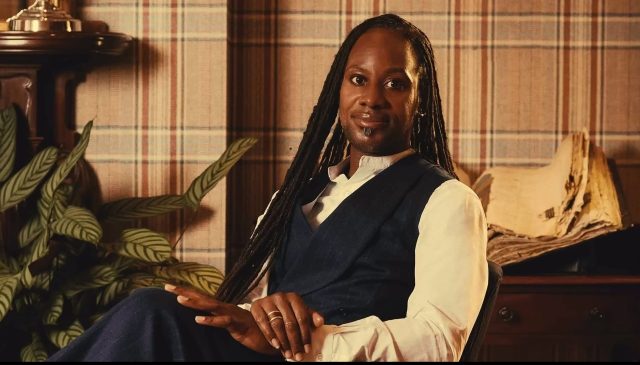
“People who write obscurely are either unskilled in writing or up to mischief.” (Photo Credit: Gad Saad/YouTube)





Amid much attention to Jason Arday’s plagiarism and advanced Walter Mittyfication, the gobbledygook of his writing style has been largely overlooked, not least by the professorial electors at Cambridge and the PhD examiners at Liverpool John Moores University.
Dawkins’ Law of the Conservation of Difficulty states that obscurantism in an academic discipline expands to fill the vacuum of its intrinsic simplicity. Modern physics is genuinely difficult. Natural selection of Pleistocene man did not prepare our poor brains for Einstein or Heisenberg. Common sense, forged in a world of middle-sized objects traveling at medium speeds, must be sent away on compassionate leave when we open a book on quantum mechanics or relativity. Physicists have no need to language-up their writing. Their subject is intrinsically difficult. Naming no names, practitioners of a subject that any fool can understand may suffer from what has been called “physics-envy”. Longing to sound more profound than they are, what recourse have they but obscurantist language? Look, for example, at the following passage from Arday’s thesis:
“An important consideration which also formed part of the theoretical paradigm for the research recognized that the mentoring process is socially constructed, and therefore the relationship between the participants and the researcher needed to be tailored towards supporting the professional development of the student teachers, and making them autonomous social actors in this process, hence the researcher adopting the secondary position of facilitator within the research.”
I must ask: did the examiners at Liverpool John Moores University, who judged his thesis worthy of a PhD, actually read it? One trivial give-away: the thesis contains 332 instances where a plural noun’s terminal “s” is incorrectly followed by an apostrophe. There’s even one in the thesis title: “An exploration of peer-mentoring among student teachers’ to inform reflective practice within the context of action research.” Where I come from, a PhD candidate has a research supervisor, with a duty of care. It’s hard to believe even he read the thesis before letting it go forward to examination.
Never mind the apostrophes. They, at least, are not a substantial barrier to understanding, but my quotations below are, I assure you, typical of the whole thesis. I made an attempt to translate them into English — see the brackets — but after the first two gave up.
“This process allowed the researcher to immerse themself in the data collated.” (This process allowed me to immerse myself…)
“As the researcher, there was an awareness that the legitimacy of such suggestions regarding reliability are open to critique, however, this research study adopted these principles in attempting to maintain reliability through a qualitative research design.” (I realized that such claims to reliability might be criticized, but I hoped that my qualitative research design was reliable).
The infamous passive voice is much in evidence, together with the associated shunning of the first-person pronoun. “I” is demoted to “the researcher”, and even he suffers a further demotion, as in the weird “As the researcher” construction.
“As the researcher, textual units concerning the narratives and biographies were identified based on the criteria that the identified themes were fit for purpose in supporting the themes associated with the study.”
“References were made with regards to the benefits that were gained from the peer-mentoring experience, with regards to developing pedagogically and working as part of a collegial environment to support each other during teacher training.”
If I might plagiarize Oscar Wilde, a single “with regards to” might be regarded as a typo. Two in one sentence looks like… well, let’s just say it’s not what we expect from a Cambridge professor.
And then there’s this:
“Throughout the process, at critical junctures the researcher was conscious that with regards to providing knowledge to the participants regarding reflection and mentoring, a contradictory position was being adopted, with regards to eliminating anything that may resemble a hierarchical structure.”
Forgive me if I plagiarize myself:
“Suppose you are an intellectual impostor with nothing to say, but with strong ambitions to succeed in academic life, collect a coterie of reverent disciples and have students around the world anoint your pages with respectful yellow highlighter. What kind of literary style would you cultivate? Not a lucid one, surely, for clarity would expose your lack of content.”
Of course, I wouldn’t normally use a public forum to lampoon a style that should have been corrected by a PhD candidate’s supervisor. I wouldn’t normally do it but — for heaven’s sake — it’s a Cambridge professor we are talking about, appointed to a presumably much-coveted chair at one of the world’s great universities, possessor of three honorary doctorates. Mightn’t you be forgiven for wondering whether, just possibly, normal standards were relaxed? Arday has now done the honorable thing and resigned, leaving the University of Cambridge with much explaining to do. A BBC news film shows Professor Hilary Cremin calling him “The best in the world”. She also said that the Board of Electors to his Cambridge professorship were “absolutely unanimous”. Really?
Fortunately, there are signs that other faculties at Cambridge are as aghast as the rest of us at what has been done to their university’s good name. May I arm them with a lovely quotation from one of science’s great stylists, Peter Medawar: “…no one who has something original or important to say will willingly run the risk of being misunderstood; people who write obscurely are either unskilled in writing or up to mischief.”
Richard Dawkins is a British evolutionary biologist, zoologist, science communicator and author. He is also the author of several books including The Selfish Gene and The God Delusion.
 RichardDawkins