




The Afghan National Police, more disciplined than traditional Taliban fighters, now patrols the streets of Kandahar. (Sanaullah SEIAM / AFP via Getty Images





The arrivals terminal of Kabul International Airport is cleaved by gender. Coalition forces rebuilt the airport during the occupation of Afghanistan, and it retains its modern style. But the Taliban have made it their own, and I enter the country amid a sea of waiting turbans to my left, veils to my right.
Almost exactly five years earlier, on 15 August 2021, the Taliban seized this airport. Chaos ensued. The Americans carried out an 18-day operation in which more than 123,000 people were airlifted to safety — the largest non-combatant evacuation in U.S. military history. On 30 August, at 11:59pm local time, the final US military plane departed Kabul, one minute before President Joe Biden’s deadline for withdrawal.
The airlift marked the end of the American-Afghan state that was born in 2001, when the US, aiming to hunt down Osama bin Laden and overthrow his Taliban allies, invaded the country and installed a Western-style government. For 20 years, this US-backed state persisted, but its unraveling took mere weeks. Everything Washington had built in the country, notably a national army, proved to be a mirage that vanished in the face of a resurgent Taliban. The regime now celebrates 31 August as the day of liberation from US occupation. Each year, parades weave through Kabul’s central squares. Celebratory gunfire sounds across the city.
Today, the capital is a mix of urban squalor and state repression. Armed Talibs patrol the streets while beggar children work the traffic, tapping insistently at windows and thrusting out supplicant hands. On Chicken Street in the city center, homeless girls play beneath brightly colored shopfronts selling trinkets and carpets to a small but growing trickle of tourists. “Things are much safer now the Taliban are in control, and there is no war,” says a local who doesn’t wish to be named. “But we have lost a lot of freedoms. That is the bargain we now live under.”
He’s right. The streets are calm. Taliban are polite – friendly even. But I am aware that this is a state beholden only to itself. People can, and are, regularly disappeared into its prisons and torture chambers without warning or due process.
Still, to understand the Taliban, you must understand where they come from. Kabul may be Afghanistan’s capital, but Kandahar, a city in the country’s south, is the Islamic Emirate’s spiritual and political center. Here its Supreme Leader, Mullah Hibatullah Akhundzada, and his circle of advisers rule, largely hidden from public view. I make my way there down the 300-mile Kabul-Kandahar highway, which cuts through vast stretches of arid plateau and dust-blown steppe. I pass goat-hair tents belonging to Afghanistan’s semi-nomadic Kuchi people and flocks of threadbare sheep. Mud-brick villages whizz past, their flat roofs and earth-colored walls almost indistinguishable from the surrounding landscape.
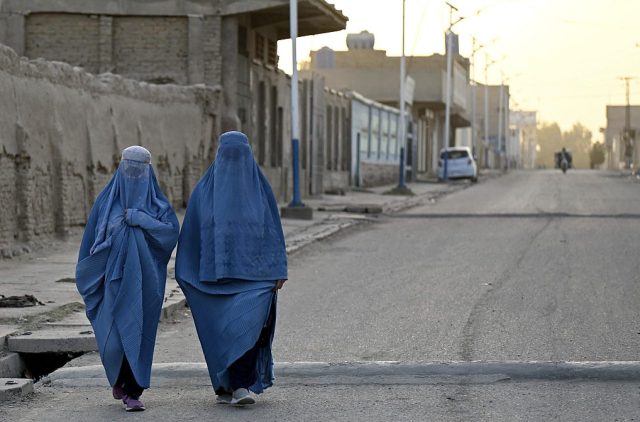
As I approach the city’s outskirts, three small girls swing incense burners, sending coils of smoke billowing skyward. The ritual is said to keep away evil spirits. In the city center, the heat is intense. Taliban flags fly everywhere. Men swathed in black keffiyehs emerge through clouds of dust kicked up by their motorbikes. Women are begging in full burqas. The poverty of Kandahar, to say nothing of the theocratic intensity, makes Kabul look like San Francisco. I am told that photography is banned.
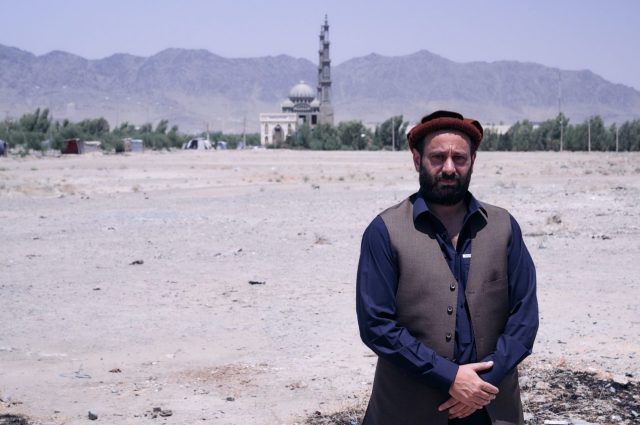
My first stop is the Ministry of Information and Culture, where I’m seeking permission to report in Kandahar. It’s roasting hot in the carpeted waiting room. In the corner, two men are carving up a huge melon. I am offered a glass jar of pear drops – the Taliban’s love of 1950s British sweets is one of the more surprising discoveries of my trip – and told that I’m in luck. A senior local official, Inamullah Samangani, has decided to grant me a spontaneous interview.
After a few minutes, I am summoned to an air-conditioned office next door. Four Talibs, one of whom is cradling an M16 rifle, are sitting barefoot on sofas. Cold melon and water are served to everyone. Samangani is an ethnic Tajik from the country’s north. He has a smooth, youthful face with a manicured mustache and tufty beard. He beams at me.
I ask him how he feels as the fifth anniversary approaches. “All our people are happy,” he replies. “This is what we wanted. After 20 years of war, this anniversary is very meaningful for us.”
What the Taliban want, he tells me, is peace and prosperity for the nation. “Afghanistan has been at war for more than 40 years. Afghanistan needs a great deal of rebuilding and construction, and we are working on this.”
What are the biggest challenges facing this new Islamic Emirate? “The situation is not normal because of the war and because of Western policies towards Afghanistan. The military war has ended, but an economic war continues. We want peace not only for Afghanistan but for our neighboring countries, the region and the world.”
I ask what he attributes the Taliban’s success to. “Our belief in Allah,” he replies without hesitation. “And our belief from the first day that we were on the right path. After September 11, when America and its allies occupied Afghanistan, we knew that freedom was our first and last choice. After 20 years, we achieved it.”
The interview ends; it’s clear that Samangani is more concerned with painting the Islamic Emirate as a reasonable partner with whom the international community can do business than getting into the realities of life here — and in this, he is like politicians everywhere. I make my way out of the office, passing a small room where a Talib is sitting on the floor, clipping his toenails.
Outside, armed men saunter in groups. Printed on a billboard overlooking a roundabout is a message from the Supreme Leader. “When you return from Hajj, don’t be wasteful by spending money on dinners and celebrations,” it warns.
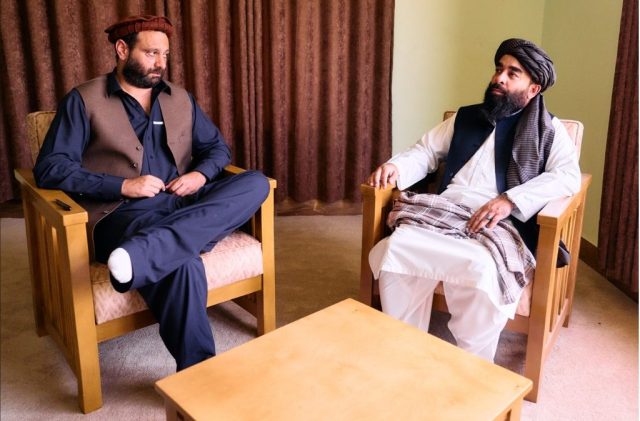
The following morning, I set off from my guest house to meet Zabihullah Mujahid, chief spokesman for the Taliban government since 25 October 2021. He became a Taliban spokesman, and a senior government official, in January 2007, during the insurgency against the US-backed Afghan government. Even as he claimed responsibility on behalf of the Taliban for attacks on coalition forces, he remained faceless and pseudonymous. But on 17 August 2021, two days after Kabul fell, he revealed himself publicly. Now he is the regime’s international face.
For security reasons, I am not initially told Mujahid’s location. Instead, I am instructed to wait for a call. As I sit in a nearby cafe, my eyes scan the room until they settle on a pair of decorative screens. One depicts two camels, the other a peacock, the faces of all three creatures covered with stickers. I’m confused until I realize why: the defacing accords with the hadith-based injunction against complete representations of dhawāt al-arwāḥ (“beings possessing souls”). If you obscure the head, you render the figure incomplete and therefore permissible. I saw nothing like this in Kabul.
The call comes; the venue is a gated residence just across the road. I walk into a spacious garden, where a flunky is watering a comparatively lush lawn. Inside, I am shown into a large room and asked to wait.
After a few minutes, Mujahid enters and sits down. He is immaculate in a white shalwar kameez with dark blue waistcoat and brown, patterned turban. Five years on, he tells me, the Taliban’s victory has brought what Afghans wanted most. “No war, no fighting, and a unified government in place.”
But victory has also forced the Taliban to govern, not just fight. Its foot soldiers and clerics, formed in the madrassas and mountains, must also now serve as policemen, civil servants and diplomats. They must manage budgets and rebuild infrastructure. For this they need international recognition, and aid money from international organizations and Western countries — above all, the US. “We definitely want good relations with the USA,” Mujahid tells me. “We have tried, but they have to try as well.”
Recognition has not been forthcoming. I ask Mujahid about the first government press conference he gave in 2021, when he promised that women would be able to work and study within the bounds of Islamic law. Girls have since been excluded from secondary schools and women from universities.
“I said that everything would be according to Sharia,” he replies, maintaining a serious demeanor and a quiet, even tone of voice throughout. “I still say that. Human rights, education — everything.”
Women still work in hospitals, schools, banks and government, he says, before adding that the exclusion of girls from secondary education, now approaching its fifth year, is “only a slight disruption in the education system”. The Emirate is working to find a way for women to study “with the necessary segregation, transport and safeguards”.
The matter of women’s rights is a serious problem for the government — even among its supporters. Mainstream Islamic law does not ban the education of women; even hardline theocracies such as Saudi Arabia have eased the restrictions on women in recent years. Afghans are furious. In Kabul, on my second day in the country, I met a man out walking with his three daughters. “We have seen a lot of improvements in different sectors and in the rebuilding of our country,” he told me. “But there are big limitations for girls. They should be able to go to school. This is a big ambition of every Afghan. We hope the government will listen to the voice of our citizens.”
But the Taliban will not budge. I suspect Mujahid will be giving the same answers to the same questions five years from now.
I ask him about another contentious issue. In Kandahar, fiber-optic internet has been cut off to private homes. Mujahid insists this is not an internet ban, but a means of ensuring internet use stays within Sharia guidelines. “With mobile internet we can [control it] to a degree,” he explains, “but with fiber-optic Wi-Fi it is harder.”
Every Talib I meet echoes what Samangani told me: they defeated the most powerful and technologically advanced army in history because of “Allah” and their faith. But the more time I spend in Afghanistan, especially in Kandahar, the clearer it is to me that the Taliban are not to be regarded simply as quasi-medieval fanatics. To Westerners, they might seem like barbarians — particularly in their treatment of women — but they do not reject technology or modernity. Except where they cannot control them, they have absorbed both.
As a result, I’m witnessing a kind of Taliban “March of Progress”. Talibs still patrol the streets with long hair, matted beards, black turbans and the imprint of the village. But what’s also emerging is a discernibly post-American Talib. At the many checkpoints between Kabul and Kandahar, these men now stand guard in matching uniforms, patches identifying them as Afghan National Police. Some wear black balaclavas like Western special forces. They cradle their weapons with conspicuous discipline: fingers straight along the receiver rather than curled around the trigger. They carry M16s and Kalashnikovs, the most famous weapons of the two superpowers defeated in Afghanistan.
One morning, I awake to the sound of a helicopter flying low overhead. “Taliban air force,” explains a friend — who proceeds to tell me a story. When the Taliban swept to power five years ago, the US-trained Afghan pilots were told to fly the helicopters to the safety of Tajikistan. One of them, already in the air, called his father to ask what he should do. The father hurried to the Taliban in their village and laid out his son’s dilemma. “He’s a son of Afghanistan,” they said. “He must come back. He will be safe.” The father relayed the message; his son switched off his transponder, turned the helicopter around mid-air, and flew home. The Taliban kept their word. Now he works as an instructor, teaching Taliban pilots to fly the helicopters the Americans left behind.
The Taliban have embraced many of the technologies and institutions of the Western order they defeated, all the while rejecting its overarching values. They carry American rifles and use Western smartphones, yet remain unyieldingly beholden to Sharia. To them there is no contradiction. Washington assumed that modernization meant, inexorably, Westernization. But the Taliban learned from America without becoming American. And in so doing they exposed the category error on which America’s war was based.
The US-led coalition claimed to be in the state-building business, but in truth it extended a narrow Western template of statehood to Afghanistan. The West offered Afghans the liberal franchise, confident they would accept it. Why wouldn’t they? This was 2001. Liberal democracy had won the Cold War, helped bring peace to Yugoslavia and presided over a decade of extraordinary capitalist prosperity. Washington went in, convinced that economic development, education, connectivity and institutions would bring democracy in their wake — and turn Kabul into Copenhagen.
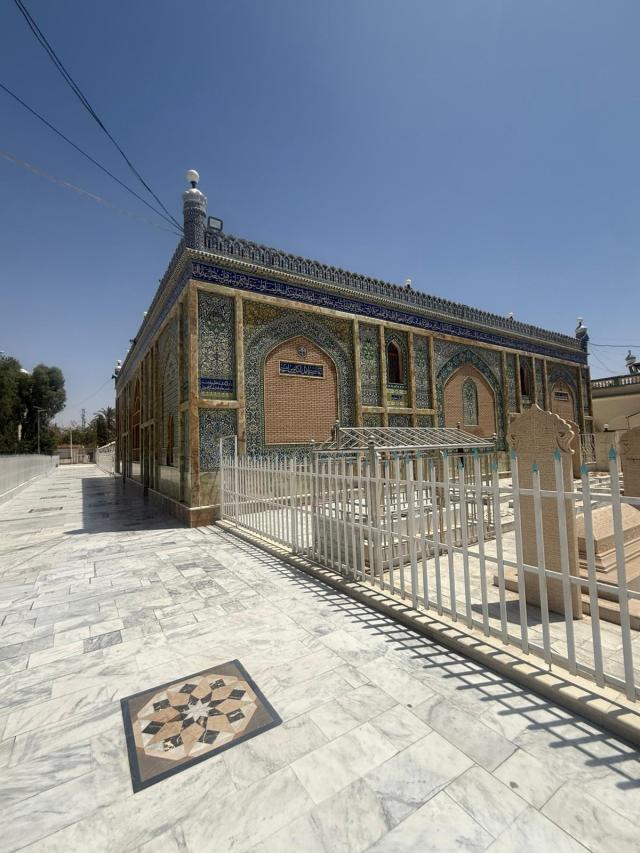
I think about this during my visit to the Khirka Sharif: a compound of buildings smothered in stars and polygons, plants and flowers. Lines of Qur’anic calligraphy thread through the patterns. Turquoise, blue and green mingle with ochre, gold and pink. Kandahar’s streets are sludge and concrete, but here, smooth white stone encircles an explosion of geometry, brilliant in the summer sun.
According to local tradition, Khirka Sharif houses the cloak bestowed upon the Prophet Muhammad during his ascension to heaven (the Mi’raj). The cloak played an important role in the early mythology of the Taliban — literally “students” in Pashto — which emerged in Kandahar in the mid-1990s. On 4 April 1996, the Taliban leader, Mullah Omar, took the cloak out of its cloth-covered box and carried it onto the roof of Kandahar’s main mosque. There, he held it aloft before thousands of religious scholars, fighters and supporters. The crowd erupted: men threw their turbans into the air in the hope that they might touch the sacred garment, while some reportedly fainted. The assembled ulema (Islamic scholars) acclaimed Omar Amir al-Mu’minin — “Commander of the Faithful” — and pledged allegiance to him. By associating himself publicly with both the Prophet and Ahmad Shah Durrani, the founder of the Afghan state who had brought the cloak to Kandahar, Omar sanctified his leadership and transformed a sacred relic into a source of political authority.
A few months later, on 27 September, Taliban forces captured Kabul and established the Islamic Emirate of Afghanistan. It lasted until 2001, when the Americans arrived with historically unprecedented military power and the apparatus of state-building: NGOs and aid agencies, elections and constitutions, Excel spreadsheets, risk assessments and results frameworks. These were the iconography of a different faith, one that rooted its legitimacy in the post-World War II liberal order.
The Taliban’s victory laid bare the error and the arrogance of that project. Modernization and Westernization are not the same thing. A fiber-optic cable is neither autocratic nor liberal. A regime can want modern roads and Western investment while oppressing women and killing homosexuals. After two weeks of reporting in Afghanistan, observing how that what is left of the American occupation has been almost completely appropriated by the Taliban; the attempt to force regime change through military means was always doomed. Today, the West pays lip service to this lesson — but the instinct, judging by Donald Trump’s attempts to topple the Islamist regime in Tehran, remains.
Just before I leave the city, I stop for lunch. I’m sitting cross-legged on the carpet, eating meat and rice, when a Talib in his early twenties comes in and sits down next to me, fascinated by the presence of foreigners. We talk. He joined the Taliban at 12 and fought the Americans and British for years. He likes my Western sunglasses and, ignoring the prohibition on photography, eagerly poses for pictures wearing a pair borrowed from my photographer. Photos and transatlantic fashion clearly delight him. What, I ask him, are his hopes for the future of Afghanistan?
“Taliban,” he says without hesitation, and smiles beatifically.
I journey back, and just under 100 miles south of Kabul, I pass through the city of Ghazni, its entrance dominated by three light-blue domes. Its open-air military museum displays rows of burned-out Soviet tanks, monuments to the Afghan mujahideen’s victory in the 1979–1989 Soviet–Afghan War. A thousand years earlier, Ghazni was the imperial capital of Mahmud of Ghazni, later celebrated as the “idol-breaker” (but-shikan) after his destruction of the Hindu temple at Somnath. When Mullah Omar destroyed the Buddhas of Bamiyan in 2001, he invoked Mahmud, casting himself as a modern-day but-shikan.
The occupying Westerners lacked this sense of history. Shortly after the disastrous 2021 withdrawal, I asked a British soldier who had served in Afghanistan how, after twenty years of war, we had understood the country so poorly. “The thing is,” he told me, “we served one-year tours and left. We weren’t there for twenty years but twenty lots of one.” Western soldiers, diplomats and officials rotated through the war, but the Taliban lived it year after year. And their sense of time and place stretched back centuries — to the cloak of the Prophet and the legend of Mahmud. There was only ever going to be one winner.
David Patrikarakos is UnHerd‘s foreign correspondent. His latest book is War in 140 characters: how social media is reshaping conflict in the 21st century. (Hachette)
 dpatrikarakos