




Nixon’s foreign policy initiatives, like opening up to China, were pragmatic, not utopian. Credit: Getty





Richard Nixon is back — this time as a source of viral memes. “Nixonmaxxing” is the latest fad roiling the young, very-online Right. Yet Nixon is being revived for the wrong reasons by those who wish to whitewash the crimes that led to the 37th president’s resignation 52 years ago this week. This Nixonian revivalism aims at justifying claims that President Trump, like Nixon, is the victim of a nefarious “deep state.”
But Nixon was no victim. While other presidents have engaged in dirty tricks against their opponents, Nixon is the only one to have had his own private criminal gang engaged in burglaries like the break-in of Democratic headquarters at the Watergate Hotel. On a tape recording from a June 17, 1971, meeting with his aides Henry Kissinger and Bob Haldeman, Nixon can be heard talking about having the Brookings Institution broken into by his goons, to retrieve files that he hoped to use to his advantage. Nixon: “I mean, I want it implemented on a thievery basis. Goddamn it, get in and get those files. Blow the safe and get it.”
But Nixon’s prison-worthy crimes and his personal flaws don’t discredit “Nixonism” — defined as a governing philosophy, relevant in our day as in his, with three main features: national-interest realism in foreign policy; economic nationalism in trade and immigration policy; and at least an effort on the part of government to be even-handed between capital and labor.
From a Nixonian perspective, peace can only be achieved by a favorable balance of power — not by the United Nations or other international institutions, and not by a utopian “global democratic revolution” that replaces all authoritarian regimes. Free trade and protectionism are equally valid national strategies, to be adopted or rejected in the service of strategic industrial sectors and a high-wage workforce. And rather than side with employers against workers, government should act as an honest broker between business and organized labor, in the interest of labor peace and a national home market enlarged by high take-home pay, rather than by high levels of government redistribution.
Tragically, the rival public philosophy of Reaganism — combining a crusading Wilsonian foreign policy, dogmatic support for economic globalization and mass immigration, and unremitting hostility to labor unions — dominated the Republican Party between the Reagan years and the election of Trump in 2016, to the detriment of both the party and the nation.
Start with Nixon’s realism abroad. In foreign policy, the differences between Nixonism and Reaganism are unbridgeable. Although Nixon worked from the desk of Woodrow Wilson and hung Wilson’s portrait in the Cabinet room next to Lincoln and Eisenhower, Nixon’s view of foreign policy as an arena of great-power struggles and compromises had more in common with that of American realists like Alexander Hamilton, Theodore Roosevelt, and Henry Cabot Lodge and European statesmen like Bismarck, Disraeli, and De Gaulle.
In a 1972 radio address, Nixon told the American people that US foreign policy must promote a “structure of peace” among great powers that rests “on the hard concrete of common interests and mutual agreements, and not on the shifting sands of naive sentimentality.”
Nixon’s predecessors had overcommitted Washington in Vietnam and elsewhere. One response was the policy of “Vietnamization,” generalized as “the Nixon Doctrine” of 1969, which declared that the United States would no longer assume full responsibility for the defense of allies through ground troops.
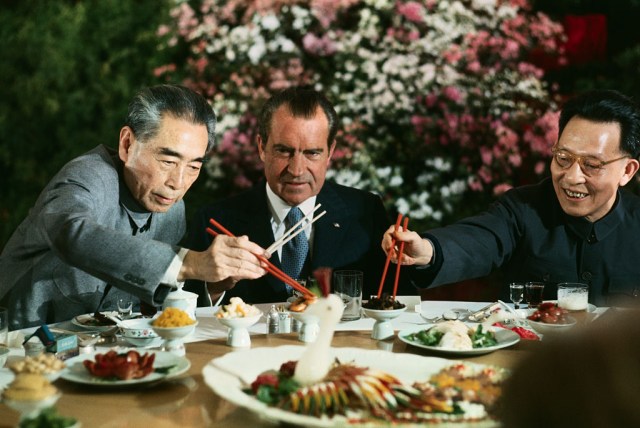
Another Nixonian response to American overextension was his outreach to China as part of a strategy of dividing Moscow from Beijing and thus splitting the communist sphere. The tactic failed to end the war in Indochina while saving South Vietnam, but Sino-American diplomacy paid off in the “second Cold War” of the 1980s, when Beijing was a de facto ally of Uncle Sam against Moscow. Nixon can’t be blamed for the deindustrialization of the United States by China’s aggressive mercantilism, which was supported by unpatriotic American corporations that presidents from Clinton to Obama tolerated after Nixon’s death in 1994.
While Reagan’s defense build-up and proxy wars with Moscow in Afghanistan and Central America contributed to the pressure on the Soviet Union, the implosion of the USSR had other causes: long-term economic decay, rising nationalism among the bloc’s constituent peoples, and Gorbachev’s refusal to crack down against dissent. Reagan’s true foreign-policy legacy wasn’t winning the Cold War; it was grafting the utopian fervor of Woodrow Wilson and other 20th-century Democratic progressives and liberal internationalists onto the formerly realist GOP.
Wilson was literally Ronald Reagan’s middle name, thanks to his father, an ardent New Deal Democrat. And Reagan, a Democrat until 1962, remained all of his life an ardent Wilsonian idealist in his approach to foreign policy. Wilson, in a speech to Congress in January 1917, before the US entry into World War I, identified the goals of American foreign policy as national self-determination, global economic liberalization, and an end to the balance of power: “These are American principles, American policies. We could stand for no others…. They are the principles of mankind and must prevail.”
True to Wilsonian ideology, in his autobiography, An American Life, Reagan asserted: “It was our policy that this great democracy of ours had a special obligation to bring freedom to other peoples.” Jeane Kirkpatrick, who served Reagan as ambassador to the United Nations, observed: “The president and many of his principal advisers see themselves as purveyors and defenders of the classical liberal tradition in politics, economics, and society.”
Rejecting the reality of conflicts of interest among states of all kinds, Reagan declared: “People do not make wars; governments do. A people free to choose will always choose peace.” Likewise, Reagan said in his 1986 State of the Union address: “We know that peace follows in freedom’s path, and conflicts erupt when the will of the people is denied.” If this “democratic peace theory” is true, then the only way to achieve a peaceful world is to promote the replacement of every authoritarian regime on earth with a liberal multiparty democracy — by example if possible, by subversion, invasion, and occupation if necessary. Wars of regime change by democratic countries are “liberation,” but not “aggression” (it helps if the would-be “liberated” country, like Iraq, Venezuela, and Iran, has major deposits of oil and gas).
Reagan’s neoconservative allies successfully lobbied for the creation in 1983 of the National Endowment for Democracy, a government-funded organization that has engaged in both overt and covert operations to destabilize or overthrow governments that Washington opposes. Contrast this with Nixon’s statement: “We would not welcome the intervention of other countries in our domestic affairs, and we cannot expect them to be cooperative when we seek to intervene directly in theirs.”
George W. Bush was as reckless in launching the Iraq War as Reagan was cautious in limiting his administration to small-scale interventions in Lebanon and Grenada. But a prudent Wilsonian ideologue is still a Wilsonian ideologue. There is a direct line from Reagan’s messianic rhetoric to the proclamation of George W. Bush in his Second Inaugural Address: “So it is the policy of the United States to seek and support the growth of democratic movements and institutions in every nation and culture, with the ultimate goal of ending tyranny in our world.” Bush’s speech merely restated Reagan’s utopian conception of US foreign policy, evident in the Gipper’s 1985 pronunciamento: “We declared the principal objective of American foreign policy to be not just the prevention of war, but the extension of freedom. And we stressed our commitment to the growth of democratic government and democratic institutions around the world.”
Trade is another source of contention between the rival governing philosophies of Nixonism and Reaganism. Nixon was a bold and unapologetic American economic nationalist. In one of several “Nixon shocks,” Nixon in 1971 dealt with a balance-of-payments problem by suspending the convertibility of the dollar to gold, blowing up the Bretton Woods system that had structured world trade and finance since the late 1940s.
The other Nixon shocks of 1971 included combating inflation with temporary wage and price controls and imposing temporary surcharges on imports to redress the trade deficit. While these were ineffective, market fundamentalists have been wrong to blame them for the high inflation of the later 1970s, which resulted from the increase in oil prices associated with the Yom Kippur War and the 1979 Iranian revolution.
Just as he found a like-minded geopolitical realist in Henry Kissinger, Nixon found an economic nationalist ally in his Treasury secretary, John Connally, who told a group of economists: “The foreigners are out to screw us. It is our job to screw them first. Thank you for your help.”
Fervent support for free trade was another traditionally Democratic value that Reagan helped to graft onto the historically protectionist, pro-manufacturing Republican Party. While Nixon the realist was willing to sacrifice the world economy to US national economic interests, for Reagan, as for other Wilsonians, the promotion of global free trade was inseparable from the promotion of world peace. In 1988, Reagan said: “I recognize … the inescapable conclusion that all of history has taught: the freer the flow of world trade, the stronger the tides of human progress and peace among nations.”
The few cases in which Reagan as president reluctantly and temporarily used tariffs and quotas to protect industries like cars, steel, and motorcycles were deviations from his free-market dogmatism. Again and again, Reagan unpatriotically smeared the American victims of foreign unfair trade practices by mercantilist regimes like Japan and South Korea. In a 1987 radio talk, Reagan blamed American trade deficits on the alleged inferiority of American products: “The way up and out of the trade deficit is not protectionism, not bringing down the competition, but instead the answer lies in improving our products and increasing our exports.”
In a 1987 speech in Cleveland, Reagan asserted that America’s trade deficit was a sign of strength. In 1985, Reagan asserted that the financialization of the US economy was an adequate substitute for the loss of manufacturing when he complained that trade deficit statistics did not count the “billions of dollars of foreign capital” that had been “invested in our government bonds … because we are the best and safest investment in the world today.”
The harm done by Reagan and Reaganism to American manufacturing was not limited to rhetoric. In 1971, the Nixon administration protected the American textile industry by imposing quotas under the Trading with the Enemy Act. In contrast, Reagan vetoed the Textile Apparel and Footwear Trade Act of 1988, claiming, “This bill represents protectionism at its worst. The supposed benefits of the bill would be temporary at best. Protectionism does not save jobs. Only improved competitiveness can truly protect jobs, yet there is nothing in this bill that would encourage domestic industries to become more competitive.”
As he had so often done before, Reagan blamed Americans instead of foreign mercantilists for the struggles of American industry in global markets, ignoring the fact that American manufacturers couldn’t compete with foreign cheap labor or foreign government subsidies. Today, the United States has one of the world’s largest markets for textiles, but 98% of textiles sold in the country are manufactured abroad.
Americans were shocked to learn during the pandemic that the United States is dependent upon foreign countries, including Communist China, for protective textiles and apparel. Thanks, Mr. Reagan!
In 1970, Nixon sought to defend American shipbuilding from foreign rivalry with the Merchant Marine Act of 1970, which provided a variety of subsidies for the American construction of ships engaged in foreign trade. A little more than a decade later, Reagan eliminated these subsidies for the strategic civilian shipbuilding industry on the advice of his aide Martin Anderson, a free-market extremist who, along with his wife, had been a personal disciple of Ayn Rand — the radical-libertarian guru. In 1977, before Reagan, America had 77 sea-going commercial ships on order. In 2023, thanks to Reagan and his successors who shared his indifference to the survival of America’s merchant marine, the United States had only 5, compared to China’s 1,749.
Finally, Nixonism and Reaganism differ on the subject of the government’s relationship with labor. Because the majority of the people in a modern nation are wage earners, not capitalists or managers, no nationalist politics can be authentic unless it defends the interests of the national working class. And the lack of bargaining power of ordinary workers with most employers requires that employer-labor-market power must be countervailed, either through collective bargaining or direct government regulation.
With most other Republicans, the young Nixon in 1947 voted for the anti-union Taft-Hartley Act that allowed state “right-to-work” laws. But as a presidential candidate in 1960, he declared: “As far as the right-to-work law, itself, is concerned, I oppose any such law nationally.”
As president, Nixon opposed labor leaders aligned with the Democrats, including Leonard Woodcock of the United Auto Workers, who made it onto Nixon’s secret “enemies list.” But he courted George Meany, the head of the AFL-CIO, and he sought the support of the Teamsters Union, declaring in 1971: “It is all too often taken for granted that the daily efforts of Teamster union members are a cornerstone of the American economic structure.” In his second term, as part of his outreach to unionized workers, Nixon appointed Peter J. Brennan, of the Building and Construction Trades Council of New York, as secretary of labor.
In contrast, of Reagan’s three secretaries of labor, two — Raymond J. Donovan and Ann McLaughlin — were former corporate executives and the third, William E. Brock, was a career politician from Tennessee. Although he had been head of an AFL-CIO-affiliated union, the Screen Actors Guild, Reagan as president broke with the tradition of earlier Republican leaders like Nixon and Eisenhower and Coolidge who attempted to at least appear even-handed toward management and labor.
In addition to breaking a strike in 1981 by firing 11,000 federal air-traffic controllers, Reagan stacked the National Labor Relations Board with anti-union, management-aligned appointees whose decisions restricted worker rights and expanded employer power.
To lead the NLRB, Reagan appointed Donald Dotson, who claimed that unions were responsible for “destruction of individual freedom.”
Reagan, the former “traveling ambassador” of General Electric in the 1950s, did the bidding of his corporate and capitalist backers in promoting right-to-work laws, hampering federal enforcement of worker rights, and seeking to weaken child-labor laws. Reagan also sought to supply American businesses with wage-suppressing mass immigration. In 1984, Reagan declared: “I believe in the idea of amnesty for those who have put down roots and lived here, even though, sometime back, they may have entered illegally.”
Reagan repeated the employer-lobby propaganda line that illegal immigrants do jobs that Americans refuse to do at any wage. In a radio address in 1977, Reagan mocked “the illegal alien fuss”: “Are great numbers of our unemployed really victims of the illegal alien invasion, or are those illegal tourists actually doing work our own people won’t do?”
The major immigration law that Reagan signed, the Immigration Reform and Control Act of 1986, was a gift to cheap-labor employers at the cost of American workers. The law provided an amnesty for nearly 3 million illegal immigrants. To deter future illegal immigration, the law created penalties for employers who hire illegal immigrant workers — but thanks to business lobbying, under Reagan and his successors of both parties in the White House, including Trump, employer penalties have almost never been imposed.
Meanwhile, to ensure that employers deprived of illegal immigrant labor did not necessarily need to hire American citizens and legal immigrants at higher wages, IRCA also increased the number of “guest workers” — a euphemism for foreign serfs with fewer rights than American workers who are indentured to their employers or labor contractors.
Not content with forcing US workers to compete with greater numbers of unfree, poorly paid “guest workers” on American soil, Reagan sought to merge America’s labor market with those of low-wage nations. During his 1980 presidential campaign, Reagan proposed a free-trade agreement between the United States and Mexico that influenced the later North American Free Trade Agreement, under which entire US industries were gutted as employers sought cheaper labor south of the border.
In his 1988 State of the Union address, Reagan told Congress: “Our goal must be a day when the free flow of trade, from the tip of Tierra del Fuego to the Arctic Circle, unites the people of the Western Hemisphere in a bond of mutually beneficial exchange.”
Reagan’s wish was indistinguishable from that of Hillary Clinton, who in 2016 told Latin-American bankers that her “dream is a hemispheric common market, with open trade and open borders.…”
The Reaganite synthesis of market fundamentalism, mass immigration, crusading democratic globalism, and anti-worker labor policy weakened the United States and contributed to the backlash that brought Trump to power twice. In fairness, the dwindling and aging number of Reagan’s Old Right defenders are correct about one thing: he was “inspirational” and “sunny” and “optimistic.”
Donald Trump borrowed his slogan “Make America Great Again” from Reagan. But in many ways, he belongs in the Nixonian tradition.
Trump’s aggressive promotion of what he considers the national interest, at the expense of allies and without moralistic rhetoric, is distinctly Nixonian. The first Trump administration’s National Security strategy in 2017 contained the line: “An America First National Security Strategy … is a strategy of principled realism that is guided by outcomes, not ideology.”
“Out with utopian idealism, in with hard-nosed realism,” declared Trump’s Defense Secretary Pete Hegseth in December 2025, in a speech at the Reagan Library (the Nixon Library might have been a more appropriate venue).
The exception to Trump’s realism is the disastrous Israeli-American war against Iran, which Trump might have avoided had he followed a precept of Kissinger in the Nixon years: “Our interests shall shape our commitments, rather than the other way around.”
In trade, too, Trump is a Nixonian nationalist, replicating the Nixon Shocks of the 1970s with frequent use of tariffs and other shocking departures of his own from the former free-trade globalist consensus.
Long before Trump in 2016 declared that “I love the poorly educated,” Nixon told some of his advisers in 1971 that “when we need support on tough problems, the uneducated are the ones that are with us.” In contrast: “When you have to call on the nation to be strong — on such things as drugs, crime, defense, our basic national position — the educated people and the leader class no longer have any character, and you can’t count on them.” For this reason, Nixon rejected anti-union conservatism and told his staff that it was “vital that we continue to recognize and work with [workers] and that we not attack unions which represent the organized structure of the working man.”
But Nixon’s outreach to organized labor was sincere and consistent, unlike Trump’s, which combines symbolism — like having Teamsters President Sean O’Brien address the 2024 Republican National Convention — with standard Right-wing anti-union policies. And instead of making the case that immigration restriction, by creating tight labor markets, can force employers to raise wages, Trump has appealed to nativist racism, describing most Mexican immigrants as criminals, and accusing Haitians of eating pets, while favoring white South Africans in refugee policy. Instead of insisting on a universal E-Verify mandate on employers, Trump has ordered ICE to forgo raids on farms dependent on cheap labor and expanded programs for unfree foreign guest workers.
Trumpism, then, is an incoherent mixture of Nixonism in defense and trade policy and anti-worker and anti-safety-net policies in the Reagan-Bush tradition. Even worse, Trump in his two terms as president has emulated some of the worst aspects of Richard Nixon, from claiming effectively unlimited powers for the executive branch to weaponizing the Department of Justice and other agencies against personal and partisan enemies.
Overall, Trump has accelerated the rejection by Republicans of the transplanted Democratic globalism of Reagan and the neocons and the party’s return to its historic nationalist tradition. Just as Nixonism is more defensible than Nixon, a thoughtful version of Trumpism without Trump after 2028 would be better than a disastrous revival of Reaganism.