




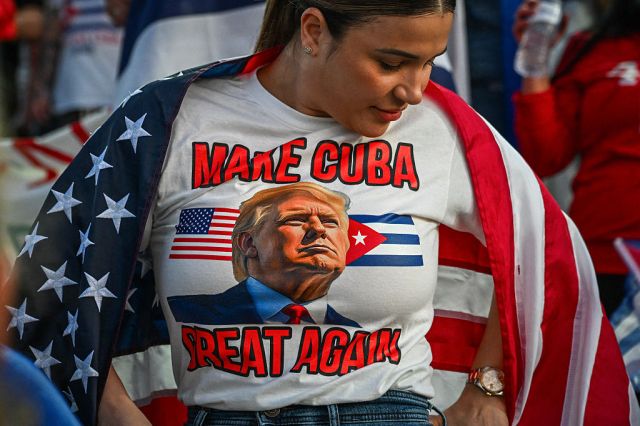
A MAGA supporter participates in the "Cuba Libre" demonstration in the city of Hialeah, Florida. Credit: Getty





The Trump administration this week pummeled Cuba with yet another round of sanctions, this time targeting its mining, construction, and metals sector. The US government continues to tighten an economic noose around the neck of the tiny island nation. This, even as the Havana regime recently enacted sweeping reforms aimed at encouraging private investment in the Cuban economy — exactly as Washington had long demanded.
It remains a mystery why an administration that styles itself “America First” has prevented third countries from selling food and oil to Havana, exacerbating an ongoing humanitarian crisis. Most Cubans now survive on fewer than two hours a day of electricity, with hospitals struggling to supply patients on life support. The reason, in short, is that Team Trump’s policy toward Cuba now is almost exclusively driven by ideology, rather than rational statecraft.
The ideology, in turn, is defined by Miami’s enclave of Cuban and other Latin-American exiles. Fundamentally stuck in their native lands, they’re determined to wield American treasure and manpower to redress old grievances. This, instead of attending to the home front, which in South Florida is racked by petty corruption, cultural maladjustment, and the politics of shouting down opponents instead of debating them.
You could, in fact, call it a form of Third Worldism.
Yet that term is, ironically, the vague omni-menace conjured by Trump administration hawks to justify their approach to Cuba, among other places. Last month, the State Department unveiled a 100-page report titled Cuba: The Capital of 21st-Century Communism. A seminal piece of MAGA propaganda, the document argues — laughably — that Cuba represents an existential risk to Americans through its sponsorship of “Third Worldism”: an anti-Western animus, replacing traditional Marxism, that supposedly unites resentful foreign hordes the world over.
Speaking with Fox News on the administration’s Cuba policy, Secretary of State Marco Rubio echoed the report, stating: “To the average American, you see Cuba, a small country — but people forget that they actually are an influence and espionage superpower.”
Rubio’s words were transparently aimed at integrating MAGA talking points with the, well, Third World grievances of his fellow Miamians. Figures like YouTube influencer Alex Otaola, businessman Marcell Felipe, and Rep. Mario Diaz-Balart (R-Fla.). In fact, it’s these Miami neocons — of mostly Cuban but also Nicaraguan and South American descent — who, in a sense, refuse to assimilate to “Northern” concerns and aspirations, even as they reside here. They also command disproportionate influence on US foreign policy.
Within the confines of South Florida, it’s hard to miss signs of Third Worldism of a more mundane variety: dead people sign off on building inspections in the Cuban-American suburb of Hialeah; Miami’s notoriously corrupt city council also attempted to cancel 2025’s municipal elections. For decades in South Florida, “Cocaine Cowboys,” such as the infamous drug kingpin Sal Magluta, evaded justice, including one occasion when Magluta walked out of jail after bribing officials. In the past decade, attempted overthrows of not one, or two, but three sitting foreign presidents were plotted by private citizens in Miami, one of which resulted in the 2021 assassination of Haitian President Jovenel Moïse.
Of course, in Miami, English is a second language. Stumble upon the odd heartland tourist in Miami Beach — like my Appalachian in-laws — and you’ll witness MAGA horror at the sight of hedonistic spring breakers mingling with “too many Latins,” many of whom don’t appear to speak English. Indeed, they don’t. Roughly 75% of residents of Miami-Dade County speak Spanish, with 25% lacking English proficiency. Yet the irony is that many of Miami’s Latin invaders are among the most fervent “anti-communist” supporters of President Trump.
Enter the household of your typical MAGA Miamian for “cafecito,” and you’re likely to view an angry YouTube stream from city native Alexander Otaola. A testament to GOP inclusion, the flamboyantly gay Otaola is an archetypal Miami neocon. Much like Fidel Castro, the bearded pundit diatribes extemporaneously for three hours every weekday, railing against the perceived enemies of US-sponsored “freedom and democracy.” With an audience of around 1 million, his show, ¡Hola Otaola!, is interladen with infomercials for Miami-based plastic surgeons, gold chains, and “anti-communist realtors.”
In 2024, Otaola ran a failed campaign for Miami-Dade county mayor. Naturally, the erstwhile Nixon and Trump consigliere Roger Stone was an advisor; in their shared appearances, the pair’s exchanges were consistently moderated by a Spanish-language interpreter. The fact that the Otaola doesn’t speak English likely cost him with English-language voters.
Much the same can be said of Otaola’s countless controversies over his censorious — some might say “Third World” — tendencies. The Miami YouTuber rightly derides the Cuban regime over its rampant censorship, surveillance, and state-sponsored humiliations of dissidents. Yet Otaola himself promotes routine boycotts of Cuban artists from his “red list” of those who perform on the island.
In 2023, he staged a protest caravan to censure a book talk, on the US government’s preferential policies toward Cuban immigrants, by Boston University professor Susan Eckstein. Otaola’s protesters also heckled Eckstein during the event, calling her “comunista”; his student supporters naturally claimed that her presence on campus made them feel “unsafe.” As one Cuban-born attendee later told me, Otaola’s antics reminded him of nothing so much as the Stalinist tactics used by the Havana regime to humiliate opponents, known as “acts of repudiation.”
Reacting to the release of the Cuba Report, Otaola lauded Rubio and the State Department for documenting “step-by-step, minute-by-minute how Havana has been training, funding, and organizing [Left-wing] groups in order to destroy free societies.” To be sure, the body of the report documents the very real affinities — and, in some cases, linkages — between Havana and Leftist radicals like the Weather Underground and the Democratic Socialists of America; last week, DSA co-chair Megan Romer mouthed the revolting words: “Cubans have access to their democracy in a way that we do not.”
Yet the State report is, in some ways, a break with Miami-neocon orthodoxy. Contrary to the view of older exiles, who hold that Fidel was practically born a Communist, the State Department claims that Marxism “was not the original battle cry of the Cuban Revolution.” Instead, it was the far more insidious “Third Worldism”: a planetary struggle, erupting after World War II, between decolonized countries and “Western civilization itself.” Never mind that Washington supported postwar decolonization in Asia and Africa.
Where is this stuff coming from? A possible source of inspiration may be the Cuban-American businessman Marcell Felipe. The head of several of Miami’s neoconservative jobs programs — including the media group América TeVé, Inspire America Foundation, and the American Museum of the Cuban Diaspora — Felipe has been at the forefront of Cuban-American outreach within the MAGA Right.
As an attendee of the 2021 National Conservatism conference in Orlando, I was disillusioned to see Miami neocons like Rubio and Felipe alongside ostensible MAGA restrainers such as JD Vance and Michael Anton. During his address — titled, “Why Cubans Get the Marxist Threat” — Felipe presaged Rubio’s future report, arguing that Havana had adapted its communism in order to infiltrate US institutions via “cultural Marxism.”
By definition, Miami neoconservatism is an evangelical, imperial ideology incompatible with the concept of national sovereignty. At every turn, Miami neocons, Rubio most notably, have found ways of integrating otherwise distinct foreign-policy objectives. Whether it’s fusing regime change in Cuba and Venezuela with the Iran war and the war on drugs, the view from South Florida hawks is that any and all evils trace back to a sinister, interconnected axis stretching from Beijing to Tehran to Moscow to Havana. “Third Worldism” is just the latest spin on this omnicause — one which conveniently centers Cuba and Iran.
Unsurprisingly, the Miami trio of lawmakers Carlos Gimenez, Maria Elvira Salazar, and Mario Diaz-Balart are the most consistently hawkish on everything from fomenting proxy wars against Russia in Ukraine, Syria, and West Africa to putting boots on the ground in Iran, Venezuela, Nicaragua, and, of course, Cuba. Within the trio, the most emblematic is Diaz-Balart, whose roots trace back to the highest echelons of the pre-Castro dictatorship of Fulgencio Batista.
A darling of the gangsters Lucky Luciano and Meyer Lansky, Batista turned Havana’s luxury hotels and casinos over to the US mob in exchange for a personal cut of casino earnings — a reality fictionalized in The Godfather Part II. In turn, his CIA-trained forces killed or disappeared at least 1,500 dissident Cubans during the 1950s. During this time, Diaz-Balart’s father, Rafael, served as Batista’s undersecretary of the interior and as majority leader in the Cuban House of Representatives. In many parts of the West, familial ties to a murderous Third World dictatorship would disqualify any politician in the eyes of voters. But in neoconservative South Florida, such ties portend a life term in Congress.
The irony is that Diaz-Balart’s father was a youth supporter of Batista going back to the dictator’s populist — and Communist-supported — first term in the 1940s. Batista featured members of the Marxist Popular Socialist Party in his cabinet until 1944 and maintained tacit support from the party until 1958. Indeed, the fact that opposition to Batista was both overwhelming and ideologically diverse contributed to the CIA’s pre-1960 determination that Fidel Castro wasn’t a communist; a further irony is that Diaz-Balart’s paternal aunt, Mirta, married Castro.
Naturally, all of this is glossed over by Diaz-Balart and other Miami neocons, who romanticize a pre-Marxist utopia on the island and ignore the legitimate grievances that led to the 1959 revolution in the first place. (In the same way, deluded progressives like DSA co-chair Ashik Saddique gloss over those who aided the revolution but nonetheless were jailed or executed for opposing Castro.)
Instead, the congressman devotes most of his time to regime change abroad; Diaz-Balart’s office features an autocrat collage of Venezuela’s Nicolás Maduro, Iran’s Ali Khamenei, Cuba’s Raul Castro, and Nicaragua’s Daniel Ortega with the labels: “Arrested,” “Eliminated,” and “Indicted.”
Accordingly, Diaz-Balart has celebrated the State Department’s screed against Cuban-sponsored “Third Worldism.” Yet much like his late relative-by-marriage Fidel Castro, the congressman has very recently embraced the anti-colonial cause elsewhere — in North Africa.
Last month, tens of thousands of Moroccan migrants swarmed Ceuta, a city on the North African Coast which Spain has controlled since the 15th century. One could be forgiven for assuming that the Spanish-descended Diaz-Balart would be an avid defender of Spanish Christendom over the invading Muslim hordes. Quite the contrary: the Miami neocon has called for Moroccan annexation of Ceuta and its sister enclave, Melilla, arguing that the pair “are not in the geographic territory of Spain.”
Wait — what happened to anti-Third Worldist zeal here? Shouldn’t an opponent of Third Worldism defend Christian Spain’s honor?
Nope. Contrived as they may seem, the congressman’s words ultimately follow a neoconservative logic centered on Cuba. The Spanish government under Prime Minister Pedro Sanchez has been harshly critical of Israel and of America’s conduct in Iran; the Islamic Republic is, of course, a staunch ally of Havana. In contrast, Morocco has taken pains to ally itself with Trump and Israel’s Benjamin Netanyahu — a fact which presumably validates the country’s decolonial grievances against Spain. This, even as Diaz-Balart condemns other forms of decoloniality as Third Worldism.
By far, the most damning aspect of Miami-neocon Third Worldism is the fact that the ideology is responsible for some of America’s worst homegrown terrorists. The State Department’s Cuba report rightly condemns Cuban support for Left-wing groups that carried out hundreds of bombings throughout the United States in the 1970s. “In one 18-month period between 1971 and 1972,” the report notes, “the FBI counted some 2,500 bombings on American soil” by homegrown radicals. Yet the report conveniently omits that some of these radicals were Right-wing Cuban-Americans, and many of their victims were fellow Cuban exiles who were perceived as insufficiently anti-communist.
In the same decade, authorities linked Cuban-Americans to 113 bombings in the United States, including the 1976 car bombing of Chilean diplomat Orlando Letelier, conducted in concert with Chilean dictator Augusto Pinochet’s intelligence services. Beyond the US homeland, Miami-based Cuban exiles were responsible for 45% of all bombings on the planet in 1974. In 1976, the Coordinación de Organizaciones Revolucionarias Unidas, headed by Miami terrorist Orlando Bosch, bombed Cubana Flight 455, killing all 73 people on board; CORU was likewise responsible for killing Letelier days prior. Bosch was eventually arrested before being pardoned by George H. W. Bush, thanks to lobbying by Miami Rep. Ilean Ros-Lehtinen, who called Bosch a “patriot and hero” upon his release.
The sad truth is that the uniparty in Washington has long condoned Third Worldism on the part of the Miami neocons; Bosch worked at various points for the CIA. The fact that Miami Third Worldism has risen to new heights under Trump owes largely to the president’s choice of Rubio as secretary of state. As MAGA apostate Pedro Gonzalez has argued, moreover, Trumpism can sometimes display the aspects of a Third World movement; last December, Miami-Dade’s Hialeah suburb announced the construction of a bronze, 12-foot statue of “Donald Trump the Fighter.” Whether in rhetoric or substance, Trump resembles many hostile and friendly Latin American caudillos.
Come what may, it seems clear that competing strands of tinpot Third Worldism will continue to hold sway over the most jingoistic and deluded in MAGA and the DSA respectively. In the unlikely event of a course correction in MAGA or Miami, the city’s neoconservative Latinos would do well to emulate their Mexican-American peers. Aside from a handful of US-based elite Mexicans, most Mexican-Americans — many of whom have lived in the United States for centuries — neither know nor care what goes on politically south of the border; adults of Mexican heritage likewise have one of the highest rates of English proficiency: at 69%, compared 59% of Cubans and 51% of Venezuelans.
Until Miami neocons assimilate into the American polity by renouncing their faith in regime-change wars — and learning English — they will inevitably entangle the rest of us in the petty grievances of America’s Magic City.
