




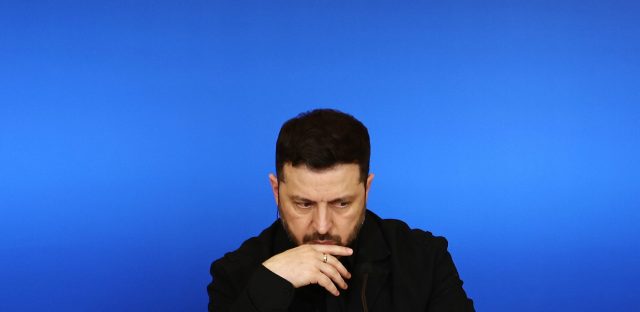
“Unless Zelensky removes this cancer at the heart of the state, the West may find it increasingly difficult to defend and financially support Ukraine.” (Henry Nicholls/ Getty)





In a sparsely furnished four-room apartment on the 18th floor of 9a Hrushevskoho Street, Kyiv, several well-connected businessmen are discussing deals involving some of Ukraine’s most powerful politicians and officials. Meanwhile, anti-corruption investigators are listening in via a concealed bug. The contents of the 1,000 hours of conversation that they record are shocking. They reveal large-scale war profiteering among President Zelensky’s inner circle. In one case concerning the state nuclear company, Energoatom, contractors were forced to pay an extra 10-15 percent in kickbacks in order to avoid contracts being blocked or canceled.
The recordings were made by the National Anti-Corruption Bureau of Ukraine (NABU) and the Specialized Anti-Corruption Prosecutor’s Office (SAPO) — the independent prosecutorial body that oversees and prosecutes NABU’s cases — as part of Operation Midas, a 15-month investigation into corruption within Ukraine’s energy sector, launched in 2024. NABU has implemented an unorthodox communications strategy, revealing information in episodes akin to a drama series like Homeland and giving suspects nicknames like The Surgeon, The Professor, The Rocket and Che Guevara.
As only a section of the transcripts has been published, the full extent of the corruption is still not known. However, the nine suspects named in the recordings so far are uncomfortably close to Zelensky. These include his former chief aide Andriy Yermak; former defense minister Rustem Umerov; former deputy prime minister Oleksii Chernyshov; and Tymur Mindich, the owner of the infamous apartment and the President’s former business partner.
So far, detectives have conducted 70 searches of premises where they seized $4 million in cash, hundreds of documents and mobile phones. Bail has been posted only to two of the nine suspects. “This is deeply regrettable”, said Kaja Kallas, the EU’s representative for Foreign Affairs, as the revelations became public last November. “It is literally the people’s money that should go to the front lines.”
All this has been deeply uncomfortable for Zelensky — who responded by announcing plans to clean up the energy sector. But many of his attempts to distance himself from the scandal have backfired. In July last year, crowds took to the streets holding homemade cardboard signs in protest after the Ukrainian parliament voted to strip NABU of its independent status, widely seen as an attempt to stem further revelations. This “Cardboard Maidan” reemerged last month after Zelensky sacked the popular modernizing defense minister, Mykhailo Fedorov, who had cracked down on corruption by making procurement of weapons more transparent. Zelensky has so far opted not to reinstall Fedorov in spite of the protests.
And there are more revelations to come. One MP, Yaroslav Zhelezniak, has said he possesses more evidence and plans to release more secret recordings confirming suspicions that corruption is endemic in wartime Ukraine. Last year a Gallup poll put Zelensky’s approval ratings at 67% — lower than at the outset of the war, but still incredibly high compared to other world leaders. However, the same poll showed 84% of Ukrainians believed fraud and bribes were widespread throughout the government. And this year, a poll found 54% of Ukrainians citing corruption as the biggest threat to the country — compared to 39% who considered war the greater peril.
Meanwhile the scandal refuses to go away — indeed, it threatens to destabilize Ukraine at a critical moment. Ukraine’s long-range drones have provided a strategic advantage in the war and its bombing of oil refineries has created a nationwide fuel shortage in Russia. Meanwhile Zelensky’s diplomacy has been starting to bear fruit in Washington, with the Senate recently voting overwhelmingly in favor of sanctions on Russia.
Zelensky was, of course, elected President in 2019 as the anti-corruption candidate — a comedian who could portray himself to the Ukrainian people as the anti-establishment outsider. On the international stage, he has been hailed as a hero for standing up for democracy and liberty and projecting Ukraine as the shining antithesis to Vladimir Putin’s mafia-like authoritarianism. All of which makes him uniquely vulnerable to the charge of hypocrisy.
While there is no evidence implicating Zelensky himself, several of his former business partners and senior members of his Servant of the People party have escaped corruption charges by fleeing abroad, leading to claims they were tipped off by government insiders.
One of them is Tymur Mindich, the owner of the infamous flat bugged by the state anti-corruption investigators. A former business partner of Zelensky, Mindich is the key protagonist in Operation Midas — indeed, the investigation tends to be referred to as The Mindich Tapes in Ukraine. Mindich fled to Israel just before being charged with masterminding the $100 million scheme that diverted money intended to fortify energy infrastructure against Russian attacks into kickbacks for corrupt officials. He also lobbied the defense minister to award military contracts to Firepoint, a company under his control which produces critical defense equipment. Ukraine has sanctioned Mindich and demanded his extradition from Israel in order that he can face justice; Mindich in turn has attempted to sue his former friend, Zelensky.
Another central figure is Andriy Yermak, the massively influential former chief of staff to Zelensky once regarded as Ukraine’s second most powerful man. “He virtually ran the country”, one Ukrainian businessman told me. Codenamed ‘The Surgeon’, Yermak, an official suspect, has been arrested and last month posted bail of £2.3 million. He dismisses allegations against him as “unfounded”.
The most explosive of the tapes is a conversation between Mindich and a woman named Natalia, who is apparently helping to oversee construction of four luxury villas near Kyiv, apparently built with the proceeds of embezzlement. It appears from the transcripts that one of the villas was intended for Mindich, one for Yermak, and another for the former deputy prime minister, Oleksiy Chernyshov. At one point, Natalia says that the interior structures of “Andriy’s” (i.e. Yermak’s) house have already been completed. At another, she mentions that a fence now separates Mindich’s villa from “Vova’s” — a common short version of Volodymyr that many have taken to mean Zelensky.
Zelensky has denied all knowledge of Mindich’s schemes and called for any corrupt officials to be jailed. So the most plausible explanation is that the President has shown poor judgment in choosing his closest advisors. To some extent this is understandable. He inherited a legacy of endemic corruption in Ukraine whereby bribes were already institutionalized, the judiciary was compromised and politically connected oligarchs routinely ripped off the people by obtaining valuable state assets for a fraction of their real value. Indeed, the very existence of organizations like NABU; the freedom of Ukrainian media to pursue the revelations; and the street protests that have been allowed to proliferate are in themselves evidence of the strength of Ukraine’s commitment to transparency.
Nevertheless, the charges against his closest friends have made it more difficult for Zelensky to distance himself from the case. This may yet become even harder as the repercussions of one Ukraine’s biggest and unnoticed scandals make their way through the courts.
This affair concerns the state takeover of Sense Bank, one of Ukraine’s biggest, with assets of £2.3 billion. Prior to 2022, it operated as Alfa-Bank Ukraine, part of a group of banks associated with the Russian oligarchs Mikhail Fridman and Petr Aven, and owned via the Luxembourg-based, ABH Holdings. Following the Russian invasion, it was sanctioned and then effectively seized by the Ukrainian state — who bought up 100% of its shares for a nominal one hryvnia in 2023. “The deal will help safeguard the interests of the Bank’s depositors and ward off threats to Ukraine’s financial stability,” stated an official announcement.
The Mindich Tapes reveal that another suspect, Oleksandr Tsukerman, was instrumental in appointing new members to Sense Bank’s board. Last May, Tsukerman telephoned a businessman named Vasyl Vesely, apparently on behalf of Zelensky. Vesely, who was described as “a watcher” from the President’s office, named the people he wanted to join the board. “There should be six of our members there in this crowd of nine”, he told Tsukerman. “These are ours and one [director] will do everything if positioned correctly”
A month later, Ukraine’s cabinet appointed those six individuals to the Sense Bank board. When the tapes were released, Vesely’s involvement — apparently as Presidential fixer — cast doubt on the independence of the board of one of Ukraine’s biggest banks. The bank’s chairman, Mykola Hladyshenko, duly suspended himself. “Sense Bank appears to have been captured by domestic criminal networks with access to the highest levels of the Ukrainian state”, a Ukrainian banking analyst told me. “The suspicion is this bank has become a vehicle for laundering the proceeds of domestic corruption, including funds that may have originated in Western aid to Ukraine”. Like Mindich, Tsukerman fled to Israel and is now the subject of an extradition request by Ukrainian prosecutors.
Some central bankers are concerned at the broader implications of the case. “This is not a scandal about individual names [joining the Sense Bank board]”, wrote Kyrylo Shevchenko, former head of the Ukraine National Bank between 2020 and 2022, after the tapes were published. “It concerns a systematically important bank, a state asset and who controls financial institutions in Ukraine during the war.” He described his own tenure at the Ukraine National Bank as being subject to “constant” political interference when it came to appointing personnel.
The involvement of Zelensky’s former chief of staff, Yermak — now under investigation for alleged corruption — in nationalizing Sense Bank is particularly problematic. The state took ownership of the bank in 2023 after passing a special law to nationalize any bank if it was insolvent. But the National Bank of Ukraine had already stated that Sense Bank was solvent.
And so the government passed a new law that enabled a bank to be declared insolvent if some of its shareholders were sanctioned. In the case of Sense Bank, three of its indirect shareholders, notably the Russian billionaire Fridman, were sanctioned and so the bank could be deemed insolvent despite the regulators stating it was financially sound. A month later, Sense Bank was nationalized and its properties, shopping centers and land were seized by the state, with a new CEO and board of directors installed.
In response, ABH Holdings filed a $1 billion lawsuit against Ukraine in the World Bank’s arbitration court. In essence, ABH Holding’s accusation is that individuals close to Zelensky, notably Yermak, used corrupt tactics of state capture to gain control of the bank. The investigative reporting platform, Follow the Money, has interpreted his a different way: as a Russian oligarch exploiting European treaties and US-based courts to sue a country that Russia has declared war on, effectively for behaving like Russia. Should ABH Holdings win, it could open a “Pandora’s box” of oligarchs using lawfare to target Ukraine, warn legal scholars quoted in the article. But noting this uncomfortable irony does not magic the problem away.
When asked about Sense Bank last year, President Zelensky told a Cabinet meeting that it “must be privatized”. But it hasn’t happened yet. The Ukrainian government has meanwhile requested the court hearings to be held in secret. ABH Holdings refuses and insists Ukraine abides by arbitration rules which states “confidentiality is neither agreed nor envisaged”. When the case is heard next year, the role of President Zelensky and his advisors will be revealed. If the Ukraine government loses the lawsuit, the award is likely to be in the hundreds of millions of pounds — a major dent in the war coffers.
But the importance of the Sense Bank case, the “Mindich Tapes”, and the far-reaching corruption investigation is more profound. Ukraine’s greatest strategic asset is not its military capability or territorial location. It is the moral clarity of its cause: that it is a democracy based on the rule of law, freedom and worthy of defending in the face of tyranny and brutality. But corruption is Ukraine’s fatal flaw. Unless Zelensky removes this cancer at the heart of the state, the West may find it increasingly difficult to defend and financially support Ukraine.
Mark Hollingsworth is a freelance journalist and author. He is the author of Londongrad – From Russia with Cash, the Inside Story of the Oligarchs and his most recent book is Agents of Influence – How the KGB Subverted Western Democracies.
 markhollings41