




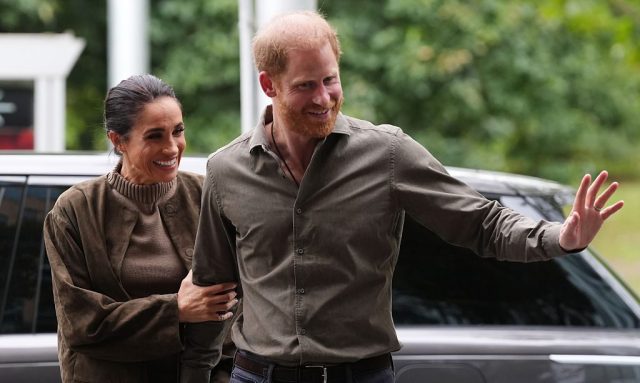
“The house was burning long before the Sussexes arrived.” (Jonathan Brady/Pool/Getty)





Two weeks after Diana died, I was riding the U-Bahn in Frankfurt. Across the crowded carriage, a young woman took a single photocopied sheet from her bag with great deliberateness and began to read. A minute later she was quietly weeping. Craning my neck, I could see that the sheet was a German translation of the words to “Candle in the Wind ’97”, clipped from Bild (the dreadful German analog to The Sun), crumpled and soft at the edges. It was clearly not the first time she had read it. We got off at the same stop, and I lost her in the crowd.
I have been thinking about that woman lately, because the son of the woman she was weeping over has come home. Yesterday, Prince Harry and Meghan, Duchess of Sussex, returned to Britain after six years in Montecito, California.
Let me declare my interests, or rather my lack of them. I hold no brief for the Sussexes. I have not tried the podcasts. I am dimly aware of the jam. I have sat through small bits of the Netflix series, in which two people who moved to California to escape publicity narrate their private lives to camera for six hours. Nor do I much care for the House of Windsor: an emotionally refrigerated dynasty whose one redeeming feature is a hollow, ironical humor flapping at the edges of an inflexible sense of duty. Asked to choose between Montecito and Balmoral, I would ask to see the wine list.
But the return interests me, and not because of the personalities. It interests me because in tragedy nobody gets out of the house. That is very nearly the definition of the genre. Orestes is raised abroad and comes home to engage in matricide; Hamlet is called back to Elsinore by a dead parent who declines to stay dead; the House of Atreus runs on a curse that no amount of relocation can outrun. I once wrote a book about tragedy, and the sentence in it I stand by most firmly is this: “We are still prisoners of the family, even a queer family.” The Windsors are our House of Atreus, with better catering and worse weather. Harry’s flight to California was never the end of the play. It was the interval, and the strawberries and cream have now been eaten.
In an article for The New York Times, under the headline “Don’t Harry and Meghan Know Better?”, Roxane Gay reads the return as she read the exile: as a parable of race. The monarchy, she observes, has cheerfully tolerated wife-beheaders, a Nazi-sympathizing abdicator and a prince who kept up his friendship with Jeffrey Epstein after the conviction, but it could not abide a black woman. About the tabloids she is simply right: the coverage of Meghan was vile, and the family’s refusal to defend her contemptible. And yet race explains less here than it appears to. The machine that mangled Meghan had already destroyed a white, aristocratic, impeccably virginal teenager called Diana Spencer, and it has chewed through every daughter-in-law fed into it before or since, whatever her color or her postcode. The Firm is an equal-opportunity destroyer of daughters-in-law. Gay ends her article with James Baldwin’s question — “Do I really want to be integrated into a burning house?” — and it is the right question with the wrong arsonist. The house was burning long before the Sussexes arrived. What breaks people in that house is not their difference from the family. It is the family.
Which is why Diana remains the far more interesting figure. I was moved by her death and take no pride in admitting it, being the kind of right-thinking soft leftist who can quote Tom Paine from memory after a couple of drinks. But what happened in September 1997 still strikes me as thrilling, and I persist in thinking it was almost revolutionary. For about a fortnight, England stopped being a Protestant country. The shrines, the votive candles, the flowers rotting in their cellophane, the icons of a wronged woman, the pilgrims sleeping out on the Mall, the conviction that grief must be displayed rather than swallowed — this was a populist catholic insurgency, catholic with a small c. It was an eruption of everything the Reformation was supposed to have buried, directed squarely against the stiff-necked Anglicanism of a family whose head is, after all, Supreme Governor of the Church of England. The irrational national feeling on which constitutional monarchy depends — the affect that it exists to capture and sedate — detached itself from the living sovereign and fastened onto a dead woman whom the family had cast out. The Queen was obliged to come down from Balmoral and bow her head to the coffin of her discarded daughter-in-law, more or less on the instructions of the tabloid press. It was the nearest thing to a revolution I ever expect to see in England in my lifetime, and it was conducted entirely in flowers.
Perhaps Diana damaged the House of Windsor beyond repair. The Firm survived, as firms often do, but like a bell with a crack in it: it still rings on the hour, but the note has never been true since. Everything after — the confessional television, the disgraced uncle stripped of his dukedom, the warring sons, the memoir with its frostbitten confidences — is aftershock. Harry is his mother’s heir in everything except the ability to carry it off: the same weaponized publicity, the same faith that feeling trumps protocol, the same slow discovery that the media that loves you is the media that eats you and will kill you.
So why is there no republic? This is the genuinely strange thing. The monarchy has given the British every possible reason to be rid of it, and yet the republican groundswell obstinately fails to swell. The polls barely move; abolition remains the hobby horse of those of us who own a copy of Rights of Man and hum “Jerusalem” in the shower. Personally, I would prefer a republic. But honesty compels a look at what happens to republics. The United States rid itself of George III and then spent two and a half centuries confecting substitute royalty: the Camelot of the Kennedys, the dynastic ambitions of the Clintons, the Obamas’ court in its tasteful exile, and now a president who has gilded the Oval Office like a Bourbon with a credit line. Abolish the monarchy without abolishing the need for one and you get kings anyway — elected ones, who are worse, since there is no constitutional plumbing for removing them gracefully.
Americans desire monarchy more than anyone. I discovered this in Washington DC on the night Diana died. I was there for a political science conference; a Brazilian waiter broke the news over a late dinner, and he had to repeat it three times before I believed him. I then sat in the lobby of the Sheraton until four in the morning, watching CNN try to assemble the story from scraps while respectable, indeed some world-famous, political theorists wept openly around me. The network’s instinct, in the absence of a court of its own, was to ask Tom Cruise for comment. A republic in mourning reaches for the Hollywood aristocracy, which is the only one it has.
The reason is that politics runs on fiction, and there is no unleaded alternative. Hobbes knew this: the state is an artificial man animated by an “Artificial Soul”, and what keeps the many obedient to the few is not force but opinion and imagination, or perhaps just fancy — the stories we seem to need to keep telling. The question is never whether we live by fictions but which ones, and whether we know it. The British monarchy is a fiction that insists it is a fact: as recently as 2023, a 74-year-old man was anointed with holy oil behind a screen while Handel played, and Parliament looked on as if this were normal.
Wallace Stevens dreamed of a supreme fiction — a fiction we know to be a fiction and believe in anyway, with our eyes open. A republic worth having would be exactly that: a crownless constitution held together not by sacred oil but by the revisable consent of people who know they made it up and might therefore make it better. Whether human beings can be governed that way — whether we can live without kings and queens — is an open question, and the evidence of the past decade is not encouraging. We seem to want thrones the way we want sugar, and the diet versions fool nobody.
Meanwhile, the play resumes. Harry comes home like Orestes, though with more limited plans, one hopes, for the family reunion. Like Hamlet, he is called back to Elsinore by a ghost, and his ghost has been visible for nearly 30 years, on tea towels and old mugs. There will be school runs and security disputes and a reconciliation with the crowned father reported by the very newspapers whose destruction Harry has sworn. Nobody gets out of the house. The best you can negotiate is a room of your own in it.
Monarchy, in the end, is not the oil, the orb or the man in the golden coach. It is a stranger weeping on public transport for a woman she never met. Can we live without kings and queens? The truth is, we have never seriously tried.