




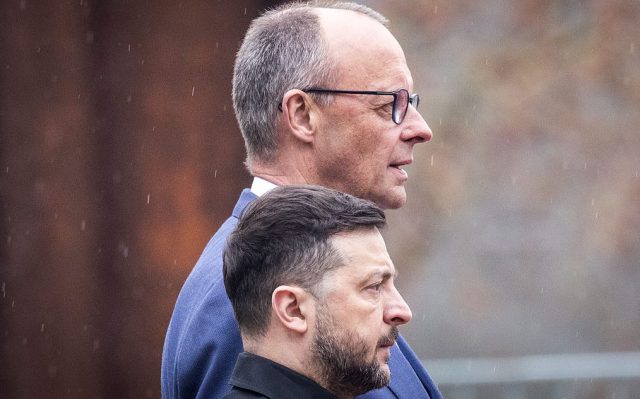
“Why support a country that bombs our infrastructure? It is a hard question to answer.” (Nadja Wohlleben/Getty)





The Germans have just caught another alleged member of the group that bombed the Nord Stream gas pipelines in September 2022. Volodymyr Zhuravlev, a deep-sea diver, was detained last week in the Croatian coastal city of Pula. In a fantastical turn of events, he had reportedly been acting as a consultant on the set of director Doug Liman’s next movie, Snake Island, about the team of Ukrainian divers that allegedly carried out the Nord Stream operation.
The bombing of the Nord Stream pipelines — which had up until then supplied Germany with cheap Russian gas — revealed an aspect of Ukraine’s military defense strategy that had previously been hidden. It became clear that the Ukrainians were seeking to break up the Russian-German relationship, which they saw as a direct threat to their own security.
The first of the Nord Stream criminal trials will start on 26 October in Hamburg. It will expose many unsavory details. The prosecutors might ask questions such as: who ordered the attacks? What did President Volodymyr Zelensky know? When did he know it? The attack left Germany in a perma-energy crisis. And while I don’t think the trial will affect Germany’s support for Ukraine in the short run, it could — depending on what is revealed — make Germany more reluctant to support Ukraine’s membership of the EU and Nato in the future.
The pipeline explosions have a long pre-history. Germany’s energy relationship with Russia dates back to the Seventies. Gerhard Schröder, a former German chancellor and personal friend of Vladimir Putin, supercharged this relationship when he proposed the Baltic Sea pipeline projects in the early 2000s. The project later became known as Nord Stream. The first pipeline, which became operational in 2011, ran from near St Petersburg in Russia to Mecklenburg-Vorpommern in eastern Germany. Before Russia’s invasion of Ukraine, Nord Stream 1 provided Germany with 55% of its gas supplies. Nord Stream 2, which was only completed in 2021, had the capacity to increase the gas flows substantially.
The Germans treated their business dealings with Russia as separate from geopolitics. The standard answer you got from German officials before the war was that the best way to foster democracy in Russia was through trade. They called it Wandel durch Handel — change through trade. If it rhymes, it must be true.
Eastern European countries, notably Poland, treated the Nord Stream pipelines as a security threat. If Germany made itself dependent on Russia for its gas, Poland would once again be surrounded by a hostile alliance. Later, France joined the group of critics. More importantly, the US Congress passed successive acts, supported by both Democrats and Republicans, to impose sanctions on Germans involved in the pipeline project. They did not go after Schröder personally. He was the supervisory board chairman of the project. But they went after Matthias Warnig, the Nord Stream CEO. Warnig was a former East German Stasi officer and another close friend of Putin. The pipeline diplomacy became particularly heated in the two years leading up to Russia’s invasion in February 2022. I myself criticized the pipelines on the grounds that they made Germany dependent on Russian gas and undermined European solidarity. At that time, virtually nobody in Germany thought about energy in geopolitical terms — but everybody else did.
A few days before Putin invaded Ukraine, the German government agreed to suspend the Nord Stream 2 pipeline, which by then had been constructed but not yet used. It still needed certification. When Putin invaded, the project died. But Nord Stream 1, the older pipeline, was still operational. Even the Green Party, the only big German party that opposed the construction of Nord Stream 2, favored the continued operation of Nord Stream 1. By that time, the Greens were responsible for energy policy in the German government. As Germany was phasing out nuclear energy and coal, the country had no alternative to gas. Even when most of their energy was coming from renewable sources, they still needed gas to cover periods when there would be no wind and no sun.
There were alternative gas suppliers back then. The US and Qatar, for instance, sold gas in liquefied form (LNG) — but during this period, Germany did not have the infrastructure in place to process it. Russia’s gas, meanwhile, was pumped directly into the gas grid.
Each of the pipelines, the old Nord Stream 1 and the new Nord Stream 2, consisted of two big tubes. On 26 September 2022, three of the four tubes exploded near the Danish island of Bornholm, including the two that made up Nord Stream 1. Initially, everybody suspected the Russians. Then the US journalist Seymour Hersh wrote an article claiming that the explosion came at the behest of the CIA.
The German prosecutor eventually established that the attack was launched from a sailing yacht chartered in Germany by a group of Ukrainian citizens, with links to the Ukrainian army and secret service. Initially, the Ukrainian government tried to deflect attention from this evidence, arguing that the plot was funded by a wealthy private individual. But that story has since been debunked.
The operatives were highly trained explosives experts and deep-sea divers. The pipelines were located 80 meters below sea level. Diving that deep is not something you learn at your local scuba-diving club. The German prosecutor established that this was a military operation through and through. The estimated physical weight of the C4 explosives used to detonate the pipelines was in the order of 50-100 kilograms. Only governments have explosives on this scale.
The German prosecutor issued a European Arrest Warrant for the operatives. The first successful arrest came in August last year, when Italian police detained Serhiy Kuznetsov, the suspected ringleader of the operation, who carelessly went on holiday to Italy. He was extradited to Germany and placed in a high-security prison. His trial is due to start this autumn.
What confuses me is why Kuznetsov thought it safe to go on holiday in the EU. Even more astonishing is the fact that the second suspect, Volodymyr Zhuravlev, whom the Polish authorities previously refused to extradite, also thought it safe to go on holiday abroad. Last week, the Croatian police arrested him. He is now awaiting extradition to Germany. This is one aspect of the story that I find puzzling. These are highly trained operatives with fake passports. Why would they go on holiday in unsafe locations?
So far, this all makes for a gripping spy story. But it may soon become a political one. Details will matter. The Wall Street Journal journalist Bojan Pancevski claims in his book, The Nord Stream Conspiracy, that the attack was orchestrated by the Ukrainian military and intelligence network, and that Valerii Zaluzhnyi, then commander-in-chief of the Ukrainian armed forces and now Ukrainian ambassador to the UK, was the most senior officer involved. We don’t know whether Zelensky gave the order or was informed. I don’t think it really matters. As president, he is responsible for the actions of his military and his intelligence service. What matters is that a Ukrainian commando sabotaged the critical energy infrastructure of a friendly country.
The media covered the pipeline explosions and the immediate aftermath half-heartedly. I suspect editors did not want to be accused of disseminating anti-Ukraine propaganda. The media supported Ukraine — and the pipeline story did not sit well with the hero worship of Zelensky. The German government also did not comment on the prosecutor’s action. But it’s worth remembering that both Olaf Scholz and Friedrich Merz could have stopped the investigation if they had wanted to. The Poles are outraged that they did not. Last week, Donald Tusk, the Polish prime minister, said that the bigger crime was the construction of the pipelines, not their destruction. I recall a tweet by the current Polish foreign minister, Radoslaw Sikorski, who was an MEP in Brussels at the time of the explosions. “Thank you, USA,” he wrote.
So, was it really a conspiracy? Over the course of my journalistic life, I’ve come to the conclusion that there are many fewer real conspiracies than most people think. What looks like a conspiracy is usually just a series of blunders. I think this was the case here too. A giant miscalculation by the Ukrainians. Back in the summer of 2022, they had pushed back the Russians. The war was going their way. Everybody wanted a photo with Zelensky. The Ukrainians thought it within their power to ensure that the Germans would not revert to their previously cozy relationship with the Russians. But after the Trump administration ended financial and most military support for Ukraine, Germany became Ukraine’s biggest supporter. What were the Ukrainians thinking?
However this story ends, I don’t expect Germany to revert to its old, naive pro-Russian reflexes. Germany will not make itself dependent on Russian gas once again. But I cannot exclude the possibility that Germany may, after the war has ended, reopen at least one of the pipelines. Germany has become reliant on natural gas — and Russia could become one of its several suppliers. We are one cold winter away from an energy crisis in Germany. And when that happens, we’ll remember who bombed the pipelines. Even without a winter crisis, I suspect that Germany’s future support for Ukraine will be less enthusiastic than it might otherwise have been.
The upcoming trial is going to release a lot of juicy information into the public domain. The media will cover it. The Alternative for Germany, the party of the far-Right, is already making a big deal out of the Nord Stream explosions. They are asking: why support a country that bombs our infrastructure? It is a hard question to answer. The German government, for sure, has not answered it.
