




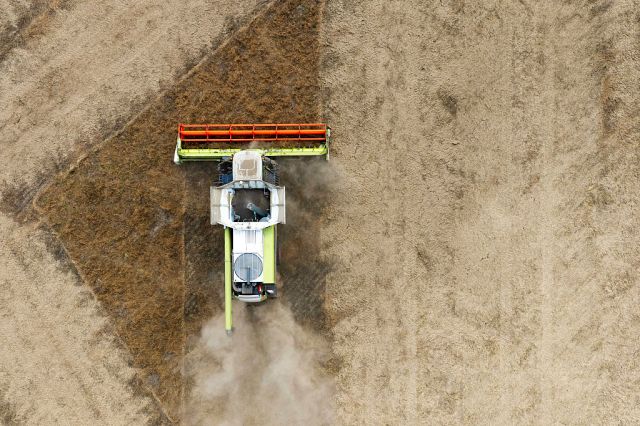
Giant dust clouds rise from a yellow-gray combine harvester as it crawls across a parched field in Suffolk. (Toby Shepheard/AFP/Getty)





The heat is somehow different — prickly, dry, searing. The fields have turned a strange desert-like khaki, and the endless blue above is empty of clouds. The sheep and cattle hug the shade beneath the oak trees, and flick their ears to shift the black flies. The streams have either dried up completely or are sad little trickles between the rocks. Dust rises behind the cars on our farm track in clouds, and settles like chalk on the oak leaves.
Surrey, perhaps, is familiar with the parched-brown cricket pitch look, and Kent has long been golden yellow with barley and wheat in summer. But for most of us, England really was, until recently, a green and pleasant land. Dark green oak trees, set in hazel-green hedges and edging shadowy green lanes, created a patchwork landscape of lush fields. Now, though, lots of England looks like Normandy, and I’m struggling to adapt.
Yes, some people like to catastrophize. Yes, extreme weather isn’t proof of climate change. And yes, some summer droughting is to be expected. But England’s problems are about so much more than the views. Harvest would normally be in full flow about now. But with the sunshine and the heat, and the Environment Agency saying we have had just 3% of the average rainfall for July, across most of the country it happened a month ago, when the fairly pitiful crops all ripened early. No wonder reports suggest this could go down as the worst cereal harvest since records began in 1984, with farmers already reporting yields way below average. All told, they’re projected to lose some £390 million in crop value.
If crops wither in the fields, grass dries up too, meaning livestock farmers have to bring in harvested forage or buy feed from elsewhere. And, again, the impact is stark. Milk production fell by 18.5 million liters across the UK in July, as farms struggled to feed their cows and keep them cool. You might ask what all this has to do with you. You will find out when you go shopping in the next few months, and the prices are higher and products more scarce. Farming is a service industry, and we work for you.
That is the big picture, but the details are equally stark. Jake Fiennes manages the Holkham Estate in Norfolk, where they graze cattle by the coastal marshes. Holkham has traditionally benefited from a chalk aquifer that fills the farm’s drainage dykes with clean, fresh water. But as drought dries up the aquifer, sea water seeps in below, forcing farmers to bring their cattle inside their barns for shade and piped water. And Fiennes is far from unique. Hannah Campbell and her mother Joy Dawson farm in south Lincolnshire. They have spent weeks carting water to their sheep after the usual ponds and river dried up. The irony, they say, is that after three months of drought each summer, they are likely to face six of winter flooding.
Water — too little or too much — is only one problem. Hattie McPhee is growing a herd of milking sheep in Cumbria, to make cheese. She says the drought has made things hard: the sheep aren’t filling the tank with milk because their summer diet is so poor. The drought doesn’t end for farms when it rains, but when its effects and costs pass. Hattie is worried about making it through the next winter, as sales will be lower, and because the hay she has made is too dry and unpalatable.
Tom and Tess Darlington have money worries too. They are tenant farmers on the Little Dalby estate, in Leicestershire, growing crops and rearing livestock. Collapsing summer yields have left a shortfall in their budgets of 300 tonnes of wheat, worth about £60,000. It means they will be extending their overdraft to buy next year’s seeds. Tom jokes that he might have to sell a kidney to carry on farming, especially when the costs of machinery only ever seem to rise, pointing out that a combine harvester for harvesting wheat now costs £600,000 or more. The investment required to make food “cheap” is insane.
On one level, clearly, a drought is just bad luck, the savage will of the gods. If it doesn’t rain for long enough, then every farming system grinds to a halt. But the severity of how drought affects a place is shaped by how it has been managed before. And the fact is that a lot of British farmland is now being farmed so efficiently — in monocultures, and fed with synthetic nutrients — that often it has quite low levels of soil organic matter. Now, this can work fine in years where there is plenty of moisture. But over time, we also know that degraded soils dry out quicker in droughts.
The Rothamstead Institute estimates that every 1% increase in soil organic carbon raises the soil’s water holding capacity by about 354,000 liters per hectare: enough to fill five swimming pools. It isn’t how much rain falls from the sky, in other words, but how much we can hold in our soils that really matters.
Systems, in short, can be too efficient; fields need some buffer, some untapped potential, that they can call on in periods of stress and exhaustion. But our farming systems are being asked to run flat-out all the time. There is no slack, and very little resilience. The basic problem is that the economics of agriculture don’t pay for soil organic matter, or for farmers to rotate crops, or to let land have periods of recovery. In practice, that means that most of our arable landscapes are now poorly adapted for extreme weather events.
No farmer looking across their once-green landscape wants to hear that they might have done something to minimize the drought. But the evidence is pretty clear that, somehow, we need to prioritize soil health.
Andy Cato, one half of the electronic music duo Groove Armada, is also a regenerative farming champion, and has been preaching this mantra for years. He thinks our conventional farming systems are not yet adapted to the realities of the dry summers we are getting. This year, his farm, in the Thames area, has had yields for winter sown wheat as high as eight tons per hectare. There may be drought, but Cato has also spent years raising soil carbon, encouraging deep-rooting plants, growing cover crops, and keeping them nutritionally balanced.
The ability of Britain to feed itself in the future may therefore depend on whether our farmers can learn to farm in ways that pack the living soil with organic matter. This might mean a return to mixed farming, with arable rotated with grazing. Green plants are especially useful here, eating sunlight — photosynthesis — then pumping carbons and sugars down into the soil. The animals themselves are vital too: half the country needs more sheep and cows, not less, as we are often told by well-meaning but profoundly ignorant environmental campaigners.
Britain, of course, is far from alone. In July, the UN Food and Agriculture Organization found that their food price index had risen to its highest level since 2023, even as the OECD’s Global Drought Outlook suggests that economic losses to drought are growing from between 3% to 7.5% per year. Altogether, some 1.7 billion people worldwide now live in places where crop yields have fallen by at least 10% due to human-induced land degradation.
All the same, the UK is especially vulnerable. Until a decade ago, we were part of the EU’s food system, which subsidized farming, and gave us access to alternative sources of food if ours failed. The risks were spread across mainland Europe, with access to arable heartlands like Ukraine beyond the EU’s borders. We ended that relationship, and now need a food system that reflects our post-Brexit isolation, one that can feed us in bad years as well as good. Economists say we can import what we need, from across the globe, but they seem curiously naive about the risks.
Once again, Ukraine is vital here. One of the bread baskets of the world, it produced 80 million tons of grain and oilseeds before Putin’s invasion, or the equivalent of about 10 kilograms for everyone on Earth. But, in case you’ve missed it, Russia is bombing the port of Odesa, from which this bounty leaves to reach our plates. It will be a good result if 50 million tons of Ukrainian grain gets to global markets this year.
In short, the old assumptions on which we built our food system no longer hold. Geopolitics has changed. The climate has changed. Rainfall patterns have changed. Food production technologies have changed. The risk-sharing balance of old, between state and farmer, has vanished. Where we source vital synthetic nutrients from has also changed: much of Britain’s came through the Strait of Hormuz. All the while, our population is growing fast, and our available farmland now has alternative uses — from solar farms, to growing biomass for biodigesters, to rewilding — that gobble up vast acres.
Yet despite the urgent need to change ourselves, we are refusing to support thousands of farmers who have applied to government schemes designed to make our landscapes more resilient. Our political class, especially in the Treasury, seems either too agriculturally illiterate or just plain indifferent. Either way, we aren’t investing at anything like the levels we did before 2016.
Political indifference and bureaucratic sluggishness is even more unfortunate given these are not things that the market, left to its own devices, makes happen. The market, after all, pushes farmers to get the efficiencies-of-scale that come with growing thousands of acres of one or two crops. That’s how you do cheap food — via mechanized monocultures — but it isn’t how you do food system that is resilient and robust, yet alone healthy.
Beyond ensuring shelves are stocked, a farming revolution could offer benefits too, not least in spreading the risks and costs of feeding the British people. Already, about 20% of us, the poorest, struggle to access and afford healthy food, which has massive implications for the NHS and straining government budgets.
All that’s for the future. For the moment, the drought continues. In my corner of Cumbria, the hillsides are withering, and the cattle stand by the water troughs huddled in whatever cover they can find. Some of our pastures have no piped water, so we will be moving the cattle nearer home in the next day or two. Even the crows look ragged and hungry, as they can no longer peck for worms. Our Southern friends have had it much worse, and are having to learn how to farm in such harsh conditions. And now, perhaps, our time is coming too.
James Rebanks is a fell farmer and the best-selling author of The Shepherd’s Life. His latest book is The Place of Tides.
 herdyshepherd1