




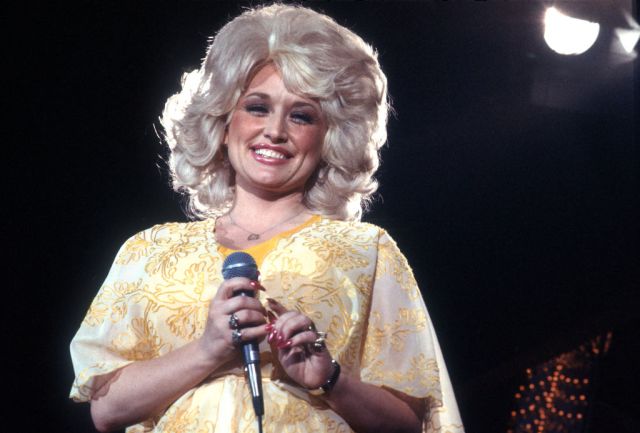
Dolly Parton performs in Los Angeles in 1975. Credit: Getty





The mountains spoke to Dolly Parton. Growing up in the deep green forests and dark hollers of East Tennessee, she listened to the rhythmic song of the whippoorwill, the steady rise and fall of her father’s ax as he chopped wood, and the hushed rustling of the wind through the red maple leaves. In those sounds, she heard songs. “Everything was music to me,” she said. “Even the katydids, or if somebody was hammering on the other side of the hill at a sawmill, I’d start writing a song with that rhythm.… Everything is a song to me.”
Dolly, who left her family’s two-room log cabin on Locust Ridge to pursue a career in songwriting in Nashville the day after her high school graduation, shared the sounds of the Appalachian mountains with the world. “I’m the only person that ever left the Smoky Mountains and took them with her,” she told Knox News in 2023. Her sweet mountain soprano and uncanny gift as an American songwriter made her a star in Nashville. But her fierce, unyielding commitment to her mountain heritage made her Appalachia’s own patron saint.
It was not uncommon, as Dolly was rising to fame, for “hillbilly” culture to be misjudged if not mocked outright. Rather than join the madding crowd, she used the qualities that defined her — her flamboyant sense of style, her razor-sharp wit, and her country girl’s charm — to bring Appalachian culture into the mainstream. One of the clearest examples of this came in her 1977 primetime interview with Barbara Walters.
“Dolly, where I come from, would I have called you a hillbilly?” Walters asked.
“If you had, it would have probably been very natural,” Dolly answered, “but I would have probably kicked your shins or something.” She gave the broadcaster a disarming giggle.
Walters pressed: “But when I think of hillbillies, am I thinking of your kind of people?”
“I think you probably are,” Dolly said. “We’re the ones that you would consider the Li’l Abner people, Daisy Mae… they took that sort of thing from us.” Dolly was referring here to Al Capp’s mid-20th-century comic strip, which profited from and deepened rural tropes. “We were very proud people,” Dolly continued, “people with a lot of class — it was country class, but it was a great deal of class.”
In later years, Dolly expressed pride in her hillbilly roots. “I mean, we were really Hill. Billies. To me that’s not an insult,” she told Southern Living in an interview. “We were really redneck, roughneck, hillbilly people. And I’m proud of it.”
Dolly’s music came from a place of deep and abiding empathy. And with it, she gave voice to the America that exists outside of the cultural centers. In her songwriting — or “songtelling,” as she called it — she resisted simplistic stereotypes, instead creating richly developed characters drawn from the people and experiences of her own childhood. She wrote, in the great American literary tradition, of eccentrics (“These Old Bones”), recluses (“Joshua”), nomads (“Gypsy, Joe and Me”), and prostitutes (“A Gamble Either Way”). She wrote also of orchard keepers and banjo pickers (“Applejack”) and of the mountain doctor and minister who delivered her, accepting a bag of cornmeal as his payment (“Dr. Robert F. Thomas”).
In interviews, she said that, among the roughly 3,000 songs she’d written during her career, “Coat of Many Colors” was her favorite. She penned the song in 1969 while touring with Porter Wagoner, scrawling the lyrics onto the back of a dry-cleaning receipts. The song tells the tale of childhood innocence and humiliation. In winter, as the first cold was setting in, Dolly’s mother Avie Lee Parton stitched a coat from bits and pieces of fabric. As she worked, she told Dolly the Biblical story of Joseph and his magnificent coat. The child’s joy and contentment turned to shame when, at school, she was met by the jeers of her classmates. In the end, the song becomes a parable about spiritual wealth.
But they didn’t understand it
And I tried to make them see
That one is only poor
Only if they choose to be
Now I know we had no money
But I was rich as I could be
In my coat of many colors
My momma made for me
Made just for me
Dolly often spoke of her father Robert Parton — who had no formal education and was not able to read or write — as the smartest man she had ever known. He had what Dolly called “horse sense,” meaning he had a kind of rural street smarts. He was skilled at bargaining, bartering, trading, valuing crops, and managing Parton family finances. “I always thought that if Daddy had an education,” Dolly wrote in Songteller, “there’s no telling what he could have been.” What he lacked in schooling, he made up for in hard work. Dolly wrote the song “Daddy’s Working Boots” as a study in labor as an expression of love.
Daddy’s workin’ boots have served as his foundation
Though just like him, they’re tired and worn
For years, they’ve helped him stand
Daddy’s working boots have filled their obligation
They’ve walked that rocky road with a mighty, mighty man
It was her father who inspired Dolly Parton’s Imagination Library, a literacy nonprofit that has donated more than 300 million books to children across the world since its launch in 1995. “I told him,” Dolly wrote, “‘Daddy, there are probably a million people in this world who don’t know how to read and write.… Don’t be ashamed of that. Let’s do something special.’”
Dolly spoke of her own tender-heartedness as a kind of super power. She believed, fundamentally, in the goodness of people, and when she could, she would step in to help, in the way of the ancient mountain matriarchs. “Your earth wisdom, your toil and love gave us food, clothing, and shelter,” Virginia folk artist Fred J. Carter wrote in the poem “Appalachian Mother,” which seems to capture her. This is Dolly’s most enduring legacy.
Following the 2016 wildfires in Eastern Tennessee, she established the My People Fund, raising more than $12.5 million total for families who lost their homes. During regional flooding in 2021, she helped raise $700,000 to support those who were affected. Then, in the aftermath of Hurricane Helene, she personally donated $1 million to Tennessee-based nonprofit the Mountain Ways Foundation. Her charitable organizations and enterprises donated another $1 million, making the total donation $2 million.
At Dollywood, the celebrated theme park in Pigeon Forge, Tennessee, fans are gathering this week to mourn the songbird’s passing, leaving homemade butterflies and other momentos. Back in 1986, at the park’s grand opening, Dolly announced: “I feel like today is the first time I really got to come home, because I have dreamed for many years of getting to come back, of bringing something back so you folks would know that I’m as proud of you as you’ve always been of me.” Today, the park is Sevier County, Tennessee’s biggest employer. In many ways, Dollywood is Dolly’s ideal of Appalachia, what it would be if she could remake it from the inside out, without poverty or pain or sorrow. “Don’t you feel proud when you’re there?” a friend once asked me. “Don’t you feel proud of who you are?”
In love and gratitude, from one mountain girl to another … thank you Dolly, for making us proud of who we are.