




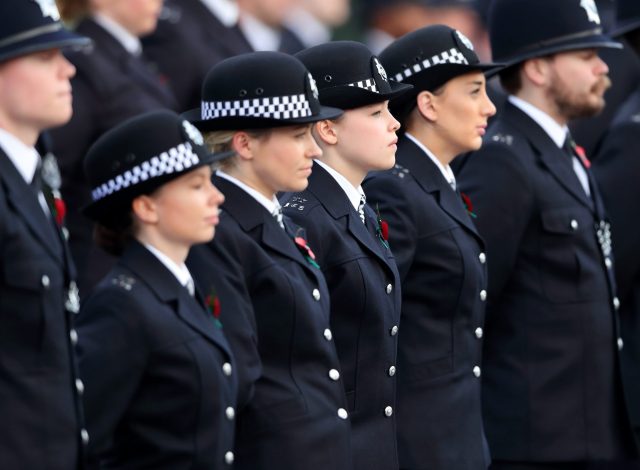
(Credit: Max Mumby/Indigo/Getty)





In February, Detective Constable Rachel Fletcher helped secure the conviction of the predatory pedophile Ross Jackson, who was jailed for 23 years for a catalog of child sexual abuse offenses. What no one outside court that day knew was that Fletcher had already been removed from public-facing duties as she was herself under investigation for gross misconduct. Northumbria police had nevertheless asked her to return to the case — “through gritted teeth”, in her telling — because without her the prosecution risked collapsing.
Six months later, she was sacked. “I’m now on the barred list alongside Wayne Couzens and multiple rapist David Carrick,” she tells me.
Her crimes, though, were of a rather different order: remarks deemed sexist and transphobic. Colleagues alleged that she repeatedly referred to men in derogatory terms, regularly stating “I hate men”, “fucking men”, and on one occasion, “all men are rapists”. She also faced complaints for comments about transgender people. The allegations were upheld, and the career of a detective who spent 24 years investigating violence against women and children was summarily terminated.
Critics will characterize Fletcher’s remarks as straightforward misandry, and she herself accepts that some of what she said might be seen as offensive and inappropriate. Her defense, though, is not that the remarks were acceptable, but that they were made in the context of investigating repeated male violence against women, and that they have been judged by a disciplinary standard not consistently applied elsewhere.
The vast majority of male perpetrators of domestic violence and stalking are never arrested — let alone convicted. Just as shockingly, the Government’s early-release scheme will apply to those few who were jailed; soon, these dangerous men will be let loose to continue their war of attrition against their victims. In the meantime, a police officer who put heart and soul into protecting victims of the most heinous crimes has been sacked for hurting the feelings of male colleagues.
Why, then, was Fletcher deemed to be such a significant disciplinary problem?
Partly, this was because she was an outlier in the force — a woman of low rank who nevertheless spoke out against self-ID and what she saw as dangerous practices within the police (including the controversial ruling on strip searches for transgender individuals). She was chair of Northumbria Police SEEN, an independent body set up by women in the force in order to challenge sex discrimination and uphold the rights and protections that relate to sex, as set out in the Equality Act 2010. Her forthright approach to these matters, she believes, set her at odds with the DEI squad.
“From the beginning of this process,” she tells me, “it has felt like they wanted rid of me. And mainly because I do not hold the views of the force about gender ideology. I have been very clear that I believe self-ID is a disaster, and that gender ideology in general is anti-women.”
Context is everything, though, and Fletcher’s determination to speak out was all taking place as the entire police force embraced Diversity, Equality and Inclusion (EDI) policies and training. As Dominic Adler stated in his investigation for UnHerd: “Fantasies of inclusion are colliding with the brick wall of reality”. Indeed, Northumbria Police, in particular, has been criticized for taking its trans rights ethos too far, being seen to take a side in a highly politicized, deeply contested social issue, while internally admonishing those who refuse to toe the accepted line.
Fletcher’s first “crime” was to express her views about how prevalent woman-hating is across society following Sarah Everard’s murder in November 2021. Some male colleagues, we subsequently learned, became “upset and offended” when she said that the only way to stop night-time rape is to put a nine-o’clock curfew on all men.
“I am upset that Sarah Everard was raped and murdered by a police officer,” she tells me in response. “It happened because of misogyny, and that’s the problem that they should be looking at, not me talking about it.” It’s worth recalling that police did suggest a curfew at the time — just one for women.
The next time she ran into trouble was in March 2023, when she complained about online training materials that had been issued as part of the EDI force strategy. One was a TED talk by Sophie Cook, a trans activist and TV newsreader. “He was talking about how he transitioned and how when he was feeling suicidal, he went and bought some make-up, and everything was better after that.”
Fletcher sent emails complaining about the Sophie Cook material. In the emails, she stated that it was offensive and misogynistic for men to claim they know what it’s like to be a woman. She explained in her complaint that she feared the force would “sleepwalk into self-ID, which would be a disaster”. Of particular concern to her was trans-identified men arrested for rape being recorded as female. “How would this work,” she points out, “with our research policy, and our crime recording?” It would completely skew the data about male violence if these were deemed to be female crimes.
Fletcher also complained about a presentation on “The power of pronouns”, delivered by a trans man and another member of the DEI team. Attendees were warned that refusal to use preferred pronouns would cause harm. Again, these were sent by email. And each time, Fletcher says she received an acknowledgment promising to review her complaints and come back to her. “But they never did, they just reported me to Professional Standards.”
When she was finally told by her sergeant that there had been complaints made against her, which would be investigated, she said out loud, “God, this is ridiculous. I’m getting done by the fucking rainbow unit!”
One complainant in the case who was in the room when she made that comment is PC Kevin Thompson, who is gay, and a passionate ally of trans people. In his statement for the tribunal he claimed that: “As a man working in that environment, I felt quite intimidated by her radical views.” It is probably noteworthy that, at the time, he insisted he wasn’t offended, and, indeed, continued to say as much until the gross misconduct disciplinary was being constructed. At that point Thompson, along with various others who had not felt moved to complain when offense was caused, suddenly decided to go on the record.
Given that the police service is now recognized as one of the most institutionally misogynistic institutions in the land, it is ironic that a woman with previous exemplary service has been sacked for making off-the-cuff remarks about male violence and women’s rights. As Fletcher puts it: “Without doubt, these trumped-up allegations came about because the entire force has been captured by gender ideology,” says Fletcher. “They went on a massive fishing expedition to gather as much dirt on me as possible so they could get rid of the big-mouthed feminist.”
The issue, then, is not whether Fletcher’s remarks and complaints were appropriate, but whether they justified dismissal when allegations of far more serious misconduct by male officers have often been dealt with less severely. Of the almost 1,000 officers facing formal internal proceedings for police perpetrated abuse, over half had their cases addressed in standard misconduct meetings — rather than gross misconduct tribunals — and so were protected from dismissal. Indeed, Northumbria police seems to be a textbook study of misogyny in the force. We learned, in 2024, that 64 Northumbria Police officers had been accused of sexual or domestic abuse in the previous four years. And, back in 2015, the chief constable, after also being accused of “rudeness”, claimed that she was treated differently because she was a woman.
It was the same story with Fletcher. “I was sacked because I challenged their unlawful conduct and their discriminatory conduct,” she claims. And she goes on to describe how not one colleague reported her at the time. They were all spoken to later on by a senior officer who was collecting “dirt”, mindful of the fact that Fletcher was repeatedly raising the fact that Northumbria Police has a huge problem with women.
If Fletcher sees her case as a witch-hunt, her fight is not over. She is preparing for an employment tribunal against Northumbria Police on the grounds of belief discrimination, and she will rely on the Forstater ruling, which held that gender-critical views deserve legal protection.
It’s hardly a ringing endorsement for any women considering joining the force. As Fletcher puts it in characteristically robust fashion: “I feel like I’ve been in an abusive relationship with my employer for about the last five years.” What woman would willingly sign up for that?
Julie Bindel is an investigative journalist, author, and feminist campaigner. Her latest book is Lesbians: Where are we now? She also writes on Substack.
 bindelj