




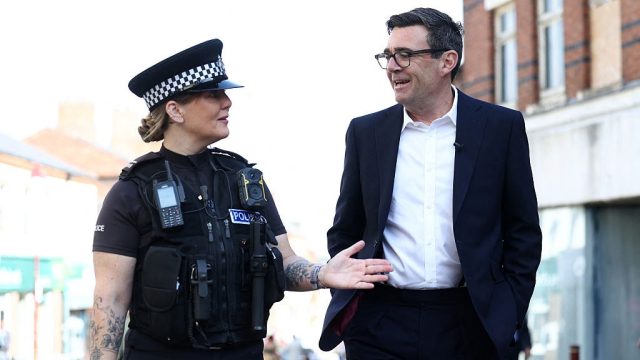
“In Burnham’s administration, I see too much of the same arrogant culture that characterized previous governments.” (Toby Shepheard/Pool/ AFP/Getty)





“Here we go again!” That’s what I find myself thinking as I watch the latest “confusion” surrounding the early release of serious sexual offenders and murderers. Another headline. Another announcement. Another promise. Then, within days, another clarification, as it becomes clear that the “experts” making the announcements hadn’t fully understood the law to start with.
The recent case of Shabir Ahmed, ringleader of a Rochdale grooming gang, illustrates the problem perfectly. His victims were repeatedly told he would be deported upon being released from prison, only to discover that a decades-old legal provision meant this had never actually been possible, with the Government scrambling to find a work-around. And now, we see the same pattern over early release. Grand announcements are made, that serious child sex offenders will not leave prison early — only for the public to discover that the law excludes offenders whose crimes were committed before 2003.
Surely the lawyers and ministers making these high-profile announcements should know the law before standing in front of the cameras? After all, these are hardly obscure technicalities that emerge from nowhere. They are fundamental legal provisions that should already be understood. Though perhaps we shouldn’t be too surprised that when Whitehall concocts policy on the hoof, reality is quick to catch up.
All this does more than expose incompetence. It also erodes public confidence in the Government and criminal justice system, with the wider public left wondering whether anyone in power actually knows what they are doing. I certainly wonder it too.
In the end, though, this is about more than politics. For survivors of child sexual exploitation, every announcement raises hope, every reversal destroys it, and every correction creates fear and uncertainty. At the Maggie Oliver Foundation, the charity I set up to support victims of sexual abuse, we meet countless survivors struggling to cope with the constant mixed messages. Every press release, every correction, retraumatizes people who have endured more than any human being should ever have to.
None of this is new. For over a decade, I’ve watched politicians, police forces and public institutions react to events instead of planning for them. I’ve seen point-scoring replace careful thought, and comms take precedence over honest accountability. Governments appear desperate to look decisive and capable, yet too often the detail just isn’t there.
And, through it all, it’s impossible not to reflect on our new prime minister. Today, Andy Burnham speaks passionately about stopping serious sexual offenders from leaving prison early. Few would argue with his words. But where was that determination when, as Mayor of Greater Manchester, he had both the opportunity and responsibility to hold Greater Manchester Police (GMP) to account for catastrophic failures — failures that allowed hundreds of children to be abused?
The context is worth repeating here. For years, GMP dismissed victims, closed inquiries and ignored vital intelligence into the grooming-gang scourge. Between 2003 and 2014, for example, one NHS worker warned police and social services about what was happening 100 times — but was told the witnesses weren’t reliable. And when officers did investigate abuse, they often went for easier convictions with lower sentences. In one case, a rapist got a 13-year-old child pregnant, yet was out of prison in less than three years.
In the aftermath of these horrors, the Operation Augusta Review, focused on South Manchester, as well as a separate Rochdale Review, studied what went wrong. Both were set up by Burnham in his role as Greater Manchester’s Police and Crime Commissioner, while I myself was heavily involved too, and overall found them to be thorough pieces of work. Not that Burnham could have done much about that: using my years of experience as a GMP detective, I had already put most of the evidence in the public domain, not least in my book Survivors. Denying what happened simply wasn’t credible.
The report into the abuse in Oldham, however, was very different, and in my opinion represented a genuine cover-up. But because I hadn’t worked in the town, I was unable to really object. Yet when, in 2025, the fourth and final “Assurance Review” was published — suggesting that lessons had been learned and the system was now working — I was appalled.
The report totally failed to include the voices of a single victim or survivor. That should have rung alarm bells from the outset, and at the time I fought fiercely to persuade Burnham that this just wasn’t right. How, I asked, could you meaningfully assure the public that the system is working better today without listening to the survivors actually experiencing it?
When challenged, Burnham personally told me that His Majesty’s Inspectorate of Constabulary (HMIC) — the body meant to oversee the police — had greater powers than the original independent review team. But that misses the point: greater powers cannot replace victims’ voices. More than that, some survivors had engaged with the review process since 2017, trusting it with deeply personal experiences and helping expose what had gone so catastrophically wrong. To then exclude them from the Assurance Review was, in my view, indefensible.
Besides, whatever Burnham’s claims about the HMIC, that still meant expecting one public body to mark another’s homework, even as the very people who could tell them what was happening on the ground were excluded.
Gary Ridgway and Malcolm Newsam — safeguarding experts who worked on the first three reports for six years — understood this completely, and I fought alongside them to keep victims’ voices at the heart of the process. For well over a year, we tried to achieve that. But ultimately we failed. Gary and Malcolm then took the principled decision to resign rather than putting their names to something they couldn’t support. Their departure was a real loss: two highly experienced professionals who’d earned the trust of victims and were ready to stand by their principles.
Whatever the review claims, I know that issues remain. And this, I think, is where the real hypocrisy lies. Every day at the Maggie Oliver Foundation, we continue to support survivors who face poor and incompetent investigations, inconsistent decision-making, inadequate communication, and institutions that still become defensive and secretive when challenged. Yes, problems have in some respects been tackled. But anyone suggesting they’ve actually been solved is either mendacious or delusional.
Yet if Burnham is clearly part of the issue here, what concerns me even more is that he’s just the latest “face” of a faceless establishment. Governments come and go. Prime ministers change. Cabinet ministers are reshuffled. But the machinery behind them often remains remarkably unchanged. In my opinion, we still have a system dominated by powerful officials, “men and women in gray suits” working behind the scenes, people the public rarely see and who are almost never held accountable when things go wrong. Different politicians front the cameras, but many of the same institutional instincts remain.
Of course, some will say things have changed, because we now have a new prime minister. And, to be sure, the style has changed since the days of Keir Starmer, and the language too. But I am far more interested in outcomes and results — and, in Burnham’s administration, I see too much of the same arrogant culture that characterized previous governments, Conservative and Labour alike.
What is new is that fewer people are willing to accept the status quo. Of course, victims have been telling their stories for decades, even if the media discusses their stories as if they’re totally new. The difference now is that those in power are far more exposed. Social media and investigative journalism make it much harder for institutions to control the narrative. Carefully managed public relations can no longer conceal horrific truths in the way they once did.
But what gives me hope are the survivors themselves. For too long, they were ignored or dismissed, while institutions closed ranks and protected their own. Today, however, victims are increasingly finding their voices, refusing to accept half-truths and vocally demanding accountability without fear.
That is a profound change, and it can only be a good thing. If I have played even a small part in moving this conversation forward over the last 13 years, then I’m immensely proud. Not because it’s been easy — it hasn’t. Not because it’s made me popular — it certainly hasn’t. But simply because every step forward has been driven by survivors who refused to stay silent, who trusted me with their stories, and who have shown extraordinary courage in demanding the justice they should have received years ago. And no one, let alone Andy Burnham, can take that away from them.