




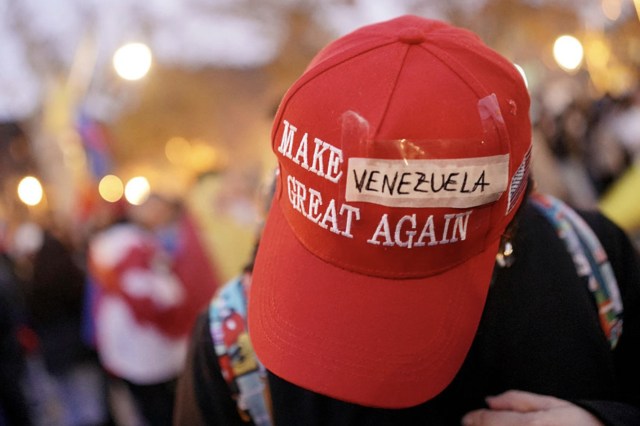
Trump's scheme to annex Venezuela had historical precedent. Credit: Getty





“American dominance of the Western Hemisphere will never be questioned again,” declared the US Department of State in a new video explaining the Trump administration’s embrace of the Monroe Doctrine, which commanded an American regional sphere of influence. Tellingly, this tribute to empire was narrated by 35-year-old Kevin Marino Cabrera, US Ambassador to Panama — and proud son of Cuban immigrants, hardly a WASP diplomat of the State Department’s traditional “pale, male, and Yale” variety. Marino Cabrera is the flesh-and-blood legacy of the events the video celebrated: America’s invasion of Cuba during the Spanish-American War and its handling of the Cuban Missile Crisis. He is a living sign of the United States’ long imperial entanglement with Cuba.
The more the United States comes to dominate Latin America, the more Latin Americans will come to dominate the United States.
Earlier this year, President Trump was taken with the idea of making Venezuela the 51st state. Such threats to annex portions of the Americas have become almost routine: Canada, Greenland, the Panama Canal, and now Venezuela. Previous US expansion schemes failed in Baja California, the Yucatan, Cuba, the Dominican Republic, and even Quebec.
Yet it is worth dwelling on what an American Venezuela would mean for the United States. The Bolivarian Republic has a population just shy of 32 million people. As the 51st star on the American flag, it would be the second largest state in the union by population, behind only California and just ahead of Texas. Allocated a fair number of electoral college votes, it would overnight become the decisive swing state in any US presidential election, with more people than Michigan, Wisconsin, and Ohio combined.
Presiding over the greatest expansion of US citizenship to a Latin American population ever would be an ironic outcome for MAGA. By comparison, the Reagan Amnesty of 1986 extended a pathway to citizenship to fewer than 3 million undocumented immigrants, predominantly from Latin America. The Trump administration is currently trying to strip 600,000 Venezuelans living in the United States of Temporary Protected Status, a legal category that protects foreign nationals from deportation but does not offer a pathway to US citizenship. To then turn around and offer it to 32 million Venezuelans, who would then presumably be free to move across state lines, would be unexpected to say the least.
Assuming any deeper thought has been put into it, perhaps the kind of US citizenship envisioned for Venezuelans in this hypothetical 51st state is a second-class variety. This was the experience of the newly minted Mexican-Americans created by the 1848 Treaty of Guadalupe Hidalgo, which ended the Mexican-American War and put the territories of New Mexico, and California under US control. The former Mexican citizens lost much of their land to white settlers during the Gold Rush, and were not able to call on the rule of law to defend themselves. De facto second-class status is already the case for US citizens of Latin American origin today, thanks to the Trump administration’s deportation policies and its reliance on racial profiling, a reality that has been driving an ever-growing number of Latinos away from Trump’s political coalition. Perhaps he simply hopes to create in Venezuela a population of US-citizen Latinos who would still like to vote for him.
In reality, the annexation of Venezuela is highly unlikely. Venezuelan President Delcy Rodriguez has been accommodating to Trump since the US capture of her predecessor, but even for her, the prospect of complete annexation seems a bridge too far. The prospect of a prolonged counterinsurgency is probably unattractive. Indeed, guerrilla resistance was a major factor in protecting Mexican territory in Baja California, Sonora, and the Yucatan Peninsula from annexation by the United States during negotiations for the Treaty of Guadalupe Hidalgo. Members of Congress were also opposed, not just liberal opponents of the war, but also white supremacists. As slaveholder Senator John C. Calhoun of South Carolina put it: “Are we to associate with ourselves as equals, companions, and fellow-citizens, the Indians and mixed race of Mexico?” There’s probably at least one Groyper in the White House wondering the same about Venezuela right now.
Yet, it is worth acknowledging that becoming US citizens would suit many Venezuelans, Cubans, and Mexicans just fine. Many risk life and limb merely to work in America, even without the hope of becoming citizens. As unhappy as Puerto Ricans are with their commonwealth status, at least they can move to New York City or Miami at will, and vote the moment they get there. Many Latin Americans are envious.
Furthermore, decisions that dramatically impact Mexico, Cuba, and Venezuela are being made in Washington every day. Everything from Mexico’s security policy to Cuba’s ability to import oil is being decided by the White House. And Nicolas Maduro, nominally the head of a foreign state, is being treated not as a prisoner of war, but as a common criminal arrested under US law, and charged in a Manhattan court. If the lives of Cubans, Venezuelans, and Mexicans are going to be shaped by the US presidency and their sovereign leaders subject to US laws, wouldn’t it be fair if they at least got to vote on it?
Many more millions of Latin Americans will indeed get to vote. Whether naturalized immigrants or their far more numerous US-born descendants, they are already one of America’s largest voting blocs. The first Latin Americans to obtain US citizenship at scale were the conquered Mexicans of the Southwest. Millions more Mexicans would later migrate north into the former Mexican territories, often actively recruited as cheap labor to work in the extractive industries of the American West. American military conquest similarly created the other large and permanent US-citizen population of Latin Americans when it annexed Puerto Rico after defeating Spain in 1898. If you are unhappy that Alexandria Ocasio-Cortez is eligible to run for president, blame President McKinley.
Meanwhile Cuba, while not formally annexed, was subjected to near-total US economic and political control, a quasi-colonial reality only broken by Fidel Castro in 1959, though Trump is now attempting to reverse the outcome. The political and economic entanglements with Cuba created a vast Cuban diaspora in the United States, even before Castro came to power. For example, Marco Rubio’s parents came to Florida not as political refugees but as economic migrants two years before the Cuban Revolution.
In more recent history, US trade policies like NAFTA created dislocation and job loss in Mexico’s agricultural heartlands, at a scale similar to the destruction of the Midwestern Rust Belt. Millions of Mexicans headed north to build new lives in the United States, very belatedly meeting the hopes of the Spanish Crown in the 16th, 17th, and 18th centuries to settle its vast North American empire with Catholic Spanish-speakers. And these pioneers in the 1990s and 2000s largely remain in the United States today, excluded from citizenship, essential for our economy, and having in most cases already produced US-born offspring. They are increasingly joining electoral populist revolts of both the Right and Left — and have proven to be open to Trump’s pitch. Yet if you deport their parents, they have the ability to punish you at the polls.
Despite its recent Latino support, Trumpism first emerged as a backlash to the post-NAFTA wave of mass Mexican migration. Earlier Anglo-American backlash, such as the state-level efforts of Proposition 187 in California or Senate Bill 1070 in Arizona had already made immigration the defining conservative issue in the American Southwest, an issue that ultimately helped shift both states blue. The restrictionist tendency has found its champion in Trump. Yet the US has already become a Latin American country in ways the Trump presidency is unable to reverse. And this would still be true if every undocumented immigrant were somehow deported tomorrow.
The United States is already home to more native Spanish-speakers than any country other than Mexico. Latin American cultural influence abounds — the Bad Bunny performance at the Super Bowl was remarkable precisely because of how mundane it was. And the American Right itself is ever more Latin American. In 2024, Trump won his second term in large part because of historic levels of Latino support. Marco Rubio, the first man since Henry Kissinger to simultaneously serve as both National Security Advisor and Secretary of State, records tributes to the United States’ distinctly Hispanic and Catholic roots. The Border Patrol agents who shot Alex Pretti in Minneapolis are both Mexican-Americans. Hispanic authoritarians from Bukele to Pinochet to Franco are figures of open admiration in many corners of the American Right. The infamous Nick Fuentes is proud of his Hispanic heritage. In Donald Trump’s America, even our Nazis are Mexican!
Geopolitically, a US shift away from Europe and towards Latin America is also a defining feature of Trump’s second term. The White House endorses presidential candidates in Latin American contests as routinely as if they were governor’s races in a US state. And often, the MAGA label is attractive to voters in Honduras, Argentina, Colombia, and elsewhere in Latin America. Rubio’s “Americas First” foreign policy — experienced by Latin Americans as bullying and Europeans as abandonment — can nevertheless be read as Washington finally realizing exactly where it is and who it shares the continent with. The rumored possible shift in the US position on the Falkland Islands — from backing Britain to backing Argentina — should be understood as merely the geopolitical manifestation of America’s increasing Hispanization. The United States today is as much part of Latin America as it is the Anglosphere. It is, in Trump’s words, “OUR hemisphere.” And the more Latin America belongs to the US, the more Latin American the US will become.
It’s already happening. For Anglo politicians from the Southwest like Beto O’Rourke or George W. Bush, the ability to deploy Spanish is now an indispensable part of retail politics. Down the class ladder, white guys aspiring to work anywhere from a kitchen to a construction site need to pick up a fair amount of español just to talk to the other guys. Even Pope Leo, the first American Pope, is really more of a Latin American, admitting he would prefer to root for Peru in the World Cup over the United States. The pontiff is simply the highest-profile example of the reverse assimilation into Latinidad that will become an ever more common part of 21st-century American life.
It is natural then for both Republicans and Democrats to want to elevate Latino candidates to win over an increasingly Latino electorate. Based on recent 2028 polling, New York Rep. Alexandria Ocasio-Cortez is a frontrunner for the Democratic presidential nomination, while Secretary of State Marco Rubio is a frontrunner for the Republican one. The 2028 campaign for the White House could well be between a Miami Cuban and a Bronx Boricua. That’s what a Monroe Doctrine gets you.
A Latino-on-Latina presidential contest in 2028 would be an objectively funny way to finally bring the Trump era of American politics to a close. A political movement which began with “Build the Wall” as its defining slogan and has lately devolved into “annex Venezuela” was never going to reverse centuries-long migration and demographic patterns. Whether these changes usher in a Lusotropical Neoconservatism or a Mestizo Socialism remains to be seen. Yet the arc of the moral universe is bending inexorably towards Latinidad. This may be the future that MAGA deserves: oprime 2 para inglés.
Antonio De Loera-Brust is the communications director for the United Farm Workers. Previously, he served as a special assistant to US Secretary of State Antony Blinken.
 @AntonioDeLoeraB