




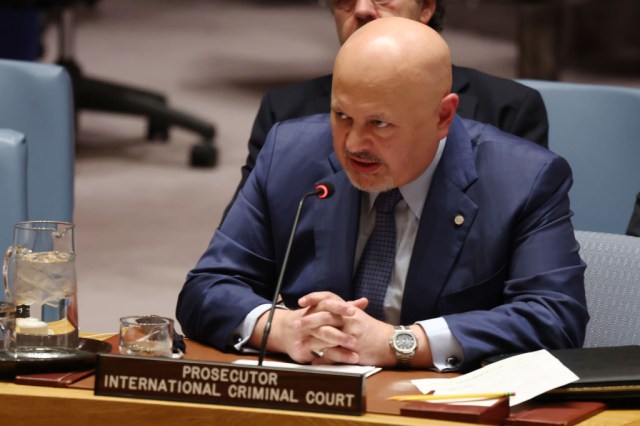
ICC prosecutor Karim Khan has been accused of “adult grooming,” leading to his resignation. Credit: Getty





There is a good case to be made that “international law,” as it presently exists, is a tangled mess of conceptual nothingness. And that the supranational institutions that purport to be predicated upon it are best ignored or abolished — especially the welter of commingled NGOs, which often seem to accomplish little other than incubate blinkered ideological trends for people with superfluous graduate degrees.
So there might be a temptation to cheer the latest crisis at the International Criminal Court, which throughout its short existence has been the prime locus of “internationalist” legal folly. Karim Khan, the court’s chief prosecutor, was expelled from office July 24, following a two-year saga shrouded in convoluted bureaucratic mystery. Ostensibly centered on allegations of sexual impropriety, they were always really more like allegations of allegations: the nature of what was even being alleged is still a morass of murk, at least insofar as any scattered details have been publicly disclosed.
The drama has been made all the more inscrutable by the “ad hoc” bureaucratic rigmarole set up to adjudicate these “allegations,” with oversight opaquely passing back and forth between an internal ICC disciplinary unit, an enigmatic ICC administrative body, a hazily affiliated division of the United Nations, an improvised secret judicial panel, back to some non-specific ICC limbo, and then finally to the “Assembly of States Parties” — thought to be the ICC’s supreme governing authority, which proceeded to terminate Khan, albeit based on authorities that hardly anyone could seem to quite ascertain, not least Khan himself.
As his day of preordained reckoning drew near, Khan remarked that “in terms of the procedure” put forth to eradicate his career and reputation, even he was being kept assiduously “in the dark … I mean, it’s amazing.” So here was one of the foremost expositors of “international law” — who had just earned rapturous applause from “international-law” enthusiasts the world over for orchestrating a series of “arrest warrants” against the likes of Benjamin Netanyahu and Vladimir Putin — marveling that even he had no clue what ad hoc methods had been devised to exact punishment on him for offenses he steadfastly denied, and which had only been the most faintly articulated. Khan was only able to learn of the latest developments, he said, “from the media,” and from “speculation.”
The ultimate claimed basis for Khan’s removal? Certainly not any somber acknowledgment of the failures of “international law,” following a sustained period of careful self-examination. Instead, of course, it was some multi-dimensional sexually implicative “adult-grooming” scandal — the core offending conduct of which remains almost indecipherable to the untrained eye, and only made putatively scandalous by the very same blinkered pathologies that have come to pervade liberal-Left NGO culture.
While Khan’s alleged wrongdoing has been widely referred to in media reports as centering on accusations of “sexual misconduct” or even “sexual assault,” a recent lengthy CNN interview with the central accuser — a putative lawyer in her late 30s named Sarah Hishan — failed to elucidate with any tangibility what, in fact, she was even accusing Khan of doing wrong, beyond transgressing the latest nebulous frontiers of “consent” and “power imbalance” theory — the bleeding edge of which one would expect to find marinating in workforce environments such as the ICC.
Khan objected, reasonably enough, to the make-it-up-as-you-go-along nature of the proceedings that were initiated against him, starting in April 2024, when they were supposedly prompted by the 39-year-old’s unveilment of her sexual-grievance story. One might even say there’s an element of karmic justice in his banishment, as “international law” is nothing if not a thoroughly make-it-up-as-you-go-along enterprise. But with Khan’s ensuing downfall, the tactics brought to bear against him have received an outsized boost of validation — which could mean similar tactics may well soon be coming to an institution near you.
It’s nearly impossible to circumnavigate the organizational, political, and personal factors that seemingly gave rise to this two-plus year debacle, but one factor that’s been less examined might simply be the most bog-standard of factional workplace resentments, which, as they are increasingly wont to do circa 2026, always find a way to inevitably escalate into vague imputations of sex crime.
Media leaks in an earlier phase of the saga tried to contextualize the genesis of the “accusations” by reference to Khan’s underlings declaring him “an unpopular boss,” who “ran the office [of the prosecutor] as a top-down operation,” and who imposed what some of them apparently saw as “controversial policies” — such as the “requirement that staff working on a particular case be based in the field.” That is, a requirement that ICC employees charged with investigating “international law” violations in far-flung places like Mali or the Philippines have to actually go and work in those places, rather than “Zooming” in remotely from their comfy work-at-home stations in Bezuidenhout or wherever. That this was apparently so “controversial” to the rising generation of “international law” advocates may speak to the general empirical soundness of “international law” fact-finding, or lack thereof.
One strangely open question — which, in a way, crystallizes the entire affair — is to what degree the main accuser, Sarah Hishan, can even be correctly described as a “lawyer,” as the CNN headline accompanying her July 16 interview labels her, as have innumerable other media reports. Inasmuch as the word “lawyer” connotes a person professionally accredited to practice law in a particular jurisdiction, there is scant evidence to indicate this label should properly apply to Hishan, who has conspicuously demanded anonymity for her media interviews, which the journalists conducting them have invariably granted without any real explanation.
While an online bio attributed to her states that she “completed the Bar in England and Wales,” Hishan does not appear on the Barrister’s Register or Solicitors Register maintained by the Bar of England and Wales. Her LinkedIn page — which she seems to have recently amended to partially anonymize herself — suggests she was enrolled more than a decade ago in something called a “Bar Professional Training Course,” administered by something called “The University of Law” — a for-profit educational venture located in Britain.
Other than this, there is no sign she has “completed” any conventional lawyering licensure. An email sent to the ICC public-affairs office, requesting clarification as to whether Sarah Hishan is currently admitted to practice law — in either Britain, Malaysia (her country of origin), the Netherlands (her country of residence as an ICC employee), or any other country — has not been returned. (That she has seemingly drawn a full ICC salary from April 2024 to present, ever since she ignited the ICC’s slow-rolling immolation, only adds another layer of self-defeating irony to the whole ordeal.)
Hishan does claim various other professional certifications — including a two-day “e-learning” course on “genocide” in 2022, another two-day 2022 “e-learning” course pertaining to “international law and the conflict in Ukraine,” and yet another two-day “workshop,” this one seemingly in-person, held by the Interagency Diversity and Inclusion Network in 2020, from which she was duly certified as completing a “training of trainers,” which thenceforth empowered her to become somebody who could purport to deliver “Gender, Diversity and Inclusion trainings to staff members working for international organizations in The Hague” — with an emphasis on concepts such as “disabilities” and “mental health.” This novel certification, perhaps more than anything else, provides the most clarifying window into her professional background, and her stem-winding odyssey in the field of “international law.”

Some skeptical observers have been keen to emphasize the presumed role of Israeli sabotage in engineering Khan’s defenestration, and there is no doubt the ICC arrest warrants he announced in May 2024 against Netanyahu and former Defense Minister Yoav Gallant provoked intense animus from Israel’s impassioned supporter network, which was then happy to seize on any perceived Khan vulnerability that may surface. But if there was a “conspiracy” afoot, it lies in plain sight. With or without any Israeli involvement, organs of “international law” such as the ICC, not unlike culturally harmonious organizations such as the Democratic Party, are more than sufficiently susceptible all on their own to these spiraling cycles of shambolic collapse the moment some sexual impropriety can be conjured or alleged, no matter how abstruse the core “allegations.”
Of course, it is true that the Jewish state, at least in the person of Netanyahu, would exploit any “allegation” that could be contrived to cast doubt on the credibility of a prosecutor who had generated enormous worldwide publicity by charging top Israeli officials with crimes — as would any defendant charged with crimes, should their prosecutor have liabilities emerge. So it’s no surprise career Israel backers and Netanyahu emissaries like the late Sen. Lindsey Graham went around whipping up whatever “accusation” whispers they could to undermine the ICC’s prosecution process. Newly released audio and video footage from an unfinished documentary, as reported in The New York Times, reveal Graham strategizing by phone with Netanyahu just before the 2024 presidential election as to how they could best amplify the “sexual-misconduct” rumors, as if Graham and Bibi were deeply concerned for the welfare of Hishan.
Netanyahu even indulged in some strategically inflammatory sex talk himself, telling the website Breitbart in August 2025 that a then-anonymous woman in Khan’s office had accused him of “raping her and sexually assaulting her for over a year.” This turned out to be a total load of hogwash, as the woman herself eventually explained to CNN that she has expressly declined to “put a label” on the conduct she was allegedly victimized by, including when someone once asked her directly if she had been raped — an episode chronicled by UN investigators who took charge of the Khan inquisition in November 2024, and eventually leaked to CNN’s Christiane Amanpour. The woman’s reasoning, she told Amanpour, was that “I am not a lawyer in this. Even though that’s my profession” — and so “It’s not my place to label anything.”
No one has to propose any sprawling clandestine “conspiracy” to note the obvious exploitability of the “ad hoc” adjudicative process concocted to determine Khan’s fate, which rested with a quasi-legislative “international-law” assembly convening in a nondescript chamber in New York City. For one thing, the final expulsion vote was conducted by secret ballot, thanks to an inexplicable provision of the original Rome Statute that established the ICC.
If the end-result of the cockamamie “international-law” tribunal was influenced by a desire among certain ICC member states to placate their American hosts in the Trump administration, this would only be surprising as cold political reality, whatever the egalitarian-flattening pretensions of the high-minded “international-law” theorists who drafted the ICC’s founding documents. US primacy has certainly remained in full force since the ICC started operations in 2002, as evidenced in miniature by the ICC governing body continuing to be physically housed in the United States, despite steadfast US refusal to join the ICC, and dare surrender any of its sovereignty to “international law.”
Perhaps the current Trump administration’s attitude on the Khan question was a political variable that these “Assembly” members, operating in an expressly political capacity, might have foreseeably taken into account as they pondered the proper recourse for Sarah Hishan’s weighty “allegations.” Khan had already invited a simmering fury for his breach of bipartisan understandings — which he had carefully cultivated with the Biden administration, and even Senate Republicans — with the allegedly “rushed” May 2024 application for arrest warrants he brought against the top Israeli officials. (Three senior Hamas officials were also charged on the same occasion, reflecting Khan’s attunement to political sensitivities, but this had no material effect in terms of dampening the fallout.)
Then soon came an incoming Republican administration already primed for baseline ideological hostility against the ICC, and which had been given all the more reason to go scorched earth. As he barreled in for his second term, Trump wasted no time imposing maximum reprisals on the ICC and Khan individually, sanctioning him by name as one of his first orders of business on Feb. 6, 2025. Among other things, this sanction appears to have barred Khan from physically attending any of the disciplinary proceedings related to him in New York, not to mention cutting him off from the US-controlled international financial system — “international law” be damned. Bank accounts frozen, no more credit cards, and travel overall severely limited. Other ICC officials were then hit by Trump-backed sanctions several months later.
Given this fraught political situation, one could easily see the faction of ICC member-states in the US-supplicating orbit — say, the EU-NATO bloc — having an interest to retain whatever favorable standing they could with the mercurial Trump. As such, these countries could have been particularly peeved with Khan for the wholesale US assault on the ICC his actions seemed to have precipitated — an especially wrenching turn for the countries that had optimistically watched a growing US-ICC truce.
Since the invasion of Ukraine, Washington had been turning toward a gradual but non-trivial embrace of the ICC, after decades of scathing antagonism. Suddenly, the US and ICC found themselves happy to set aside old differences and collaborate on going hard after Russia. Even eminent Republican congressional figures such as Graham — who previously would’ve been known as among the ICC’s most boisterous haters — were glad-handing with Karim Khan during the Biden years, a detente clearly stemming in part from the concerted effort undertaken by Khan himself to smooth relations with both Republicans and leery Democrats.
These efforts had seemingly paid off, as bipartisan 2022 legislation authorized US officials to “render assistance” to the ICC in an anticipated prosecution of Putin, by placing him in the same category of unique evildoers as Saddam Hussein, Osama bin Laden, and Slobodan Milošević, whereby America would allow an exception to the standard prohibition against any US collaboration with the ICC. Long gone were the days when Graham & co. had championed an infamous law that could theoretically authorize a US military invasion of the Netherlands, in the event that any American servicemen were ever scooped up and brought to The Hague.
But in this new Ukraine-heady period, the US presidential administration was being led by reverential devotees of Rules-Based International Order. Joe Biden and Antony Blinken had already seen to it that executive order(s) from Trump’s first term, which even then had slapped the ICC with retributive sanctions, were revoked almost a year before Putin aroused the flames of liberal-internationalist fervor all the more epically by invading Ukraine.
Bolstered by this period of glorious bipartisan unity against Russia, and thus an improbable upsurge in official US-ICC tolerance under Karim Khan’s tutelage, Biden and the Democrats did all they reasonably could to keep the momentum going. In April 2023, Attorney General Merrick Garland even dispatched a DOJ prosecutor to The Hague to provide the ICC with “significant resources,” courtesy of the US taxpayer, for use in a multitude of “ad hoc” efforts aimed at activating otherwise-flaccid EU-based instruments of international law which might be utilized to “hold accountable” the war-making Russians, up to and including Putin himself. The prior default flaccidity of these mechanisms suddenly stiffened like magic, thanks to a virile overnight infusion of US hegemonic zeal.
But this moment of glory was soon squandered … and capped off by an “adult grooming” fiasco.
One theory goes that as the first murmurs of “accusations” emerged against Khan in April 2024, he suddenly switched tactics from steady US-ameliorating to willful US-antagonizing. No question Khan was politically astute enough to know that dropping a Netanyahu arrest bombshell would promptly upend whatever collaborative trajectory might have been in progress with his American partners — even under a Democratic administration, at least one helmed by self-proclaimed Zionists such as Biden and his secretary of state, Antony Blinken. He must also have anticipated the tentative new cohort of ICC-curious Republicans, personified by Graham, would erupt into instant vindictive frenzy. And that the reverberations were destined to extend to the faction of ICC member states that maintain allegiance to Israel, namely the EU-NATO bloc of Germany, Britain, and France (kind of) — which also happen to be outsized contributors to the ICC’s operational budget — as well as miscellaneous others like Poland (kind of), Hungary, the Baltics, etc.
So much for that brief, shining moment of Ukraine-inspired harmony!
One thing leads to another, and the next thing you know, it’s July 13, 2026 — 11 days before the scheduled vote to oust Khan — and there’s Secretary of State Marco Rubio, striding forth on behalf of the Trump administration to announce a “sweeping campaign to dismantle” what he declared was the “intolerable threat” the ICC posed to American sovereignty. (As if all those gender-diverse folx on temporary Dutch visas were getting ready to storm down Pennsylvania Avenue.) Rubio vowed “no diplomatic option will be off-limits” in this invigorated anti-ICC campaign. Meaning, it would presumably not be “off-limits” to politely encourage the ICC member states and their New York-based diplomatic reps to please consider voting to remove Karim Khan the following week. For added laughs, they could even tearfully act like they were doing it to honor “grooming” survivors.
Michael Tracey is a journalist in Jersey City, NJ. He can be found on Substack at Michael Tracey.
 mtracey