




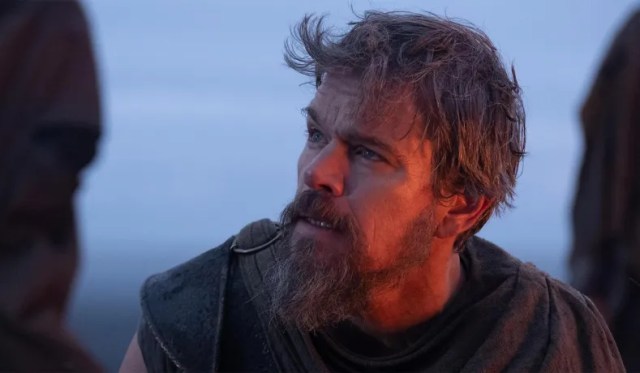
“Odysseus was deplored for his lack of scruple, his amorality, his low cunning.” (The Odyssey/Universal Pictures/IMDb)





When you hear the phrase “Ancient Greece”, what are the first words that come into your head? The names of a few great thinkers, perhaps: Plato, Socrates, Aristotle, Zeno? Or maybe some grand abstractions: democracy, philosophy, geometry, reason? If so, then you are in good company: if there is one thing everyone knows about the Greeks, it is that they forged the great systems of knowledge and philosophy upon which all Western thought depends. But this is precisely the conception you ought to put out of your mind if, like thousands of others this week, you decide to go to the cinema and watch The Odyssey.
The Odyssey does not come from the same world as the other pinnacles of Greek culture we all know and love and tweet about. For one thing, it is much older: the events it recounts take place during the late Bronze Age, around 1200 years before the golden age of Attic culture that spawned Socrates and Plato. The poem itself was set down in writing only after centuries of oral transmission — but even the written document is older than not just Plato and Sophocles, but the Persian War, the Olympic Games, and even the Archaic poets like Sappho and Alcaeus. In fact, Homer barely ever uses words that mean “Greek” or “Hellenic” at all: The Iliad and Odyssey are really about a mess of tiny, disunited Mycenaean kingdoms whose subjects wear boar’s tusk helmets and fight with bronze weapons and write, on the rare occasions that they write at all, in a complicated ideographical script called Linear B that was only deciphered in the Fifties.
No heroic figure better illustrates just how different these two worlds — the Homeric and the Attic — were than Odysseus. It is true that he was often admired by the Greeks of the Athenian Golden Age: the intelligence evinced by his ruses was impossible to ignore for such a self-consciously brainy civilization. But just as frequently, Odysseus was deplored for his lack of scruple, his amorality, his low cunning. Pindar suspected that “the fame of Odysseus is become greater than his toils, through the sweet lays that Homer sang”. Sophocles had his main character, Philoctetes, berate Odysseus for being a “shameless wretch! from whom nor truth nor justice, / Naught that becomes the generous mind, can flow”. Even Socrates, who was generally rather keen on intelligence as a virtue, stopped short of straightforwardly defending the man from Ithaca in the Lesser Hippias, preferring instead to show how his interlocutor is just as bad as Odysseus, because he is a deceiver, not of others, but of himself.
What was it about Odysseus’s intelligence that proved so unsettling to these vast, rational, civilization-founding minds? In a series of essays and books published in the Sixties and Seventies, the French classicists Jean-Pierre Vernant and Marcel Detienne offer one interesting interpretation. In the Homeric epic, they point out, the words used to evoke Odysseus’s particular kind of intelligence are very different from the words that denote intelligence in later Greek. In Plato and Aristotle, for example, the usual abstractions of choice are nous, logos and episteme — all of which suggest the faculties and forms of knowledge concerned with grasping a stable, intelligible order. Homer, by contrast, tends to use the word metis, which denotes a more practical kind of intelligence. Something flexible, unrepresentable, as variegated as the flecks of light that glint off bronze armor: the uncanny knack some people have for getting things done.
All through the Odyssey, Homer lingers over Odysseus’s feats of knowhow and craft every bit as lovingly as he does the feats of martial strength performed by Achilles, Hector, and Ajax in the Iliad. In Book 5, we watch him fell trees, bore joints and build with his own hands the raft that carries him from Calypso’s island; he steers himself across the open sea armed only with his knowledge of the stars. In Book 21, we see him string his great bow “like an expert singer skilled at lyre and song” in order to best the outrageous suitors who have colonized his house. In Book 23, we learn of his skills at carpentry, and the fact that he fashioned his marriage bed by carving it from the living trunk of an olive tree. Even the famous scar by which the servant Eurycleia eventually recognizes him is testament to his knowhow — specifically, in the distinctly non-Mycenaean art of hunting for boar.
What distinguishes these skills from the kind of airy, abstract knowledge we find in, say, Plato? Vernant and Detienne list several divergences, but perhaps the most important is the peculiar relationship metis has with its own formal representation. For Plato and Socrates, a written or spoken representation of the truth is the truth; indeed, words like episteme actually imply some kind of representation of the world. Metis, by contrast, cannot be grasped abstractly; the moment you try to write it down, or codify it, you lose it. Odysseus may be best remembered as a creator of elaborate plans, but these plans are rarely laid out before him as a nice, clear set of steps; they are always provisional, prone to being revised whenever a cyclops bars the doors to the cave you are hiding in, or the sea-god who has taken against you tears apart your raft — when, in short, reality proves to be stranger and more variable than your own ordered representation of it. In Book 13, the goddess Athena explicitly admires this quality in her champion. When she meets him in disguise on the shores of Ithaca — and begins, for what it’s worth, one of the greatest, most under-appreciated flirtation scenes in all literature — she adores the fact that he begins to lie to her without yet knowing why he is lying. He has a blind conviction that pretense might yet prove useful in future improvisations: “Here among mortal men you’re far the best at tactics, spinning yarns, and I am famous among the gods for wisdom, cunning wiles [metis] too.”
The choice of words is no accident. In ancient Greek theogony, “metis” had another important meaning. Specifically, it was the name given to Athena’s mother — the Oceanid nymph who marries Zeus in the primordial age of the Titans, before the Greek pantheon has settled into its familiar form. As Hesiod records it, after the wedding, the couple receive a prophecy. Metis will bear two children: a daughter, who will match her father in wisdom and strength; and a son, who will one day overthrow him. In response, Zeus swallows Metis whole — “put[s] her away inside his own belly … so that this goddess should think for him, for good and for evil”. The message is clear enough: power and strength are all very well; so too are patriarchal authority and abstract Apolline knowledge. But if you want to be King of the Gods, you gulp down metis, the most mysterious, unrepresentable form of intelligence of all.
It is striking, too, how many of Odysseus’s 20th-century admirers seem to single out something like metis as unusually appropriate to the modern age. Joyce, who reimagined Odysseus as an unassuming Jewish advertising agent named Leopold Bloom, always stressed that what he admired most in Homer’s protagonist was his completeness and wholeness, his ability to adapt to any task. He was, according to Joyce, “son to Laertes … father to Telemachus, husband to Penelope, lover of Calypso, companion in arms of the Greek warriors around Troy, and King of Ithaca” — all of which combine to render him the “most human” character in world literature. Over the course of Ulysses, Odysseus, in his wiliness, his adaptability, his endless capacity for reinventing himself, becomes a kind of antidote to modern alienation: by being identified with him, Bloom somehow transcends his boring bourgeois job and predictable bourgeois relationships, and becomes whole. In The Human Condition, Hannah Arendt went so far as to suggest the Homeric ethic as an anti-capitalist strategy: “In the world of Homer, Paris and Odysseus help in the building of their houses, Nausicaa herself washes the linen of her brothers, etc. All this belongs to the self-sufficiency of the Homeric hero, to his independence and the autonomic supremacy of his person.”
Nevertheless, there is something slightly unfamiliar about reading the accounts of Joyce and Arendt — or, for that matter, other modern Odysseus-fanciers like T.E. Lawrence and Derek Walcott — in the 21st century. The jury’s decision is in, and it has been decided that the Greek ideal means top-down planning, rational bureaucracy, vast sovereign efforts to make the world conform as neatly to abstract standards as possible. For Le Corbusier, Greek ideals justified razing half of Paris and replacing the curlicued old buildings with Parthenon-esque cuboids; for contemporary politicians, the grand old Greek word “democracy” is used to justify an increasingly inane and arbitrary form of abstract proceduralism. These days, the rational, modern institutions that claim to be the heirs to the Greek tradition — the halls of democratic government, the geometrical housing estates, the immaculate American universities with Greek letters on their porticoes — seem less capable than ever of producing a single individual as well-rounded, as universally capable, as polymetis, as Odysseus.
If there’s one hope I have for the wave of Odyssey-mania that is set to crest this week, it is that it might remind us that the intellectual legacy of Ancient Greece is far more mysterious than our culture likes to remember. The importance of un-representable knowledge is hard to discern in the philosophers of Golden-Age Athens — though even Plato, it must be said, put rationality in its place, giving over a good chunk of the Phaedrus is to the discussion of the revelatory power of the mania induced by poetry and sex and alcohol. But the further back you go, the clearer the mystery gets: the Pythagorean geometers guarded the secret of irrational numbers, and drowned Hippasus for revealing them to the world; the Orphic cults refused to disclose their secret wisdom to anyone who had not undergone elaborate purification rituals. But for my money, it was the earliest Greek writer of all who did it best. No-one since — in any language — has better captured the essential wildness of the human intellect, its storminess, its amplitude, that is matched only by the wine-dark sea.