




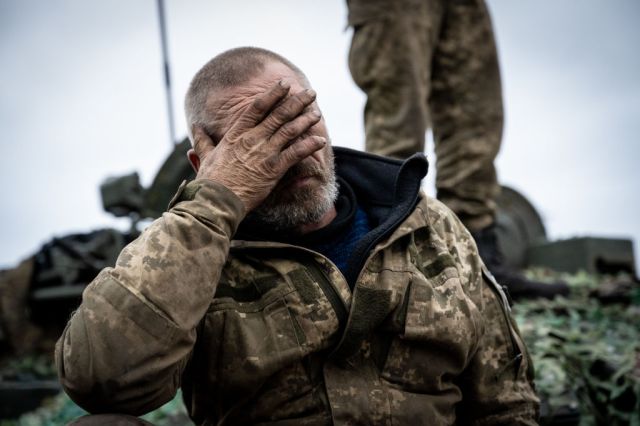
“No amount of ‘intellectual mobilization’ will be enough to contain public fury.” (Scott Peterson/Getty)





“No!” the woman cries. “May you be damned!” You can hear the despair in her voice, as masked men grab her husband, then bundle him into a waiting van. Within seconds, she’s alone, weeping in the middle of the street. This is Odesa, but scenes like it, captured on phones and posted online, hammer Ukrainian cities as relentlessly as Russian missiles. Since Putin’s full-scale invasion began, over a million Ukrainians have been conscripted to defend their homeland. And, as voluntary recruits have dried up, the army has begun resorting to the same methods faced by that couple in Odesa. People even have a term for it: “busification”.
The process is brutally simple. Draft officers, often accompanied by police, snatch military-age men off the streets, before delivering them to recruitment centers. There, many are pressured through threats, intimidation, and physical abuse to pass military medical examinations and sign draft papers. Men with serious conditions — including HIV, tuberculosis and even cancer — are routinely declared fit for service. Whether they like it or not, the recruitment officers must meet quotas; the only question is who fills them. Yet with Ukraine’s wealthy elite reluctant to heed the call, Kyiv’s recruitment crisis is becoming a class crisis too, one that could cause chaos long after the guns fall silent.
Ukraine currently mobilizes around 30,000 men each month — yet many never make it to the front. Some flee training centers at the first opportunity, while others are later discharged as medically unfit. By autumn 2025, according to official figures, roughly 300,000 servicemen had gone AWOL or deserted. The numbers have become so politically sensitive that the authorities now keep the data secret. But the direction of travel is clear: Ukraine’s pool of willing fighters is shrinking. As a result, coercion has moved from the margins to the very center of national life.
Straightforward coercion, however, is only part of the story, as mobilization becomes a social scourge too. Today’s Ukrainian army is, increasingly, an army of the poor. Members of the upper-middle class — and especially the political and economic establishment — possess the resources, connections, and influence necessary to shield themselves from military service. Through a combination of legal work-arounds and bribes, they can avoid donning uniforms for a range of reasons, from illness, to having several children, to caring for disabled relatives. Others are exempt because they’re university students or academics, or work at strategic companies, particularly those linked to the defense sector.
A significant portion of Ukraine’s cultural and academic intelligentsia belongs to this privileged group. Many have received exemptions from military service while continuing their professional activities uninterrupted. In return, the state expects ideological loyalty and intellectual labor in support of the war effort. This includes promoting “decolonization” narratives that often amount to anti-Russian ethnonationalism. It also means deliberately ignoring the deep penetration of far-Right groups into the military, and remaining silent about the normalization of Nazi symbols within parts of the armed forces. But, most importantly, it means justifying coercive mobilization as a necessary instrument of national survival in what is routinely described as an “existential war”.
A substantial number of Ukrainian intellectuals have willingly embraced this arrangement, placing themselves in the service of state interests while convincing themselves that they’re fighting on the “information front” in a war for independence from Russia. Others are motivated by more pragmatic considerations: preserving the privileges that come with exemption from military service. Still others remain loyal out of fear.
Fear, after all, is not an abstract concern. The costs of dissent have become increasingly visible. A recent example is the Ukrainian-Canadian political scientist Ivan Katchanovski, who became the target of a public campaign of denunciation by Ukrainian and Western scholars over his interpretation of the war. Katchanovski has argued for a more nuanced explanation of the conflict — one that looks beyond Russian imperialism and Putin’s ambitions to include the role of the Ukrainian far-Right, Nato, and a post-Cold War security architecture that excluded Moscow. Rather than confronting these arguments on their scholarly merits, many of his critics simply accused the scholar of spreading “Kremlin propaganda”. Whatever one thinks of Katchanovski’s views, the episode sent a clear message: questioning dominant wartime narratives can carry serious professional and reputational consequences.
Meanwhile, justifying mobilization, regardless of how coercive, violent, or degrading it may be, has become a central task of Ukraine’s liberal intelligentsia. In May 2026, for instance, the prominent historian and public intellectual Yaroslav Hrytsak argued that patriotic appeals and financial incentives alone are insufficient to sustain effective mobilization in the country. In his view, society must also rely on fear and moral condemnation. As an example, Hrytsak invoked Britain’s experience during the First World War, when women handed white feathers to men who didn’t enlist, publicly shaming them as cowards.
What is striking is that Hrytsak offered no criticism of this practice, despite its deeply controversial legacy. The white-feather campaign stigmatized not only those unwilling to fight, but also veterans, disabled men, the seriously ill, and countless others who were unfit for military service. Yet in contemporary Ukraine, this history is increasingly presented not as a cautionary tale but as a model worthy of emulation.
In reality, of course, the public shaming of men who avoid military service is already deeply embedded in Ukrainian public discourse. For example, the popular singer Alyona Alyona, who represented the country at the 2024 Eurovision, mockingly referred to such men as “Mama’s little boys” and publicly defended the harsh measures employed against draft evaders. Oleksandra Ustinova, an MP, has similarly attacked men who leave Ukraine to avoid service, arguing that the current civil penalties should be replaced by criminal prosecutions. Yet there’s an irony here. Ustinova’s own draft-age husband left Ukraine for the US after Russia’s invasion in March 2022, bought a house and a car there, and has shown little intention of returning.
There are other ironies too. In September 2024, Yaroslava Kravchenko, a celebrity TV host, published a report on male artists who had left Ukraine under the telling title “Those Who Escaped from Ukraine”. Like many women who publicly denounce supposed draft dodgers, Kravchenko herself enjoys unrestricted international travel for both work and leisure. Many other female celebrities are in the same boat. Women, after all, remain exempt from the travel restrictions imposed under martial law — restrictions that prevent millions of Ukrainian men from leaving the country regardless of their personal circumstances, political views, or willingness to fight.
This asymmetry lies at the heart of growing social tensions. Those who champion moral condemnation often do so from positions of relative safety and freedom. They can cross borders, pursue careers abroad, and retain control over their own lives. The men they shame cannot. From the very first days of the war, Ukraine has cultivated the image of the ideal man: self-sacrificing, strong, courageous, and unfailingly committed to defending his family, his home, his nation. He is prepared, if necessary, to give his life for this cause.
His opposite is the ukhyliant — the draft evader. In the dominant narrative, he is portrayed as a coward who’ll resort to any means necessary to evade what is presented as his “natural” masculine duty. Public shaming of such men has become normalized, routine, and Ukrainian media has played a significant role in this process. Flippant headlines like “Draft Dodger Stopped by a Bear at the Romanian Border” or “Grandma Draft Dodger: Odesa Man Dressed as an Elderly Woman to Cross the Border” have now become commonplace. And though Article 35 of Ukraine’s constitution theoretically guarantees the right to alternative service for conscientious objectors, that right has effectively ceased to exist. A recent investigation into the “Skala” regiment alleged that some men who refused to serve were beaten into compliance.
All the while, some Ukrainian feminists have directed their criticism at draft evaders while largely overlooking a wartime system that casts men as protectors and women as those in need of protection — precisely the gender hierarchy feminism claims to oppose. This flirtation with militaristic nationalism has left many feminists blind to the women whose lives are shattered by busification. Behind every man dragged into a recruitment van, then tortured or beaten to death by draft officers, let alone killed at the front, stands a mother, a daughter, a wife, bearing the fear, grief, and trauma that follow. But because their suffering complicates the dominant wartime narrative, this reality is largely met with silence.
A similar silence greets another group of inconvenient women — those who have become active in the grassroots struggle against forced mobilization. Gender in Detail, Ukraine’s leading gender website, has had remarkably little to say about the women standing in the way of busification. These women are threatened, attacked, prosecuted, and publicly shamed for defending relatives — or complete strangers — from recruitment vans. The courage of these women, from teenage girls to pensioners, can be seen in countless videos confronting recruitment officers and the police. Their courage is visible, their suffering documented. Yet their invisibility, in the end, is political.
That, of course, raises a broader question. With the frontlines mostly stagnant, and with the meatgrinder war annihilating Ukraine’s demographics, why is the government so intent on continuing with busification at all costs? Ukraine no longer appears to have the final say over its own future. That decision is increasingly shared with — or subordinated to — its Western sponsors, who view Ukrainian men less as citizens than as expendable military assets. The EU’s plan to refuse protection to Ukrainian men of draft age exposes this logic. By denying them refuge, Europe is effectively forcing them back to the front. Their bodies have become instruments in a larger geopolitical project: bleeding Russia. That’s further suggests that the war has become a Western proxy war against Putin. In return, Ukraine’s venal political elite, led by Volodymyr Zelensky, enjoys Western political protection — whatever the moral and legal problems with busification.
There’s another question here too. If Ukraine is being bled dry for Brussels, why not end militarization altogether? Unfortunately, those who suggest this path, advocating diplomacy or negotiations, are marginalized. When Yuliia Mendel, Zelensky’s former press secretary, told Tucker Carlson that the Ukrainian president had sabotaged peace talks with Russia, much of Ukraine’s mainstream media and a number of prominent liberal commentators responded not with debate but with a coordinated effort to discredit her, branding her a purveyor of “Russian narratives”.
Liberal intellectuals share responsibility for silencing these unwanted voices. Yet neither the state nor its intellectual allies can suppress these realities forever. Beneath the surface, they are fueling growing resentment and social anger. Every attempt to silence grievances only deepens the sense of injustice, and if the pressure continues to build, it may eventually spark a political and social explosion.
There are signs of this already. In the village of Ozero, for instance, locals blocked a military recruitment vehicle, smashed its windows, and freed a mobilized man. Elsewhere, confrontations between recruitment officers and civilians have involved dozens of people, often escalating into verbal abuse and physical violence. Attacks on recruitment officers with knives, shovels, and clubs have become increasingly common too. As the military’s manpower crisis deepens, mobilization grows more coercive — and public resistance more intense. The way things are going, no amount of “intellectual mobilization” will be enough to contain public fury.