




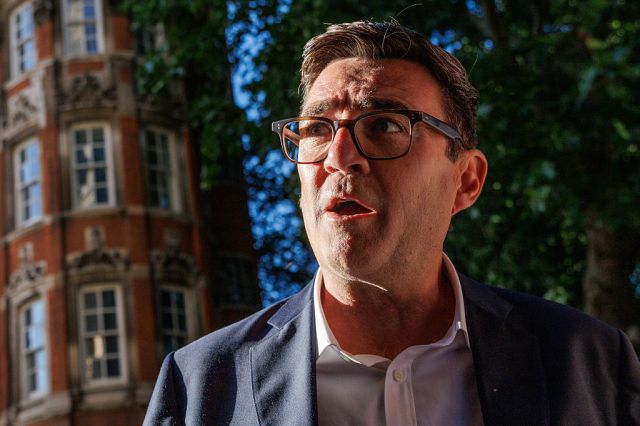
“Burnham’s story is as misleading as it is seductive.” (Dan Kitwood/Getty)





“Growth in every corner of the country”, “more money in people’s pockets”, and “people taking back control of what matters to them”: these three phrases could summarize Andy Burnham’s big idea of devolving power away from Westminster, but they are actually taken from Labour’s 2024 local election campaign. That was when another prime minister in waiting, Keir Starmer, promised “full fat devolution” to “take on regional inequality” and unlock “the pride people have in their communities”. In truth, though, those three goals could have come from any number of campaigns since the Brexit referendum a decade ago. The task of bringing power and prosperity to places beyond London’s orbit has become the sword in the stone of British politics. Burnham is not the first to grip the hilt and flex his muscles, and the chances are he will not be the last.
We are still in the era of “Take Back Control”, to cite Dominic Cummings’ winning slogan for the Vote Leave campaign. The various iterations of this message have shared a basic, underlying narrative, and it holds that people feel poor, insecure and disenfranchised because, at some point in the past, power that was once accountable and responsive to their desires was bundled up and removed elsewhere, whether to Brussels, the quangocracy or Westminster. The implication is that prosperity and a sense of agency can be mechanistically “returned” to the people by reforming the state.
This narrative is not wrong, exactly — over time, far too much responsibility has become concentrated in the wrong places — but it is incomplete in ways that will render empty its promises of renewal. It does not reckon with the profound changes to society, and to our own attitudes and expectations, which have accompanied the flight of power to remote institutions. Taking that power back sounds desirable in the abstract; but we ought to ask if Britain is still able to govern itself in a more local fashion, and whether it actually wants to.
Arguments about taking back power often rely on invocations of history, on the imagined textures and resonances of the past. Burnham’s pitch, delivered last month in the People’s History Museum in Manchester — where else? — is to reverse the legacy of Thatcherism, returning to a postwar golden age of social democracy in which local authorities still resided over powerful industrial cities and built masses of new council housing. This story is as misleading as it is seductive. It is true that Thatcher stripped power away from local government, motivated in part by the resistance to her policies of Labour-controlled councils, most famously the Militant Tendency in Liverpool. Yet by the Seventies, the processes of centralization were already well advanced. The 1945 Labour government had taken the biggest step by nationalizing municipally owned utilities (which Burnham now wants to return to local control), seizing control of key industries and displacing municipal hospitals through the creation of the NHS.
During the Fifties and Sixties, meanwhile, the Labour leadership concurred with their Conservative opponents that, as the historian J.A. Chandler puts it, “a modern world was not based on neighborhood community but on communities at a distance”, and especially the new opportunities and connections created by mass car ownership, such that “localism was, therefore, becoming irrelevant”. These were some of the factors leading to the 1972 Local Government Act, which removed powers from many towns and cities to a new tier of regional authorities. Before there was Norman Tebbit telling unemployed workers to “get on your bike”, there was Harold Wilson encouraging them to buy a British Leyland car.
The real golden age of local government came earlier, roughly between the 1870s and the First World War, and it had a very different character. During these decades, the councils of the great industrial cities of the Midlands and the North — not to mention Scottish cities like Glasgow — built what we now think of as the British state. They rolled out elementary education, dug expensive clean water and sewer systems, and bought up gas and electricity grids. They pioneered social housing, laid out parks and operated the first urban transport systems; by 1905, there were 161 municipal tramway services in Britain. And, of course, they invested in magnificent civic architecture: those town halls, law courts, libraries, concert buildings and art galleries, pompously decked out in neoclassical or Gothic splendor, which now present themselves so uncomfortably as symbols of lost greatness.
If Burnham really wanted to summon a renaissance of local agency and pride, he could have walked down the street from the People’s History Museum and stood in front of the Manchester Town Hall, a grand edifice built during the 1870s, or even the glorious Tootal Buildings, erected two decades later, where he was based as Greater Manchester mayor. The problem is that the councilors, aldermen and mayors who enacted the marvels of the late-Victorian metropolis were not “the People”. They were, rather, the elites of industrial society: magnates, business managers, or partners of white-collar firms, who collected no salaries for their public roles on the grounds that civic leaders should be men of independent means. The archetypal example was Joseph Chamberlain, the energetic mayor of Birmingham and managing director of the West Midlands’ biggest screw manufacturer. Though held up as the father of “municipal socialism”, Chamberlain insisted that governing a town was like running a large business.
By the early 20th century, local governments controlled half of all state spending in Britain, and raised three quarters of their own budgets (today they account for just a fifth of total spending, or less than a tenth when transfers from central government are deducted). They did this through taxation, but also through long-term loans and the profits of the services they provided. Whitehall was content to take the best policies the town halls came up with and encourage others to adopt them.
How was it that Victorian capitalists pioneered the municipal model that, according to Burnham, represents the future of socialism? One answer comes from the “civic gospel” preached by nonconformist Protestant ministers such as George Dawson in Birmingham, and by “New Liberals” such as Thomas Hill Green in Oxford, which encouraged those with wealth to commit it to public betterment. Dawson argued that “a great town is a solemn organization through which should flow, and in which should be shaped, all the highest, loftiest, and truest ends of man’s intellectual and moral nature”.
But there was a good measure of self-interest too; or rather, overlapping interests between successful businessmen and the communities in which they were rooted. Factory owners benefited from cheap municipalized gas and electricity, not to mention a healthier and more educated workforce. Cities were essentially governed as oligarchies. Those grand civic buildings — which, revealingly, were often erected before the medical, sanitary and educational needs of the population had been addressed — operated as gentlemen’s clubs, where networks were maintained and commercial projects developed.
The lesson here is not that capitalists make the best civic leaders, but that to achieve the kind of ambitious local government that Burnham yearns for, it helps a great deal if material conditions and cultural expectations are aligned in such a way that those with wealth and power wish to invest in their local communities. It helps, for that matter, if ordinary people are inclined to direct their own political energies within local horizons; the triumph of local government coincided with the expansion of the vote, and Britain’s first mass membership political parties emerged in a municipal context. In this era, power was local because loyalties, dependencies and reputations were local.
But the same economic and social forces which brought this world into being also ensured that it would be transitory. Why would an increasingly organized working class be content with oligarchic governance indefinitely? It is true that, during the interwar period, as the old Liberal Party of the industrialists waned, the municipal worldview remained strong in both Labour and the Conservatives. All three parties were on Manchester City Council in the early Thirties, for instance, when another civic landmark, the neoclassical Central Library, went up. But the logic of 20th-century socialism pointed inexorably towards centralized national government as the best vehicle for organizing industry and welfare provision, and this duly arrived in 1945. The religiously inspired philanthropic movements which had done so much to administer essential services likewise found in the growing powers of central government the most effective means towards their goals.
As for the business elites, they soon outgrew their municipal framework. Throughout the first half of the 20th century, companies were growing and merging to become national entities, encouraged by governments who saw this as the only way for Britain to remain competitive. In the decades after the Second World War, big business transcended national boundaries. Organizations on this scale have little stake in the long-term prosperity of towns and local areas, which they are inclined to view as assets on a spreadsheet. It is now assumed to be the Government’s responsibility to invest in those assets, so as to create an inviting climate for them.
Not all big businesses are so deracinated, of course. In Stoke-on-Trent, for instance, the Coates family employs thousands of people at their fabulously successful online gambling company, Bet365, while doling out philanthropy to healthcare, hospices and education in the area, to say nothing of John Coates’s ownership of Stoke City Football Club. By and large, though, the role of business in urban regeneration today tends to look more like Burnham’s Manchester. Gone are the stone facades with their columns and ornament, superseded by soaring glass apartment buildings whose rents flow to real-estate companies, private-equity firms and foreign-investment vehicles, the land having been granted for development on hugely advantageous terms. It is, ironically, a very Thatcherite model, and while it may bring economic benefits in terms of further private investment and jobs, it is unlikely to awaken the “growth in every postcode and hope in every heart” that Burnham has so mawkishly pledged.
But perhaps the greatest blame for the ebbing away of local power and prestige lies with us, the voters and consumers who demand more of it in principle while resolutely ignoring it in practice. Already in the Sixties, surveys showed that people treated local elections as referendums on the national parties. That era saw the spread not just of cars but also of television, technologies that together drew people’s attention and ambition away from their immediate surroundings. Today even national politics and broadcasting seems parochial for the masses mainlining American podcasts and social media through their smartphones. Do people consuming TikToks about Palestine, or X videos about crimes in US cities, really want to spend more time parsing local policy platforms? Would they really want to navigate new layers of service provision and taxes? They might say they want to, arguably they should want to, but they almost certainly don’t. A recent poll found that, after more than a quarter-century of devolution in Wales, almost 70% are wrong or unsure about who has responsibility for policing (Westminster), while a third are unaware that the Welsh government controls health and education.
The truth is that the over-centralization has taken place in our own minds as much as in the systems we inhabit, for the two are conjoined. The alienation that stems from having our lives arranged by remote, impersonal agencies, whether political, commercial or bureaucratic, is very real. It is a problem that we are forced to live under rules and processes which reflect the values of people who have little in common with us; and it does leave us unbearably impotent when those rules and processes become dysfunctional. But we have already been conditioned by this relationship to power. In politics as in everything else, we have become globalized consumers who expect our preferences to be met by obliging providers with minimal effort on our part. We surrender responsibility, and in return we feel entitled to complain, to nurse resentments, to demand equal treatment and to deny deference to anyone with pretensions to authority. At least until the centralized systems fail entirely.
One only has to listen to the casual contempt of the average British person talking about “the council” to realize that, were local government given greater powers, it would invite the same resentments as Westminster does today. In these circumstances, the role of mayor is probably the one best suited to our political culture: a largely symbolic figurehead who answers a local desire for recognition, and gives voice to the strange combination of dissatisfaction and entitlement which marks our relationship with central government. It is a role that Burnham was well suited to, unlike the thankless task of devolving power to a body politic which has forgotten how to use it.
Wessie du Toit writes about culture, design and ideas. His Substack is The Pathos of Things.
 wessiedutoit