




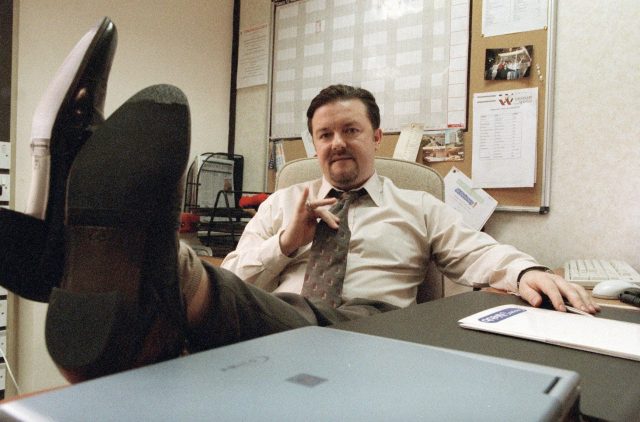
Would he thrive in Future Works? (The Office/IMDB)





“If you put Varun in front of people, he’ll just talk about startup fundraising for two hours. I highly doubt David Brent could do that.” We’re in Slough’s premier office space and local worthy Vineet Vijh, a man who has made it his life’s mission to overturn the reputation bestowed upon it by Ricky Gervais and The Office, is giving me a tour of the town’s newfound pride and joy.
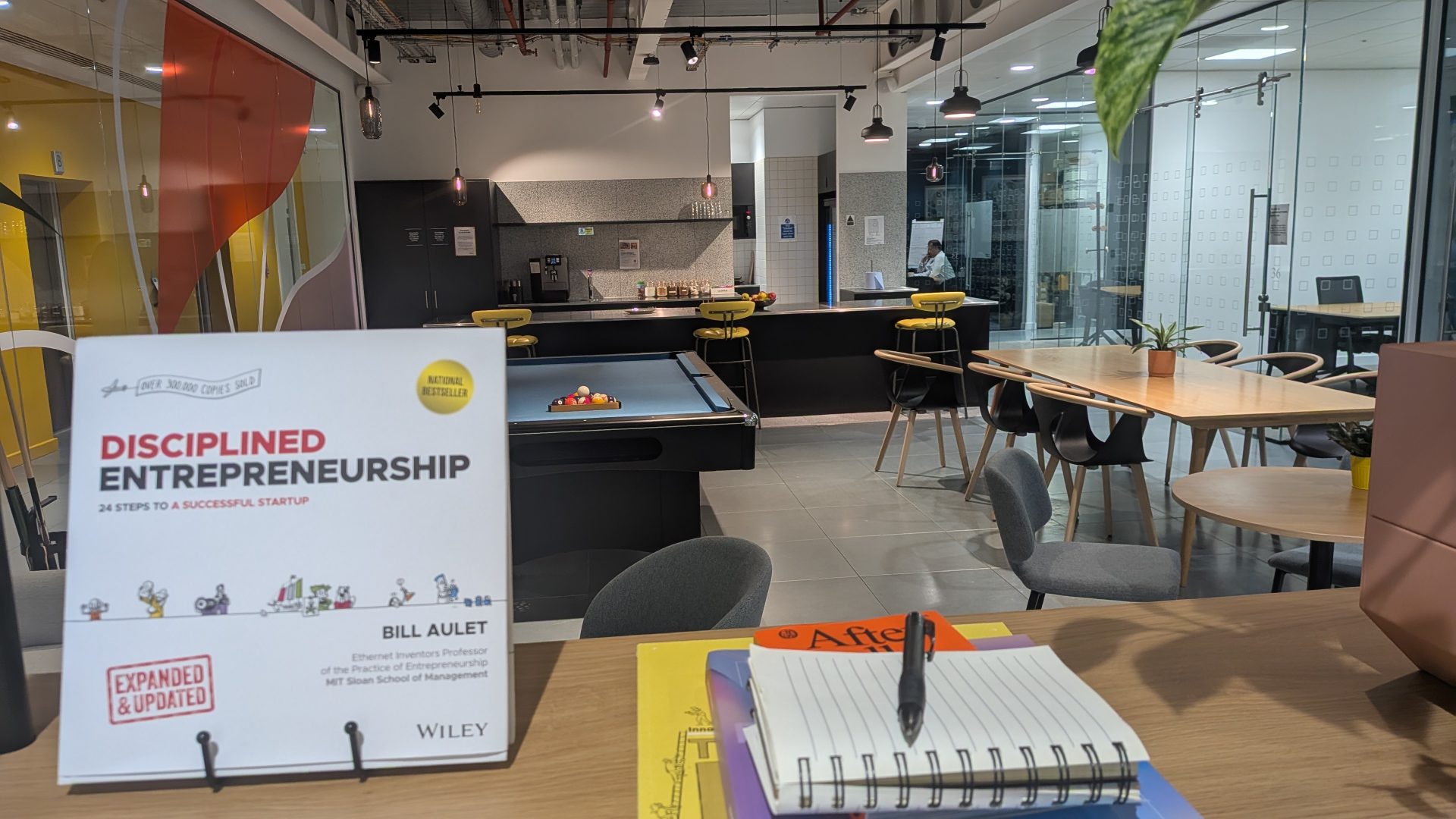
Future Works, a co-working space at the end of the Elizabeth Line, is a disconcertingly optimistic upgrade to Wernham Hogg, the paper-merchant setting of The Office. The program today celebrates its 25th anniversary — and still plays an outsized role in the national imagination when it comes to depicting the purgatory of worklife just outside the capital. “The last time something happened around here,” says one 28-year-old product designer with the deadpan voice of Martin Freeman’s Tim, “was when someone shat on the wall outside.”
But these jaded souls, once preyed upon by the likes of David Brent, are slowly being replaced. Now Slough is rallying around the entrepreneurs and thought leaders of Future Works in their bid to become UK Town of Culture in 2028, hoping to pip rival Guildford by pioneering the “creative expression” of a very different England to the one depicted by The Office.
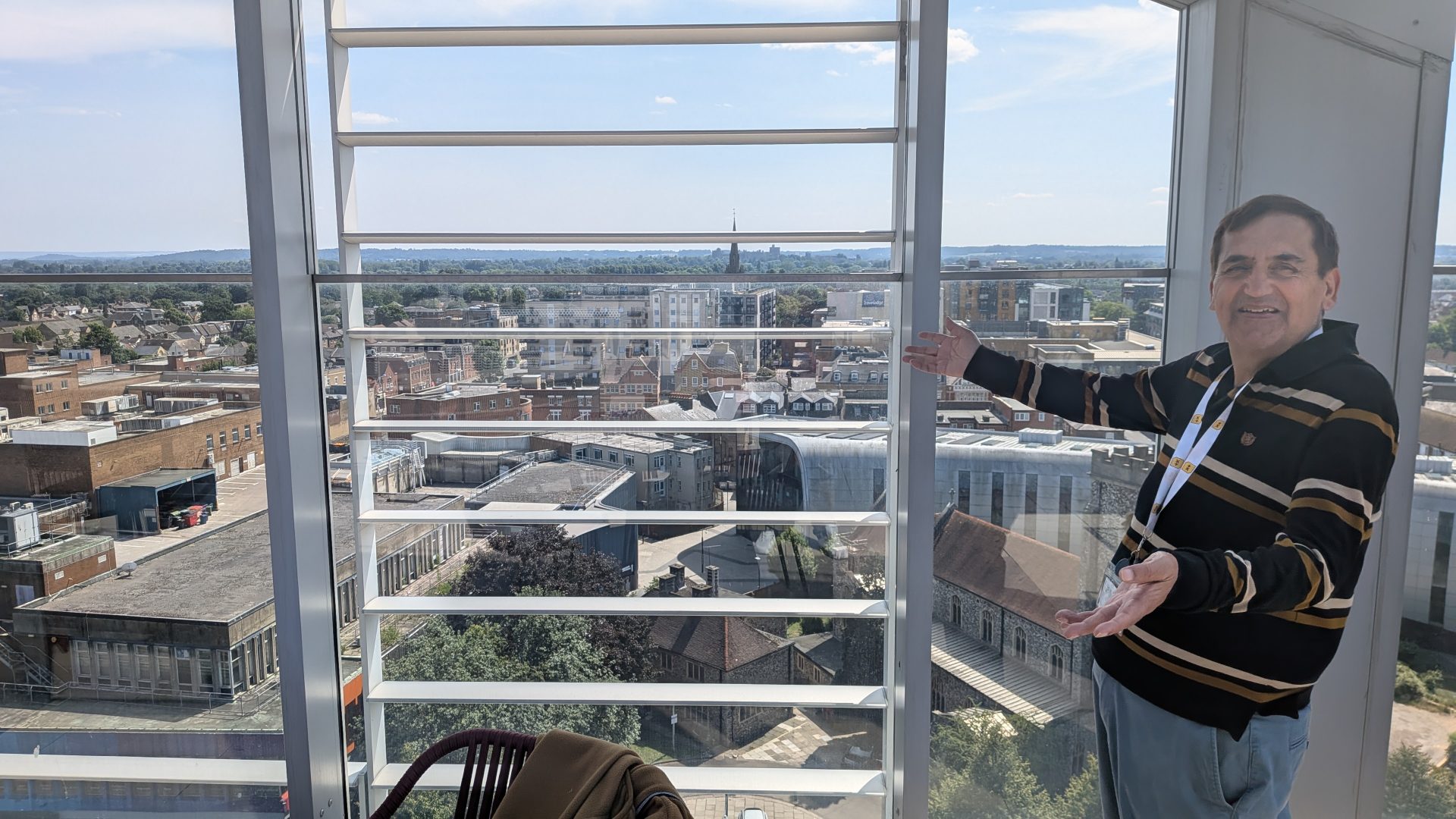
“I’m a networker,” says 31-year-old Varun, one of Future Work’s entrepreneurs, sitting in front of multiple screens in an eerily empty room. As he launches into a pitch for his fintech startup, there are a few stray Brentisms (his favorite film is Will Smith’s The Pursuit of Happyness) but few other signs of the former regional manager of Wernham Hogg. Unlike Brent, he is a boss first and only. He has no real desire to be a friend or entertainer, and certainly no cultural hinterland that might entail an admiration of Ian Botham or an impression of Basil Fawlty.
“Being a founder can be lonely,” Varun confesses when I give him the chance to expand on his workplace philosophy à la Brent. He’s already found himself crying in the toilets due to the stress of running a startup. That angst is appropriate: Slough, after all, doesn’t exactly inspire the more whimsical, rural turn of England’s present comic imagination, with its hits like The Detectorists and This Country. Here you can find Europe’s largest collection of data centers, plonked in the midst of a place that both tops the country’s league tables for income deprivation, and is the most ethnically diverse local authority outside London.
Downstairs, I try to see if I can find a few Gareths, or even a long-suffering Dawn. But like the notorious brutalist roundabout from the opening credit, many of these familiarities have been replaced. “I don’t think Brent would survive here now to be honest,” says Nilesh, who works as a financial consultant. “We’ve had to make a few tough decisions around firing people because of AI. And I don’t think he’d manage that because ultimately he’s a wimp.” And then there’s the town’s diversity, he says, referencing the scene where David Brent gets two Asian warehouse workers mixed up. “There’d certainly be more of that happening.”
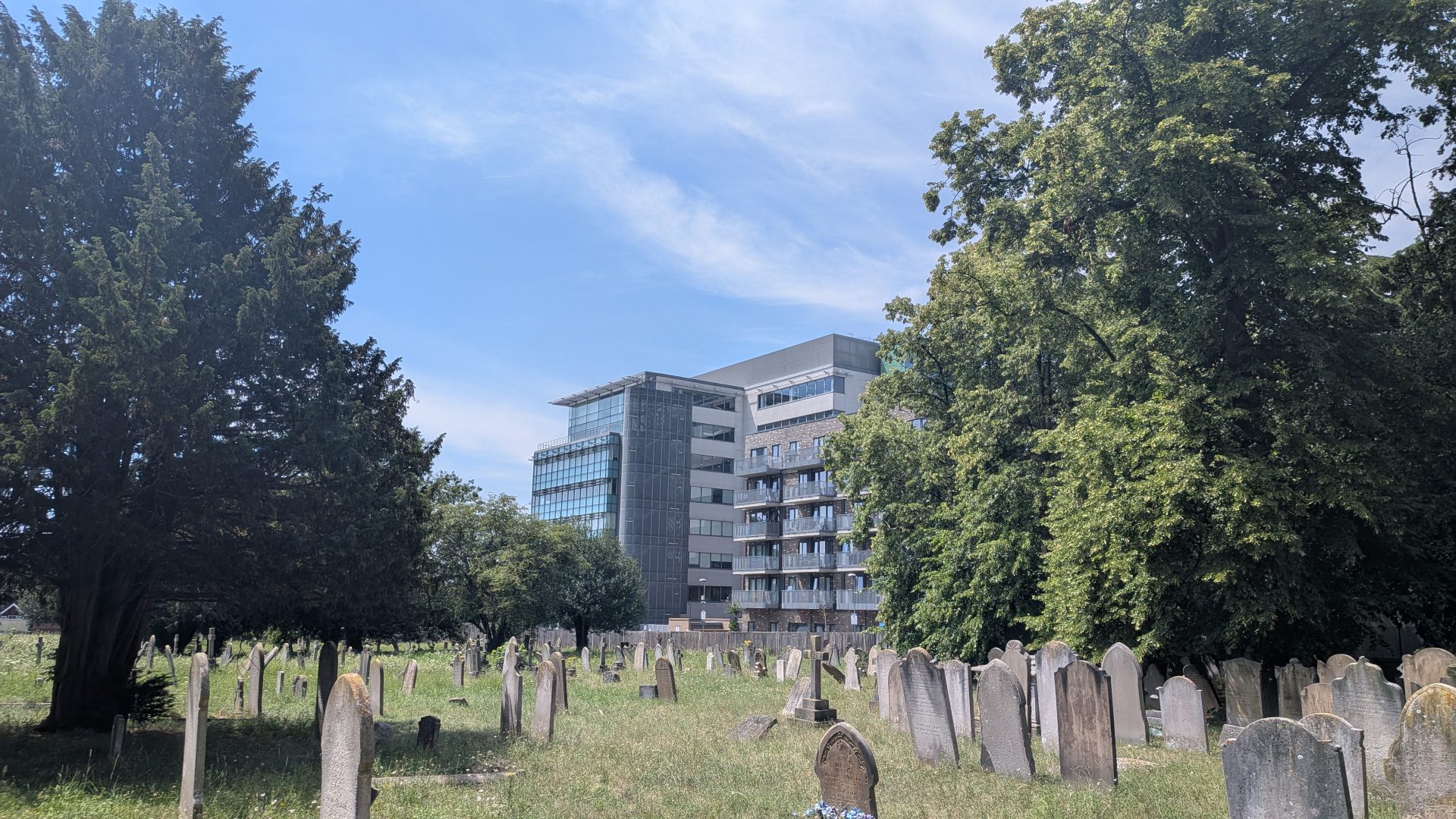
Could the Slough of 2026 still produce a David Brent? It’s a question of national significance, given The Office’s role in depicting a certain idea of England, one that sulks outside the M25, and which is in theory home to most of us, with our dull jobs and deferred dreams. Its geography reflects Brent’s own ambitions. As he put it, “Slough’s a big place and when I’m finished I’ve got Reading, Aldershot, Bracknell.” Yet these sudden London hinterlands are now forming the vanguard of a very different English worklife. Here you can find the ominous megastructures of the AI revolution, bearing down on co-working spaces left to run the less exotic fringes of our globalized services economy, where an anxious churn — graduates, officer workers trying to reinvent themselves, newly arrived migrants — all muddle along together.
Slough, against the grain of its once-terminal drabness, now finds itself the champion of a lackluster kind of Anglofuturism. John Betjeman and his “friendly bombs” have partly got their wish, thanks to Berkeley Homes and logistics developer SEGRO, with many of the brutalist, run-down shopping centers replaced to create a new landscape of self-contained residential complexes. From a distance, some of these plastic mausoleums can be confused for one of the town’s many data centers, which have helped create a peculiar microclimate of isolated despair on London’s far-flung borders.
The irony of Slough’s recent transformation is that The Office rose to popularity in the ebb-tide of the New Labour years, a place where David Brent was left to roam in the mire of a lost future. On the eve of the millennium, Tony Blair pronounced his government had a “thousand days to prepare for a thousand years”. A timescale evidently rushed, as the country became plastered with call centers and the pastiche futurism of “pseudo-modernism”, one that produced a different kind of desperation to the crumbling postwar social contract it was intended to upgrade. For most people, Blair’s “information superhighway” still meant being stuck in an office somewhere like Slough.
And then there was Brent himself. The shock troops of New Labour were the middle managers and the Mondeo Men, those trying to straddle the blokey relatability of the Nineties with the prying managerial togetherness of “The Third Way”. Sue Nye, a Labour apparatchik and wife of the BBC Chairman who championed the programme, thought she was watching a true-to-life documentary: a mistake perhaps brought about by her familiarity with the office of then-Chancellor Gordon Brown.
Once Wernham Hogg had taken hold in the national consciousness, it seemed to pop up everywhere. When Blair visited Slough police station after The Office’s second series, he greeted staff and modeled a drug test with Brentian panache. And so the regional manager from Slough became a sort of pathology for a nation weaned on delusions of grandeur, run by a set of politicians supposed to be delivering the future but who secretly fancied themselves as rockstars, humanitarians, and your own best friend.
Now a version of the future Blair once promised seems to have finally arrived in Slough — albeit one with less comic potential. When Vineet Vijh shows me a script of his updated version of The Office, set in Future Works and co-written to boost the Town of Culture bid, it’s clear that Slough’s attempts to find its feet in this new world have ended up slightly hysterical. And in this it certainly manages to capture the country’s own changing comedic manners, less masochistic and self-deprecating, and more in tune with a different national preoccupation: trying to broker a safe and gentle way for all the different tribes that now occupy modern Britain to get along.
The humor is derived not from everyone being “trapped”, as they were in the Slough of the 2000s, but from what happens “when everyone is free”. Unsurprisingly, there is now no place for Chris Finch, Wernham Hogg’s blokey sales rep, who does not survive the updated sitcom’s desired shift from “office culture to 150 cultures”. He is now a LinkedIn influencer. Comic set pieces revolve around the office’s diversity, both in background and occupation, with running gags involving “pitches every Friday that might change the world” and “flash mobs of dancers” frustrating the efforts of the documentarians. Curiously, despite potentially thriving in such an environment, David Brent is missing entirely.
“There is something I like to call Schrödinger’s Slough,” says Rob Deeks, a social worker and champion of the town, as I ask him to take me on a tour to see if the new sitcom really does justice to the town. “To outsiders it is simultaneously a drab, gray and dreary place, but then also a vibrant, growing and sometimes dangerous place that no one apparently wants to live in.” When I suggest he might be touching on the broader condition of England, he takes me on a whistle-stop tour: a 10-minute drive that takes in the playing fields of Eton, a busy mosque now serving one of the first estates built to home bombed-out Londoners, and a data center that wafts the smells of cremated plastic into back gardens.
For the town’s population, Deeks suggests this environment can create a peculiar unease, a sense that they’re living in a future that doesn’t really want them. “To be honest,” he says, “I don’t think the people living here have any idea what goes on in there”, pointing to a row of semi-detached houses that back onto a data center where the majority of England’s internet traffic is processed. “Slough is full of people who have just moved here or are just trying to get by. I think this stuff gets put here because you know they’re not going to make a fuss.”
Closer to the heart of Slough, I go in search of some more familiar set pieces from The Office, spots that might spark a bit of life into the town’s new sitcom. “No one goes out anymore in Slough,” say a pair of NHS nurses, implying that there would be no one left in Chasers, the nightclub from series one, for Brent and Chris Finch to chat up. “The people who work just seem to live in their own world, and then there are now lots of people here from places where drinking is not a big part of their culture.” Where would they set a sitcom in Slough now? The two look at each other bemused. “I’m not really sure. Perhaps you can try out the high street, which still has the odd character.”
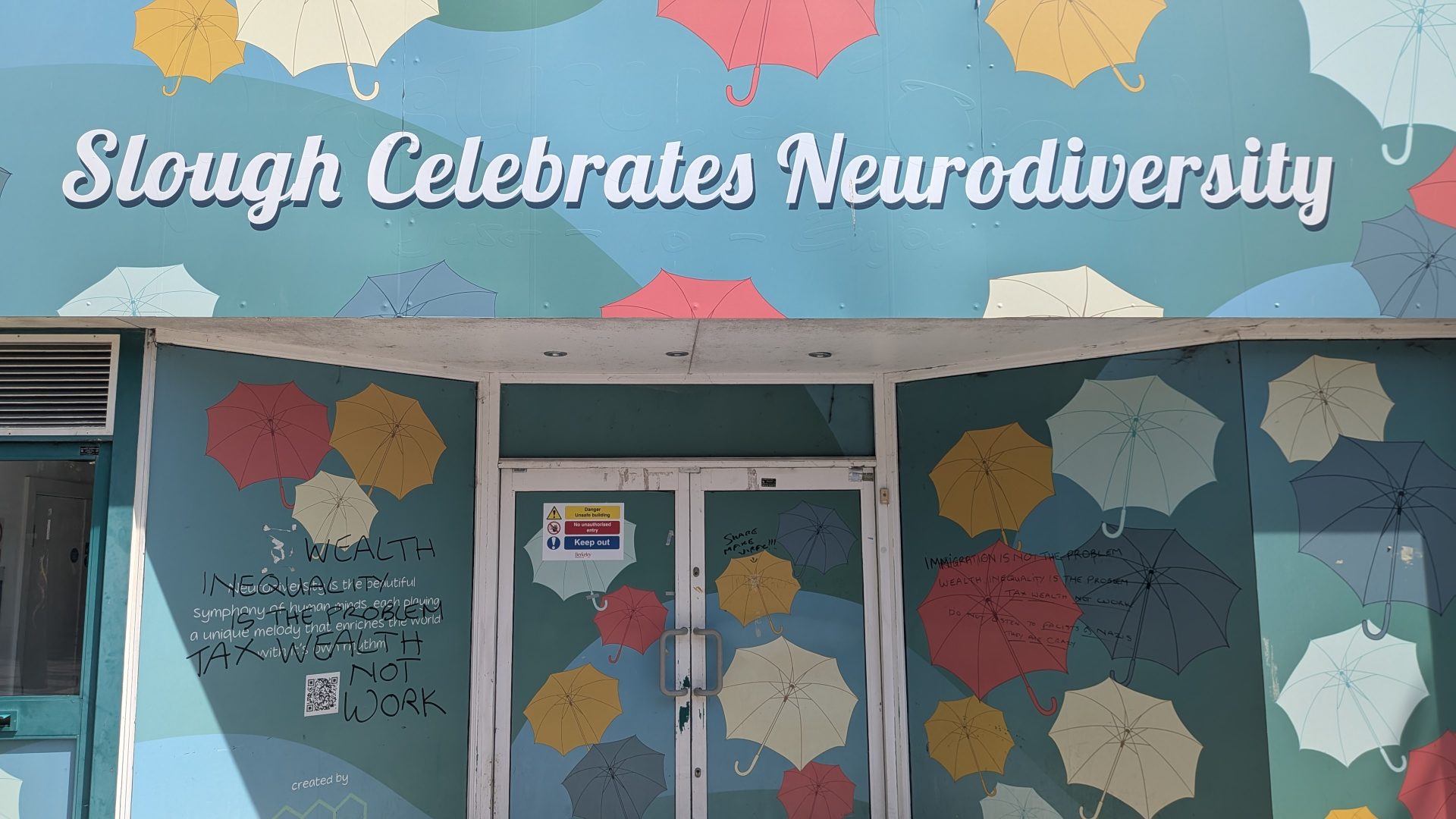
Vineet Vijh at Future Works warned me not to go to the high street. He insisted it was not representative of his aspiring Town of Culture. It certainly contains past ruins from previous efforts at regeneration. There’s a boarded-up shop, with a flowery facade that reads: “Slough Celebrates Neurodiversity”. Graffitied onto it is an argument about immigration and the odd “Allahu Akbar” in a frantic scrawl.
Much of this will soon be replaced, with Berkeley Homes having bought up the shopping center, promising a residential-cum-leisure-complex it insists will make people want to “enjoy and actually visit Slough”. By 2039, those living in its penthouse will be able to view the Future Works by the Elizabeth Line, and gaze across the M25 towards the shimmering lights of Hounslow and Heathrow.
In the meantime, I spot an unlikely pair outside the derelict shopping center, a man who looks eerily like Chris Finch, who has just lost his patience at the job center. He’s with a woman wearing a black hijab. “Oh fuck off,” he screams at her before marching off. “Don’t worry about him,” she says. He’s just having one of his moments.” And sure enough the pair are suddenly back together, conspiring as they walk briskly up the high street. This odd couple are never going to win Slough its Town of Culture prize, but they’re certainly the makings of a more fitting drama than the one set in Future Works.
