




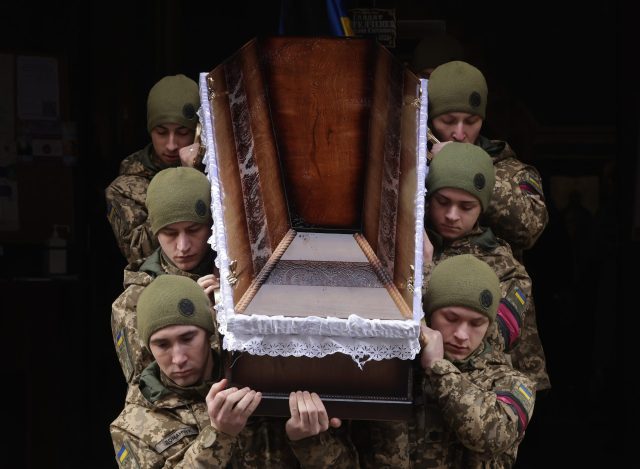
'When Russians feel pinned against the wall, they harden'. (Sean Gallup/Getty)





It has become something of a seasonal ritual. Every summer, Brussels launches a fresh propaganda offensive on Ukraine — and this year is no different. “The tide is turning”, Commission President Ursula von der Leyen declared on social media a few weeks ago, claiming that Ukraine, with European and Nato help, has seized the initiative, while Russia has been forced onto the defensive. The same phrase has since been echoed verbatim by politicians and commentators across the transatlantic ecosystem, in what is clearly a coordinated narrative push. Meanwhile, we are told that the Russian economy is — once again — on the brink of collapse, and that even Putin’s downfall may be imminent.
We have been here before. At regular intervals since Putin’s invasion, the Western political-media complex has worked to convince the public that victory for Ukraine was just around the corner, and that Russia itself was on the verge of collapse. In 2023, for instance, Western journalists and agenda-setters spent months hyping Ukraine’s counteroffensive, which was going to “turn the tide” in Kyiv’s favor. The campaign was a catastrophic failure, producing mass casualties and negligible territorial gains.
The latest alleged game-changer is Ukraine’s drone-strike campaign inside Russia — reaching as far as Saint Petersburg and Moscow — targeting logistics, fuel depots, refineries and supply lines. Several civilian targets have also been hit, causing numerous casualties. On Monday, Moscow suffered the largest drone attack so far. President Zelensky has now announced a 40-day operation against Russian targets to “influence the aggressor state in order to press for an end to the war”, which is likely to mean many more such attacks. These measures coincide with the EU’s disbursement of the first €3.2 billion installment of its €90 billion loan to Ukraine.
The timing is not coincidental. On Tuesday, a crucial Nato summit began in Ankara, where the pro-war lobby — both in Europe and in Washington — is desperate to make the case that Ukraine is winning. It’s a narrative that Trump himself appears happy to indulge, probably to compensate for the Iran fiasco: he even signed the G7 leaders’ recent statement committing to “increase the delivery of air defense capacities, additional systems and interceptors, and long-range capabilities”; to consider extending production licenses to Ukraine; and to “strengthen our sanctions, including those on the oil and gas sectors”.
It is also, in all likelihood, a response to mounting war fatigue in the West, confirmed by the refusal of the Czech Republic, Slovakia and Hungary to finance the aforementioned loan — an opt-out that Hungary’s new pro-EU government has strikingly not reversed so far — followed by the new Bulgarian government’s decision to prohibit arms supplies to Ukraine.
Kyiv’s drone campaign is certainly having an impact. Russian oil production has been affected; there have been serious fuel shortages across the country, as even Putin has admitted. Ukraine has also disrupted Russian supply routes north of the Sea of Azov, causing power outages in Crimea and in the Russian-held part of Ukraine’s Kherson region nearby. But these attacks are unlikely to change the course of the war. The Russian economy is faltering, yet it remains in a better position than much of the EU. Indeed, citing higher oil prices, largely a consequence of the Iran war, the International Monetary Fund in April raised its forecast for Russia’s 2026 GDP growth by 0.3 points, to 1.1%. Meanwhile, it revised the forecast downward for the EU’s top three economies — Germany, France and Italy — to 0.8%, 0.9% and 0.2% respectively.
More crucially, though, the Russian army continues to advance on the battlefield. It is steadily closing in on its goal of conquering the entire Donbass. Just the other day, Moscow announced the capture of Kostiantynivka — a town in Donetsk and the largest settlement it’s taken since Mariupol. The city was one of the last strongholds on the road to important Ukrainian-controlled cities, Kramatorsk and Sloviansk, whose capture is the Kremlin’s ultimate objective in the Donbass. Russian troops are also advancing around Chasiv Yar and Toretsk, making gains in urban fighting and on elevated positions, and continue to advance around Lyman and Rai-Oleksandrivka. All this flatly contradicts the prevailing “Ukraine has turned the tide” narrative.
If further proof were needed that things are going badly for Ukraine, one need only look at the increasingly widespread “busification” policy — the kidnapping of conscription-age men off the streets to be sent to the front, which is fueling growing domestic opposition to the war — or at the EU’s proposal to exclude military-age Ukrainian men, in practice all men aged 23 to 60, from the bloc’s temporary protection scheme.
In this light, the drone campaign looks less like a game-changer than a sign of desperation: given Ukraine’s inability to turn the tide on the battlefield, Kyiv and Nato have decided to “bring the war to Russia”. Yet there is no evidence that Ukraine’s drone campaign will turn the war around — much less force Putin to capitulate. Indeed, over the past few days, Russian forces launched some of the largest drone and missile strikes on Kyiv so far, killing dozens of people.
How much Ukraine’s campaign is affecting public support for Putin is hard to say. It is true that it is having an effect on Russian morale, but as Leonid Ragozin has written, the situation in the country remains relatively stable: for all the dramatic visuals of burning refineries and queues at petrol stations, most Russians have seen worse in their lifetimes, and the vast majority still enjoy a standard of living comparable to that of the poorer EU countries — a far cry from what they endured throughout the bad old days in the Nineties.
The most reliable “poll” will come on 20 September, when Russia holds elections to the State Duma; some analysts predict that the ruling United Russia Party will suffer a humiliating result at the hands of the Communists to its Left and the (confusingly named) Liberal Democratic Party to its Right. But anyone hoping this might pressure Putin into ending the war will be disappointed: both parties have taken an even more hardline stance on the conflict than Putin’s United Russia party. The Ukrainian attacks are, if anything, emboldening the more hawkish voices in the Kremlin, who accuse Putin of mismanaging the conflict and are demanding a far more forceful response. After all, history suggests that when Russians feel pinned against the wall, they do not capitulate; they harden. Thus, the greater the pressure on Russia becomes, the more likely it is that Putin will find himself compelled to escalate the war.
Regardless of the short-term effects, Ukraine’s drone campaign is a textbook example of how drones are rewriting the rules of warfare in real time. Strategic deep strikes — the ability to reach the enemy’s cities, industries and leadership far behind the front — were until recently the privilege of countries with powerful air forces and missile arsenals. But low-cost, mass-produced drones have democratized it. A country losing the attritional contest on the ground — as Ukraine, on paper vastly inferior to Russia in material and manpower terms, plainly is — can now inflict vast damage deep inside the stronger power’s territory. And once the weaker side exercises that option, whatever incentive the stronger side may have had to exercise restraint collapses.
It is, after all, a matter of historical record that so far Russia has refrained from inflicting mass destruction on Kyiv and other major cities far from the front line, and throughout most of the war has conspicuously spared government decision-making centers — despite having the means to do so. For the first eight months of the conflict, Moscow also left Ukraine’s energy grid untouched; strikes began only after the Kerch Bridge attack of October 2022. In this sense, drone warfare does level the playing field, but it also invites escalation, by stripping the weaker side of the indirect protection that asymmetry itself — its inability to inflict mass damage on the enemy — once afforded it.
This is what makes the current moment so dangerous. A nuclear superpower is being subjected to a sustained campaign of strikes against its principal cities, its strategic infrastructure and, by extension, its leadership — supported by Western intelligence, executed with Western weapons and now backed by an explicit G7 commitment to “accelerate” the delivery of long-range capabilities.
As Matthew Blackburn of the Norwegian Institute of International Affairs recently has warned, if Moscow decides its restraint within Ukraine is being exploited to impose humiliating damage on the Russian heartland, it may abandon strikes on Ukrainian infrastructure in favor of the European supply hubs and manufacturing sites that make Kyiv’s deep-strike campaign possible in the first place, thereby correcting the asymmetry and restoring deterrence on its own terms. Indeed, Moscow has repeatedly signaled that its patience is not unlimited; voices within the Russian establishment increasingly speak of restoring deterrence by striking targets in Europe itself. The reason Russia has so far refused to do so is obvious: such an attack could easily spiral into an all-out war that Russia has no interest in fighting — as even General Alexus Grynkewich, Nato’s Supreme Allied Commander Europe and the alliance’s top military commander, recently noted. Simply put, the cost of retaliation has thus far exceeded the cost of tolerance. But if the latter keeps increasing, Russia’s calculus could very well change.
The essential fact is that nobody in the West knows where Russia’s red lines lie — and indeed Western policy seems to proceed on the assumption that they do not exist at all. Meanwhile, the Europeans keep arguing that there is no alternative to continuing to support Ukraine indefinitely because “Russia refuses to negotiate”. But as Anatol Lieven of the Quincy Institute recently wrote, it is the EU — not Russia — that has so far refused to negotiate. While Moscow has spent the past year in sustained talks with Washington and progressively abandoned several of its core demands, the Europeans have made negotiations conditional on an unconditional ceasefire that Russia cannot accept without surrendering its only leverage, and have wrapped this precondition in “principles” that amount to a demand for Russian capitulation.
The main victim of this posture has been Ukraine itself, condemned to a grinding war of attrition it cannot win militarily. Should exhaustion eventually produce a ceasefire without a settlement, meanwhile, it could lead to a Kashmir-style condition of permanent insecurity. It is in Ukraine’s interest — and in Europe’s interest as a whole — to negotiate a comprehensive peace settlement instead. We know in broad terms what any realistic settlement would entail: territorial concessions from Ukraine in exchange for security guarantees (short of Nato membership and Western troop deployments). Whether such an offer would suffice for Putin to claim his measure of victory and end the war, nobody can yet know. But what we do know is the cost of the status quo.
Thomas Fazi is an UnHerd columnist and translator. His latest book is The Covid Consensus, co-authored with Toby Green.
 battleforeurope