




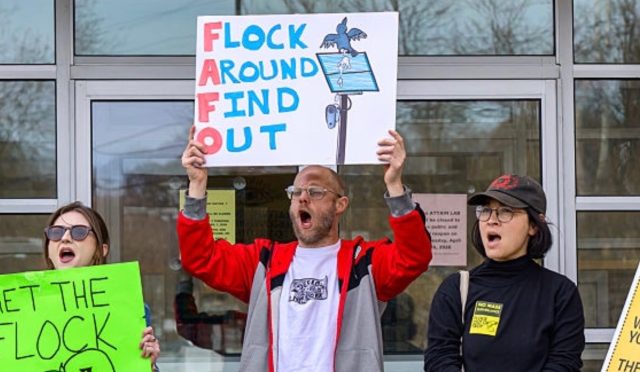
Activists protest the installation of Flock Safety cameras. Credit: Getty





Xavier Bautista grew up in the largely working-class black and Latino community of The Port in Cambridge, Mass. During his life, Xavier watched as an influx of Harvard and MIT students and faculty dramatically transformed The Port, gentrifying what had been one of the city’s last affordable neighborhoods. Even with these changes, Xavier remained deeply connected to the area. He enjoyed taking his own 5-year-old son to the same playground he had the run of when he was a boy.
Then, in the early-morning hours of July 4, masked gunmen allegedly shot Bautista, just off that same park, as he was beginning his shift as an employee of the city’s Department of Public Works. He remained lying on the pavement for more than an hour before a passerby discovered him. By the time emergency services arrived, Bautista was dead.
As if his killing weren’t tragic enough for his family, in the days that followed another dimension of the story unfolded. Just weeks before the shooting, the Cambridge city council had voted to shut off ShotSpotter, the gunshot-detection system that had been used by the city for more than a decade to help the police locate shootings and to more quickly respond to victims in high-crime areas. One of those unutilized sensors was located only feet from where Xavier lay wounded.
Viewed in isolation, Cambridge’s removal of an anti-crime technology could be dismissed as the predictable politics of a college town with an oversupply of highly educated liberal voters. But Cambridge isn’t an isolated case. Across the country, Left-wing activists and progressive elected officials are increasingly targeting law-enforcement technologies they cast as tools of state surveillance, corporate power, and racial inequality.
ShotSpotter is one such technology. Others include Flock Safety — a license-plate-recognition system that police departments use daily to apprehend suspects fleeing crime scenes, locate abducted children, and recover stolen vehicles. Together, these local campaigns show how opposition to new anti-crime technologies has become fertile ground for Left-wing activists seeking political wins.
Yet affluent progressives are rarely the ones who pay the price for this kind of anti-policing push.
For Bautista’s family and many residents of The Port, the city’s decision was impossible to fathom. Days after his death, more than 200 angry residents packed a meeting with city officials, demanding answers. The central question that emerged in the discussion was: why had the city removed a technology that existed to help first responders reach gunshot victims more quickly?
The answer begins in January, when a 24-year-old Harvard graduate and self-identified democratic socialist named Ayah Al-Zubi — the youngest person ever elected to the city council — was sworn into office and immediately appointed chairwoman of the council’s public-safety committee. Al-Zubi had no background in law enforcement or public safety, nor had she ever lived in a low-income neighborhood, having spent most of her adolescence in a comfortable suburb of Cincinnati, where both of her parents worked as dentists.
Even so, Al-Zubi made ending Cambridge’s ShotSpotter program her first priority in office. It was a cause she’d championed for months alongside other local Left activists, who’d concluded — rather suddenly, it seemed — that the tried-and-tested technology is an instrument of racialized surveillance.
In the public hearings that followed, activists repeatedly hammered this point: that ShotSpotter was inherently racist because its sensors were disproportionately concentrated in predominantly black and Latino neighborhoods. As one elderly white Cambridge resident told the committee, “ShotSpotter does not make Cambridge a safer community… It makes Cambridge a more oppressive place to live… particularly for its black and brown residents who are already targeted by racism.”
Others repeatedly cited an 82% false-positive rate, a figure drawn from a nearly decade-old Harvard Crimson analysis that the Cambridge Police Department disputes. And still others criticized the technology for failing to deter gun violence, despite the fact that its manufacturer, SoundThinking, has consistently described ShotSpotter as primarily a gunfire-detection-and-response tool, rather than a prevention system.
Yet these present-focused arguments ultimately took up only a small share of the advocacy. Far more common was reasoning focused not on what ShotSpotter actually does, but on what it might someday achieve. Activists warned that the sensors could eventually record private conversations and that ICE agents or a future Republican administration might gain access to the data.
Future speculation thus dominated the discussions. The arguments reflected what has become a defining characteristic of contemporary Left-wing politics: a paranoid style and a paranoid political imagination detached from reality, in which hypothetical future abuses of technology and state authority carry far greater significance than present challenges. Soon, the council voted to remove ShotSpotter, with five votes in favor of the proposal, two opposed, and two abstaining.
The successful effort of a small group of Left-wing activists to remove ShotSpotter in Cambridge reflects a broader transformation in the nature of progressive activism during President Trump’s second administration. Compared to the first Trump presidency, when opposition was organized centrally around resisting a single political figure, today’s activism is more fragmented and directed toward technological objects that have come to symbolize the larger political and economic systems the movement opposes.
Whether the target is a gunshot-detection system, a license-plate reader, a Tesla car, or a hyperscale data center, the hardware increasingly becomes the site through which broader Left-wing anxieties about surveillance, policing, capitalism, and inequality are expressed. This new focus revises the mission of the historic Left, which welcomed technological advancement, even as it sought to reform or revolutionize the relations of production. Under the new dispensation, the product itself is the target — and advancement is presumed suspect unless proved otherwise.
The pattern has become unmistakable. Since Trump’s return to office, dozens of predominantly progressive cities, the largest being Los Angeles, have ended or reconsidered their relationships with Flock Safety. In each of these cases, the campaigns shifted the debate away from the technology’s demonstrated uses and toward what it might someday become. Similar campaigns have targeted data centers, turning reasonable land-use disputes into a broader ideological struggle over Big Tech.
This shift coincides with two larger developments. The first is the growing disarray of the liberal institutions that once organized and directed Left-wing political energy. After nearly a decade of defining themselves in opposition to Trump, Democrats and the broader network of DC-based progressive organizations have struggled to produce a comparable national movement capable of channeling the Left’s diverse grievances into a unified political project. The Women’s March, the impeachment campaigns, and the George Floyd protests represented the high-water mark of that form of resistance, yet none produced a durable political movement beyond opposition to Trump himself.
As Trump approaches the end of his presidency, even that organizing center is beginning to dissolve, and the political energy it once contained is dispersing into smaller, localized battles fought in mayor’s offices and city-council meetings over the technologies increasingly shaping everyday life.
The second development is the speed at which computing has embedded itself into the economy. As semiconductors have shrunk and computing power has become cheaper, more industries have adopted technology capable of processing vast amounts of information and automating tasks that once required human judgment or that were simply impossible to perform at scale.
Public safety and law enforcement have enjoyed the benefits of this computing revolution. Tools like ShotSpotter and Flock Safety are examples of the same more-powerful computing now commonplace across medicine, manufacturing, and finance, filling long-standing operational needs through automation and pattern recognition. The primary difference is that the Left sees these technologies, when used by law enforcement, as proxies for fears about the future of state authority and technological control.
To be sure, new technologies can produce unexpected consequences. Social media promised greater openness and connection but also gave rise to pervasive targeted advertising and worsening mental-health outcomes for adolescents. That history helps explain the public’s current unease with new technologies.
But broad skepticism alone doesn’t explain why anti-crime technology has emerged as a lightning rod for Left-wing ire. The reason lies in the unique character of the technological revolution. Unlike previous waves of technological change, today’s computing revolution has unfolded without a broadly shared national narrative explaining its purpose, benefits, or tradeoffs. That vacuum has given activists an opportunity to frame the debate, and to define these technologies primarily as instruments of surveillance and social control.
As political commentators search for signs of how the Democratic Party will regain national power in 2028, much of their attention remains fixed on Democrats in Congress. But a quieter political movement is taking shape in local governments across the country. Led by informal networks of Left-leaning activists and citizens, it has become one of the most effective forces of our time, helping to block billions of dollars in government contracts with major technology companies and successfully turning symbolic political campaigns into real policy victories.
Perhaps more important, these campaigns reveal something deeper about the modern Left. Its belief system is now defined by a generalized suspicion of technology, institutions, and the exercise of power itself, mirroring the descent of parts of the Right into conspiracism and what used to be called the paranoid style. As these ideas become more influential within the Democratic Party, it is worth asking whether they provide the foundation for a national campaign capable of persuading ordinary Americans that Democrats are prepared to govern. At stake, after all, are the lives of people like Xavier Bautista, whose death might have been prevented had Cambridge retained the technology it chose to abandon in response to the Left’s anti-tech paranoia.