




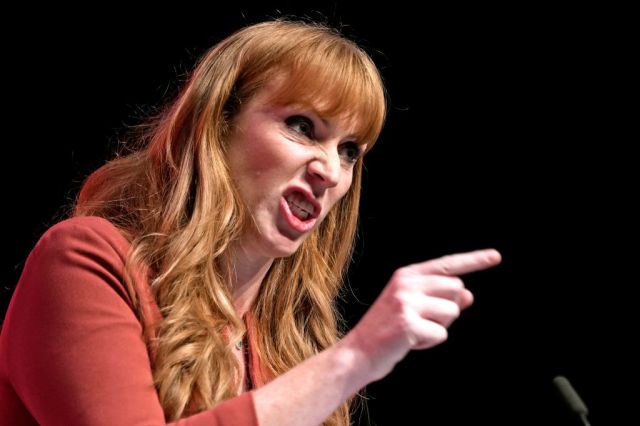
“It is sometimes useful to have one or two disinhibited voices around to harness voter fury.” (Christopher Furlong/Getty)





In politics as in football, play is paused to allow the injured to leave the field. During Starmer’s final PMQs on Wednesday, Kemi Badenoch desisted from attacking, delivering a warm and twinkly-eyed tribute to the leader on his way to the back benches instead. Starmer said some nice things in return, and everyone chuckled fondly. It was as if she had never called him two-tier Kier, or ever said that Labour was the party of paedo defenders.
Minutes from an early exit, Starmer was magnanimous about his opponent’s hard tackles, saying “it has to be robust — that is the way politics is done”. Some colleagues apparently differ with him on this, implying that the Leader of the Opposition’s swingeing takedowns expose Labour MPs to extra public risk. When she recently spoke of “400 knives stuck in [Starmer’s] back”, there were vague suggestions it might be an incitement to violence, a point about as convincing as saying it was actually a covert plug for the Sheffield steel industry. Meanwhile Education Secretary Bridget Phillipson — branded a “spiteful class warrior” by Badenoch during the same session — has been making more capital out of her big moment than a diving Argentinian mid-fielder tapped lightly on the shoulder. She has even just posed with the phrase emblazoned on a t-shirt.
There is a general air of unreality to all of this; a feeling of opportunistically seizing on small issues in order to distract from bigger ones. One elephant in the room is the way many Labour MPs themselves behaved until about five minutes ago, surfing a collapse in online civility norms during the 2010s to lay into political enemies in the most brutal terms. This week we were vividly reminded of that fact, as old tweets from politicians emerged about Ann Widdecombe: David Lammy writing in 2019 that she was “absolutely poisonous” and a “bigot”; and Jess Phillips incongruously urging readers to vote the “little fascist beast” off Strictly in 2010. Though their tone is jarring now, only a few years ago practically everyone on the Left seemed to be at it, rattling off six casual accusations of profound moral degeneracy before breakfast. As Lammy paid solemn homage to Widdecombe after last week’s horrific events, his words rang pretty hollow. I wonder, though, whether he ever really meant any of it at all.
In ordinary life, insults are rarely launched with a cool head. The red mist has descended and you have officially retreated from constructive communication, which is how you find yourself suddenly ranting and raving at someone, or posting something stupid online; all a bit embarrassing once you calm down. In politics, by contrast, insults are strategically useful — indeed, a US university has recently identified a category of “conflict entrepreneurs” in politics, leveraging verbal toxicity for personal gain. Insults can get you media attention, bond voters together against a perceived outgroup, or silence a whole flank by way of intimidation. So useful are they, in fact, that there is no need for the presence of any feelings of anger or grievance to motivate them at all. You can tweet out a judiciously chosen insult, then tick it off your to-do list. Maybe your SpAd could even write it for you.
To be on the other end of this icy process, as I occasionally have been, feels weirdly impersonal. Although dressed up in the language of individualized guilt, you sense it is not really about you at all. You are merely a useful object, whose previous statements and actions have provided the raw material for the construction of a helpful folk devil: take one small extract of interview, add a pinch of a speech, and finish with a sprinkling of social media quotes. Voilà! You now have a credible enemy of right-thinking people everywhere. What is happening to the person underneath the socially constructed fright mask is of negligible interest; and so, of course, is the issue of whether the mask was ever a decent fit. The only important question is whether it works.
Equally, in the politically motivated case — PMQs aside — there is rarely a need to address your target directly. It is so much more effective to call someone disgusting and evil in the third person, and whether they find out or not is incidental. Lammy and Phillips wrote vicious things about Widdecombe for others to read — she wasn’t ever on Twitter. I suspect that this passive-aggressive tradition is partly why Badenoch’s directness and commitment to combat seems particularly shocking to some opponents. It feels like a violation of the modern rules of the game.
If Reform candidates aren’t very good at this disassociated stuff, it is only because most are relatively new to politics, still preferring to launch traditionally chaotic, angry broadsides — a fact which makes their social media histories so interesting to the press. Most professional politicians would not be so gauche. Granted, it is sometimes useful to have one or two disinhibited voices around to harness voter fury, a role Angela Rayner once played for Starmer with her comments about the Johnson government (namely: “a bunch of scum, homophobic, racist, misogynistic, absolute vile banana republic, vile, nasty, Etonian piece of scum” — for which she later apologized). But most of the time, the benefits of a particular line of character assassination should be carefully weighed in advance.
This is not to say it can’t still go wrong. The Left’s studied habit of calling certain groups of people racist, homophobic, transphobic, and so on, has turned into a terrible problem for them retrospectively. The most obvious issue was that the categories were so expansive: once racists were defined as “anyone with doubts about immigration”, and transphobes as “anyone who believes in human biology”, the reviled out-group suddenly contained large numbers of Labour and swing voters. This was unfortunately self-defeating, to say the least.
But equally, the contrast classes didn’t sound anywhere near seductive enough. Useful political insults should positively flatter an in-group by way of a pleasing, easily graspable distinction between you and the maligned ones on the outside. When you call someone a workshy scrounger, you implicitly butter up diligent taxpayers; in mocking snowflakes, you pay tribute to the psychologically resilient majority. Yet the opposite of a racist/homophobe/transphobe (etc.) was defined only as an “ally”, a badge most immediately appealing to Second World War enthusiasts. Even at their most effective, the Left’s chosen insults worked by instilling fear of dissent rather than disseminating good vibes.
Back to the present, and just as it once seemed politically astute for some on the Left to call people awful names and launch group attacks, now it appears astute for them to condemn other politicians’ verbal behavior as highly likely to cause violence. Equally, just as it was fashionable for the Right to defend free speech for a while, now there is renewed energy around trying to curtail it in the name of safeguarding, with some now demanding that social media companies be held accountable for abuse of MPs. Leaving aside the question of whether the claims about inciting violence are true — which I’ll get to in a moment — either way, to say so is unquestionably yet another move in the political game. When you are in politics, everything is a move in the game. My fears about threat are genuine, but yours are cynically confected. You are a pathetic snowflake, but I am a genuine target. My free speech is important, but yours puts me in danger. The idea that only one side is making capital out of all this is yet another useful fiction to sell to your own side.
Obviously, the claim about certain words causing violence is extremely difficult to verify. It concerns a counterfactual; would such-and-such a despicable act still have happened had a particular MP or his point of view not been all over the papers or on the BBC? Since we are each subject to hundreds of daily influences, and fewer and fewer people engage with mainstream media sources anyway, it is hard to say. But if we are looking for possible motives for political violence, we can at least say that over the past decade or so, members of one party in particular were regularly telling young and impressionable people that a large section of society was positively hateful and dangerous; a threat to the British way of life, rightly conceived, as well as to the planet as a whole. And if we are looking at means, many of these kids belonged to families who watched Question Time and read the Guardian. And no, I’m not talking about Reform. If the new Prime Minister wants to convince the public that his party is not playing yet more games, he should publicly acknowledge the lingering atmosphere of division and fear that Labour members did so much to create.
