




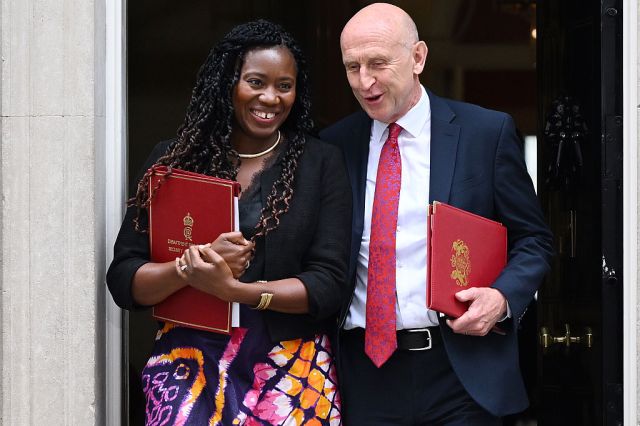
Fahnbulleh and Healey at Downing Street this week. (Ben Montgomery/Getty Images)





At first glance, the new Prime Minister’s choice of Miatta Fahnbulleh as energy secretary would appear to suggest more of the same: more Net Zero, less oil and gas. Fahnbulleh was formerly a junior minister in Ed Miliband’s Department of Energy Security and Net Zero, and her elevation to the top job might appear a like-for-like substitution — a sort of Miliband-lite.
However, that understates the import of her promotion. Energy will be a vital component of Andy Burnham’s premiership. Net Zero has become a defining element of Labour’s offering. Consumers and businesses desperately want energy bills to come down.
Meanwhile, Fahnbulleh is anything but an underling. A child refugee from war-torn Liberia, she made her way to Oxford and proceeded to a doctorate at the London School of Economics. Here, she established her bona fides as a scholar with well-elaborated and nuanced academic publications on industrial policy and the climate crisis. Moreover, her strong vision for localism, rooted in the cooperative tradition, has earned her the moniker of Burnham’s brain. It’s therefore safe to say she assumes her position with both authority and clout.
That’s all for the better, because she will immediately face two big decisions: how to bring down energy bills about which consumers and businesses alike have been screaming; and how to reconcile that imperative with her commitment to Net Zero and the phasing-out of fossil fuels at a time of extreme volatility, when a rebel group in Yemen can push the price of oil to over $100 a barrel .
To a considerable degree, this task comes down to balancing short-term with long-term goals, and strategy with tactics. In the short term, scrapping green levies and allowing for further exploration of Britain’s oil and gas reserves in the North Sea, as called for by both Reform and Conservative parties, would appear to be an obvious win: not only could the measures create jobs, advocates argue, but they would reduce energy bills and allow the country to substitute cheap, local gas for imports.
However, such benefits would be largely short-term, while the gains can be exaggerated. In the first place, it isn’t renewable energy that is driving up British electricity bills — it is the pricing model and the high cost of natural gas (a price which is itself set on international markets). Indeed, the most effective way to bring down bills in the long term would be to double down on renewables and completely eliminate gas from the energy system. As for green levies, these make up only a small share of total electricity bills, and in any case, the programs these levies fund, such as the Warm Home Discount for vulnerable households, would otherwise have to be paid for through general taxation. Distribution costs count for more, and one of the reasons electricity bills are rising so fast is that infrastructure must be upgraded to deal with increasingly severe weather events, itself a product of the climate change caused by carbon emissions.
Meanwhile, as an investment proposition, the fossil industry’s benefits are immediate, but possibly no more than that. Oil companies pay large dividends — but that’s because it’s an industry which appears to have a finite life and so their capital expenditure tends to fall below that of growth industries. This, indeed, has been a source of Donald Trump’s frustration with the sector: he wants the companies to drill, baby, drill to bring down prices, and they understandably reply: why bother? We’re happy to keep supply limited and make money off higher prices while the good times last.
Most of the future growth in demand for energy will come from the developing world, much of which is leading the way in the transition away from fossil fuels. Developing countries are not necessarily pursuing this path out of concern for climate change. What is driving this is instead energy security — that is, the eminently practical consideration that renewable energy relies on entirely local resources. Countries with abundant renewable energy reserves are not so vulnerable to foreign suppliers or the vagaries of the market — let alone price shocks like the recent interruption caused by the Middle East war. When the price of your input can leap in a week or its supply can suddenly get cut, as we’re seeing now in both the Strait of Hormuz and the Red Sea, the attraction of relying on home-grown energy only grows stronger.
Meanwhile, renewable energy has turned out to be one of the most dynamic sectors of the UK economy, with a vibrant startup ecosystem that is riding on the back of Government policies and growing much faster than the overall economy. Investment in the sector has grown 20 times over in just the last decade and London is now Europe’s leading climate-tech hub. To roll back Net Zero would be to cripple a sector that could potentially be at the vanguard of a new industrial revolution — a spectacular economic own goal.
So, when it comes to industrial policy, which both Burnham and Fahnbulleh favor, there is much to commend Net Zero. In principle, it might be possible to partially reconcile the competing demands by allowing an expansion of oil and gas production — the windfall tax may come in for reconsideration — and then using the Government’s share of the revenues to support the energy transition. (This is the approach used by Norway and some of the Gulf states). But long-term, it makes sense for the Government to put its eggs in the basket of this rising sector rather than a legacy industry.
However, this is where the real challenge to the country’s energy policy will lie — namely, does the Government have any eggs to play with? Burnham has entered Downing Street with the same set of fiscal constraints that felled his predecessor, and there is little reason to expect those to ease much. Burnham has said that while he might look for a little flexibility, he will abide by the same fiscal rules Rachel Reeves had set for herself.
In truth, he doesn’t have much choice: if he doesn’t bind John Healey, the new Chancellor, this way, the bond market will do it for him. And while investors have greeted Healey favorably, with gilts moving in line with the bonds of Britain’s G7 partners, those rates have been rising across the board, and look set to keep doing so.
Meanwhile, given that Healey resigned from the Starmer government over its failure to adequately fund the country’s defense budget, it’s a safe bet that doing so was a condition for his taking his new job. So, in addition to having to find more money to pay rising debt costs, Burnham will need to find more money to pay for defense spending.
And yet for all that urgency, he has further tied his hands by making it impossible, at least for now, to tackle the one Government bill that everyone agrees has got out of control: welfare spending. Burnham campaigned on the pledge not to scrap the triple-lock that is the principal driver of that portfolio’s ever-rising price tag. As a result, we saw how tricky he made his task the moment he crossed the threshold of No. 10. The Prime Minister announced he would eliminate VAT on energy bills and fund it from the savings he’d make by scrapping the digital ID scheme, only to have a former minister point out that scheme was unfunded.
If Burnham is to proceed with his ambitious plans to remake Britain and shift the economy to renewable energy, effecting a new industrial revolution in the process, he will therefore need to make some very tough choices, lest he end up making lots of promises that his Chancellor nixes. Since the Labour manifesto did not ask for a mandate for such hard choices, he may have to secure one of his own.
But that poses a rather large dilemma. To secure his own mandate, Burnham would need to call an election, something for which there appears to be little appetite among either the public at large or his own backbenchers, many of whom would probably lose their jobs, given the scale of Labour’s current majority. But to make the sort of bold decisions that might underpin his attempt at national renewal — such as serious welfare reform, raising income taxes or reintegrating with Europe — Burnham would effectively have to tear up the manifesto Labour campaigned on.
On the upside, he comes to office with some advantages over his predecessor. He is, obviously, a more gifted communicator, and he also has a clearer message to deliver — a more fully-formed vision of government based on devolution, local action, and a constructive state presence in daily life. He also takes power with an evident plan to make government more effective, placing more power in the Cabinet Office rather than maintaining Starmer’s approach of relinquishing decision-making authority to a Chancellor who often gave the impression of looking at a computer spreadsheet before reciting “Treasury says no”.
But he’ll need all these skills and powers, because his task isn’t enviable. He is shackled with the albatross that sank the Starmer premiership, bequeathed to him by Starmer and Reeves — a set of fiscal constraints, resulting from careless election pledges, which still make it impossible to do anything more than incremental tinkering — like ostensibly temporary VAT cuts, or £2 bus fares. His new energy secretary has the potential to assist him in his goal of transforming Britain — but only if he can figure how to pay for it.
He must therefore find a way to offload the weight of his inherited burden. If he doesn’t, he will join the lengthening list of short-term premiers that Britain has begun compiling.
John Rapley is an author and academic who divides his time between London, Johannesburg and Ottawa. His books include Why Empires Fall: Rome, America and the Future of the West (with Peter Heather, Penguin, 2023) and Twilight of the Money Gods: Economics as a Religion (Simon & Schuster, 2017).
 jarapley