




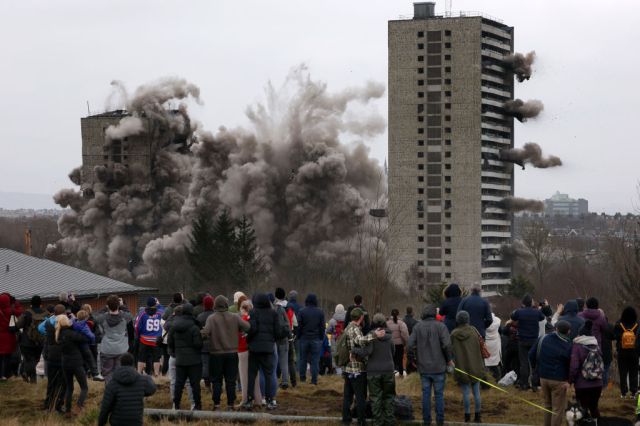
Spectators watch a demolition in Glasgow in 2025. (Jeff J Mitchell/Getty Images)





The current political mood in Britain makes it easy to lose sight of things. Even as Andy Burnham, Keir Starmer’s successor in waiting, gave his first major policy speech on Monday, economic trends were quietly deteriorating. Rachel Reeves had recently seized on strong first-quarter GDP growth to shore up the leadership’s claim to staying in office, but the figures largely predate the Iran crisis and obscure the underlying picture.
In April, the headline and youth unemployment rates stood at 4.9% and 16.2% respectively, with recent estimates suggesting that an additional 2.5% of the working-age population has taken up out-of-work benefits since 2018. Graduate and entry-level hiring is being reined in and vacancies have fallen below pre-pandemic levels. Meanwhile, as the energy shock from the Iran war works through the system, the Bank of England expects inflation to climb above 3% in the summer, keeping pressure on sterling, gilt yields, and already strained household budgets.
What has attracted less attention is the thing that, more than anything else, has anchored this country’s economic discourse and political imagination over recent decades, and which will exacerbate burdens for young people in particular: housing. Burnham himself seems acutely aware of this. “If you’ve not got control of housing,” he said last September, “you’ve not got control of the costs the country is facing.” In Monday’s speech he seemingly doubled down on making housing a priority, vowing to oversee “biggest council house building program since the postwar period” using “public land, vacant public land to reduce costs”.
Yet by any sensible measure, the housing price growth that marked the 2010s and early 2020s has come to an end. Nominal prices have been broadly flat nationally for nearly three years. London flat values have dropped more than 5% in 12 months, and two in five new-build buyers in the capital who sold in 2025 did so at a loss. HM Land Registry’s index shows real prices have fallen 12.4% from their 2021 peak.
Would it be so bad for this trend to continue? The cost of renting and homeownership in Britain is unusually high in international comparison. According to the English Housing Survey, private rental households spend on average 39% of pre-tax income on rent, with the poorest fifth paying 63% even after housing support, up from 56% in 2019-20. The latest OECD data show one in four UK households paying more than 40% of disposable income on housing; this puts it in line with Spain’s rate, and is significantly higher than Greece’s, Italy’s and Portugal’s, nearly twice Japan’s (12.3%), and almost four times Germany’s (6.7%).
The cohort most exposed, routinely spending over half their gross income on rent, is young people under 35 in London and the South East. Because average house prices in those regions run 10 to 13 times average annual income, these people are effectively locked out of ownership for the foreseeable future. A British private renter born around 1995 has minimal prospects of acquiring property without inherited capital, lives by necessity where entry-level jobs are concentrated and costs are highest, and faces the real-terms erosion of whatever savings they manage to accumulate. Wouldn’t an abatement of the trend that brought all this about be highly welcome?
Unfortunately not. When house prices rise, rents tend to rise too, partly because landlords set them as a desired percentage return of the property’s current value, partly because rising prices push would-be owner-occupiers into the rental market. When prices fall, rents don’t follow. Since house price growth peaked in mid-2022, rents have risen 27.7%, exceeding inflation by 3.1 percentage points. The asset has lost real value for those who hold it, and the cost has risen for those who do not. Because the share of income spent on rent is rising, savings can’t compound fast enough for a household to afford a deposit even as values fall.
So “let housing prices fall” is not the solution. And the economic effects of falling values could be widely felt and pernicious. To understand why, we need to consider how housing as an asset reshaped Britain’s political economy.
The main social divide used to be between those who earn from labor and those who derive income from financial assets. That is no longer quite true. The wealthiest households are now increasingly the highest earners in both categories at once, parlaying favorable labor-market positions into anything that generates capital gains. Life chances and intergenerational mobility are now decisively structured by access to asset ownership and the leverage it permits. Many ordinary households have come to act like financial firms, riding asset price inflation and using credit to acquire claims on future appreciation. Middle-class voters have been reconstituted around their capacity to participate in this game, and household balance sheets are now welded to broader economic trends in a way they once were not.
Britain is the most fully-developed case of this dynamic among large advanced economies, and the asset around which the game is organized is overwhelmingly residential property. In the most recent ONS national accounts, residential property and the land beneath it account for around 60% of UK household net worth, with the remainder consisting of pension and other financial assets that the average household cannot access until retirement. Outstanding residential mortgage debt sits at around 66% of GDP, having peaked above 80% after the financial crisis. The UK remains among the more mortgage-leveraged advanced economies, alongside Australia, the Netherlands and Canada; the corresponding figures for Germany, France and Italy run between 22% and 50%.
The concentration of household wealth in housing has a financial-sector counterpart. Around half of all UK bank lending now flows into mortgages, against roughly 15% reaching businesses; the German ratio is closer to one-to-one. The UK banking sector has organized itself around lending against bricks and mortar rather than productive capacity, producing a financial system whose principal activity is the inflation of an existing asset class rather than the funding of new investment. The coalition defending British housing wealth includes a mortgaged middle class whose housing costs are not the problem. The problem is concentrated on those who pay them rent.
This is the legacy of the post-1979 settlement. Thatcher’s government encouraged a particular kind of citizen: an owner-occupier whose stake in society was financial and whose political loyalty would be cemented by rising prices. The Housing Act 1980 and the Local Government, Planning and Land Act 1980 converted a substantial stock of public housing into a tradable financial asset. Around 2.5 million council homes were sold under Right to Buy at an average discount of 40%, and a stock that had peaked at almost a third of all UK housing fell to less than a fifth. The Big Bang reforms of 1986 transformed retail banking from corporate lending into secured household lending. The introduction of buy-to-let mortgages in 1996 opened residential property to leveraged investment in a way that had not previously been possible.
By the mid-Nineties, the British political class had constructed an economy in which housing was the favored store of household wealth almost by default. Capital gains on a principal private residence had been exempt from tax since 1965. There was no annual wealth tax, no imputed rent tax of the kind found in Switzerland and the Netherlands, and council tax bands had been frozen in 1991 values. The alternatives were inaccessible or unattractive: direct stock ownership had collapsed from around 54% of UK-listed equities held by individuals in 1963 to around 11% by the early 2020s, and the FTSE 100 returned far below the cumulative gains available to leveraged homeowners. Defined benefit pensions (fixed payout) were progressively closed and replaced with defined contribution schemes (payout depending on contributions over time and investment performance). The median household was left with housing as the only legible, accessible, tax-advantaged store of wealth on offer.
The resulting intergenerational divide is one of the most striking features of British politics: voting patterns now align extraordinarily well with housing tenure, and through tenure with age and asset position. The electorate divides crudely into three: an asset-holding coalition (homeowners above 50 outside London, around 13% of adults, voting two-to-one for the Reform-Conservative Right at high turnout); a renter coalition (under-40 private renters in cities, around 17% of adults, breaking two-to-one for Labour-Lib Dem-Green at lower turnout and dispersed across fewer seats); and the mortgagor middle (indebted working-age owners, around 29% of households, split nearly five ways). The mortgagor middle is the decisive swing constituency and its acute financial pains in 2024-26 have been driving Labour’s current collapse.
Charting this group’s balance sheet is therefore key to understanding how falling prices will play out. The immediate risk is negative equity. A household that bought a £550,000 central London flat in mid-2022 with a 90% loan-to-value mortgage, and has paid down only around £8,000 of principal, would tip into negative equity if market value fell below the remaining balance of around £487,000. London flat values have already fallen 8-10% nominally since 2022, leaving such a household with barely ~£10,000 to ~£20,000 of equity on a £55,000 deposit; a further nominal decline of 3-5% (well within range over the next 12 months) would push them under.
The consequences are immediate and self-reinforcing. The household cannot sell without realizing a cash loss to the lender, and cannot refinance onto competitive rates because the best deals are reserved for lower loan-to-value bands. They are locked into their current property and their lender’s standard variable rate, typically two to three points above the market. The equity withdrawal that has underpinned British consumption for four decades closes off entirely.
The cessation of housing price growth has broader macroeconomic consequences too, transmitting through three main channels: wealth effects, by which households feel poorer and reduce consumption; the credit channel, by which tighter lending against depreciating collateral suppresses the broader flow of credit; and the construction channel, by which falling prices make speculative housebuilding unviable in a sector that accounts for around 6% of UK GDP.
But the dominant mechanism in the UK is through mortgages. A recent study estimates that two-thirds of the consumption response to a UK interest rate change works through the asset price route rather than direct cash flow: as lower rates push prices up, households extract equity against the higher values and spend it. When prices stop rising, as they have despite the Bank of England cutting rates four times since autumn 2024, this channel closes.
These problems are compounded by the impending price shock from the Iran war. The crisis has already pushed UK inflation to 3.3% in March 2026, with services inflation at 4.5% and the Bank expecting CPI to climb above 4% by summer. Markets that previously expected two further interest rate cuts in 2026 have priced them out entirely and are now pricing a meaningful probability of a hike by year-end; one MPC member voted to raise rates on 30 April. Two-year fixed mortgage rates have risen by around 0.9% since the start of February. Around 41% of UK mortgage accounts, some 3.6 million households, will refinance from low-rate fixes onto these higher rates between mid-2025 and mid-2028, with the typical borrower facing a £107 monthly payment rise. And while the headline figure to mortgage arrears (the share of outstanding mortgage payments that are missed or incomplete) remains low by historical standards, this is because only part of the cohort has yet refinanced and the labor market has so far cushioned the shock. But the full transmission of the past four years of monetary policy is still partly ahead of us.
The UK’s exposure is unusual by international standards. British mortgages are typically fixed for two, three or five years, against a 30-year US standard, 10 to 15 years in Germany, and up to 30 years with refinancing optionality in Denmark. This gap is a consequence of the UK having a bank-based rather than capital markets-based housing finance system: banks prefer shorter fixes because it means less duration risk on their balance sheets. UK households therefore experience rate changes far more rapidly than households in any comparable advanced economy. The Bank of England prefers this arrangement, since it allows it to fight inflation by slowing the economy through the direct effect on household cash flows. But the recent unresponsiveness of prices to rate cuts implies the Bank has lost much of its ability to stimulate consumption once inflation ebbs. The main policy response to the coming shock will be politically painful in a way subsequent cuts cannot easily offset.
The mortgagor middle is therefore hit by compounding shocks simultaneously: falling real asset values, suppressed equity withdrawal, and rising nominal mortgage costs. The same household is losing wealth on the asset, losing access to credit against the depleted equity, and paying more in cash to hold it. The electoral consequences shouldn’t come as a surprise.
What politically plausible options remain? Rachel Reeves’s rent-freeze episode in late April was instructive. The Chancellor, casting around for a visible cost-of-living intervention as inflation crept up and local elections approached, briefly floated a temporary halt on private rent rises. Downing Street killed the idea within hours. The intellectual case against rent controls is straightforward: they tend to worsen supply shortages, accelerate landlord exits, and shift the costs of scarcity onto a less mobile cohort of tenants. But rent controls are usually meant not as a solution but as a circuit-breaker. Their use is indicative of a deep policy crisis and of a government caught in a bind. Any viable solution to the British housing question requires a deliberate diminution of the housing wealth held by the current voting majority — which is why such solutions have been politely set aside for 40 years.
The most obvious short-term response is to build more. England built 208,600 additional dwellings in 2024-25, and is broadly on track to repeat that figure in 2025-26, against a government target implying 300,000 a year. There are 1.34 million households on local authority waiting lists, the highest since 2014. London is the most acute case: just 28,576 new homes were completed in the capital in 2024-25 against a London Plan target of 88,000, with 23 of 33 boroughs recording zero housing starts in the first quarter of 2025. By contrast, Tokyo, whose population has grown at a similar pace to London’s, registers around 133,000 new constructions a year (or about 2.9 times as many homes per capita) with essentially no real-terms house price appreciation across the period. Over the same span, London prices have roughly tripled nominally and risen close to 90% in real terms. UK supply is constrained by excessive regulation, a planning system designed in the late Forties for a country with a state-led housebuilding sector that has not existed for 40 years, and the collapse of institutional capacity to build public housing at scale.
Another source of pressure is the market’s openness to global financial flows. Around 27% of London residential transactions in the first quarter of 2024 went to foreign buyers. The aggregate, at 189,793 properties in England and Wales at the end of 2024, is modest in volume but concentrated at the top of the market in ways that ripple through the price chain. An LSE study suggests every 1% increase in foreign transaction share is associated with a 2.1% rise in local house prices. UK residential property functions as a sterling-denominated safe-haven asset for international wealth, particularly from Hong Kong, Singapore, the Gulf and increasingly from a politically uncertain United States.
In economic terms, removing barriers to construction and restricting openness to global investors are viable responses to both the affordability crisis and the pain that stagnating prices will bring. But politically the problem runs deeper. Britain has reconfigured its economy in a way that is difficult to unwind. For four decades, rising house prices have stood in for productivity growth, wage growth, pension provision and, in some sense, the legitimacy of the broader economic order. The country has tolerated the long stagnation of real incomes after 2008 in part because the value of the asset under each homeowner’s feet kept rising. As the market reverses, that settlement is under strain.
What we are likely to see is a slow, grinding adjustment of the kind central London has been undergoing for a decade, and that Japan has lived through since the early Nineties. Japanese housing has been broadly flat or falling in nominal terms throughout that period. Most Japanese have come to accept this as normal, partly because homes are now treated more as depreciating consumption goods than appreciating financial assets, and partly because the broader macroeconomic settlement simply does not depend on rising house prices in the way the British one still does.
In Britain, too, the adjustment could be slow, painful, and accompanied by a long-term shift in household wealth composition that takes a generation to play out. Years of real-terms stagnation will erode housing wealth without provoking a full nominal collapse; persistent inflation will quietly redistribute purchasing power from creditors to debtors; the political coalition that defended the settlement is aging out of the electorally decisive cohorts. That coalition is dominated by property-owning over-55s who benefited from buying into a rising market and now vote in disproportionate numbers; their children stand to inherit. It is at their expense that the tacit settlement of the 2010s will have to be redrawn. Any government serious about solving Britain’s housing problem has to face this head on.
