




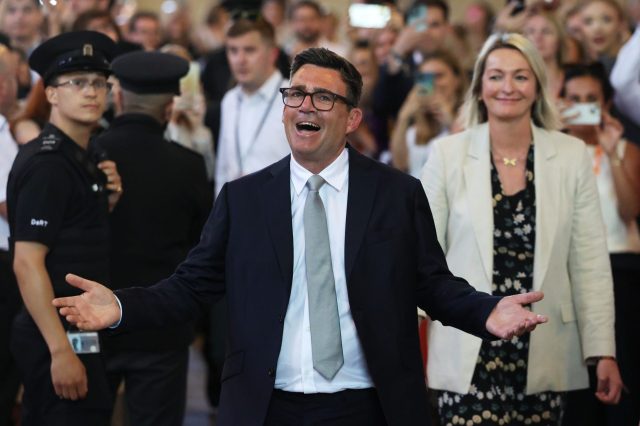
Meet the new boss, the same as the old boss. (Dan Kitwood/Getty)





The political temperaments of Keir Starmer and Andy Burnham couldn’t be more different. While the current prime minister is a sober, plodding proceduralist, whose worldview has been forged by decades of litigation, Burnham’s approach is based on instinct. Yet if media attention, perhaps understandably, has focused on how they speak, or how they dress — no suits for the constantly t-shirted Burnham — their substantive differences are clearest in how both think about devolution. That feels particularly pertinent given how loudly the incoming PM has asserted his localist credentials. Beyond announcing a “No. 10 North”, and hinting he wouldn’t even live in Downing Street, Andy Burnham has already promised the biggest “rebalancing of power our country has ever seen”.
In theory, of course, we’ve been here before, with Starmer also trying to connect English devolution with a post-Brexit politics. In 2023, while still in opposition and riding high in the polls, Burnham’s soon-to-be predecessor said his plans for devolution would transform “‘take back control”’ from a slogan into a solution. Alas, things turned out rather differently. Indeed, if a single issue encapsulates the pathologies of the Starmer regime, it is local government reorganization (LGR) — the outgoing PM’s plan to streamline councils — as well as the introduction of more metro mayors. In the two years since 2024, when a flagship white paper was published to address both, quiet constitutional radicalism has met with ever more farcical incompetence. This is Starmerism: triple-distilled.
Because so much else has happened, it’s easy to forget just how ludicrous parts of that agenda are. From 2028, for instance, the largest city-region in Europe will be the combined “metro area” of Norfolk and Suffolk. Feted to have a single mayor overseeing a fiefdom of some 9,200 square kilometers, that mayoral authority will be around the same size as Cyprus — and six times larger than Greater London. The idea of Norwich being the administrative capital of a city-state, eclipsing Madrid or Paris in scope, sounds like something from an Alan Partridge fever dream. For Keir Starmer, it was simply part of re-forging the British state.
Almost as bad is the proposal for a single mayor to cover the whole of Hampshire and the Isle of Wight. Given the uproar when Emirates sponsored the Spinnaker Tower in Portsmouth, and planned to paint the iconic building in the same colors as Southampton football club, it’ll be interesting to see how the two places integrate. In Portsmouth, the nickname for the denizens of Southampton, some 17 miles away, is “scum”. Those who live in the home of the Royal Navy, meanwhile, enjoy the nickname “skates” (you’ll have to Google why). There is no history of collaboration between the two cities — both of which enjoy almost 1,000 years of continuous history. It’s a similar story with Cumbria, soon to be a metro area as well as a county, with the authority forecast to be over twice as large as France’s largest municipality. That’s despite the fact that Carlisle, Cumbria’s largest city, has a population of just 100,000, and the region is best known for the empty Lake District.
Would Burnham repeat such bizarre absurdities? There are grounds for cautious optimism. In February 2023, Burnham spoke to the journalist Steve Richards. There’s little reason to be cynical about his remarks at the time, not least because his chances of a national comeback seemed negligible, with Starmer riding high in the polls. And yet, for more than half an hour, the then-mayor for Greater Manchester spoke convincingly of a “place first” approach to devolution. “In a post-Brexit, post-pandemic world,” Burnham intoned, isn’t it clear “that Whitehall can’t cope with this? It’s struggling, and it’s because the wiring of the county isn’t right.”
Throughout that conversation two things stood out. The first is how, for Burnham, any localist agenda must fit the needs of communities which already exist. “Legitimacy comes from the people and the place,” as he puts it. Which makes you wonder whether plans for an East Anglia super-region, let alone a South Coast version of Neom, will truly come to pass in his premiership. The second is how devolution isn’t merely a means to rewire Britain’s economy, but to determine which issues matter in the first place. Whitehall’s inability to craft solutions partially stems from the fact it has little idea what the problems are. Policy-making, in the argot of the former Manchester mayor, is thus divorced from place.
Three years on and it’s clear that, in other ways too, Starmer has continued with the very approach Burnham was skeptical of. For all Starmer’s talk of dispersing power away from London, and the public really taking back control, his faction essentially selected the Labour candidate for the west of England mayor (the now disgraced Dan Norris), while blocking Jamie Driscoll from standing in the North East. Then there were the times the leadership’s retinue made Richard Leonard resign as the party’s Scottish leader, and steered the controversial Vaughan Gething to the role of first minister in Cardiff. Starmer, and much of the Labour Right, were comfortable with devolution, and “giving power away”, so long as those who received it agreed with them.
That hints at another divide with Burnham, who, whatever his other faults, seems to have shed any factionalist baggage. He was certainly a Blairite upon entering Parliament in 2001. Yet in his speech on Monday, he took aim at the whipping system and its tendency to foreclose political debate. Looking further ahead, of course, it’s hard to see how a “place first” approach won’t clash with the political management of the Labour establishment: including its propensity to parachute in preferred candidates for “safe seats”.
Still, it’s a start, especially when you consider that Starmer’s approach to local politics — arrogant, entitled and defined from the center — was so inept that it actively undermined confidence in the need for reform. Starmer’s LGR was meant to be the biggest shake-up of local politics in England since the Sixties. If more mayors, furnished with greater powers, is about enhancing democracy, then LGR was about delivering a more standardized bureaucracy across England. Fair enough: my home county of Hampshire presently boasts 15 different authorities, including “two-tier” district and county councils. LGR means that number will fall to five unitary authorities, all enjoying the same range of competences.
While the changes make sense in theory, as has often been the case with Starmer the execution has been disastrous. Why? Because reforming ambition was encumbered by hubris, which in turn fed incompetence, something extending far beyond ambitions of conjoining old rivals like Southampton and Portsmouth. Starmer’s government, with its enormous majority, sought to remake key parts of national life at breakneck speed. As a result, many councils regarded the timetable as unrealistic, with authorities expected to develop new unitary structures, governance arrangements and financial models within months. It often felt like No. 10 was applying the principles of DIY SOS to the biggest overhaul of local government in over half a century.
Alongside the rush, far-reaching questions remain unanswered. For instance, will newly integrated authorities have to pool historic debts? Would a council broadly in the black (such as Portsmouth) have to absorb liabilities from another in the red (like Hampshire County Council)? And if an authority that runs surpluses integrates with another that runs crippling deficits, what help is on offer from the Treasury? These are, understandably, huge points of contention for council leaders across the country. Yet they have been met with little more than hand-waving and vague promises of things being alright in the end. Speak to almost any council leader, and you’ll likely hear shock at how blasé and reckless London has been throughout.
Which brings us to another major difference between our prime ministers, present and future. While Starmer viewed local government re-organisation, and more metro mayors, as a means of achieving growth within the existing model, Burnham regards empowering city-regions as a way of bypassing No. 11 and the most dysfunctional parts of Whitehall. That is, after all, the subtext of him opening an office in Manchester. While the primary aim is to take power out of Westminster and, as Burnham put it this week, create a political “circuit-breaker”, a secondary aspect would be to strengthen the role of the prime minister himself.
Whatever you think of it, at least that’s a vision. Compare it to the LGR, whose preference for a “unitary layer” for local government emerged from a single paper published by PWC. The ultimate argument for those vast mayoral authorities from Hampshire to East Anglia, meanwhile, can be found in a report compiled by McKinsey. Why the need for such scale? Because, in order for regional governments to compete for investment, that’s what’s required — with two million inhabitants apparently the starting point to create sufficient capacity, generate adequate brand recognition, and access the right tier of investors.
In other words, those new mayors up for election two years from now are less about empowering local people, or reviving England’s smaller cities, than ensuring creditworthiness. This is why somewhere like Cumbria is suddenly expected to become a city-region. And while this again may sound coherent in principle, you have to question whether such contrived and synthetic entities will garner sufficient democratic legitimacy in the long-term. History and tradition — Portsmouth’s star-and-crescent flag goes back to the Third Crusade — is apparently irrelevant to a Treasury that regards city-regions as little more than economic zones. In a way, it’s strangely reminiscent of arguments for greater European integration made by liberals in recent decades. Reducing transaction costs matters more than anything else. For Burnham, though, if cities are certainly a locus for policy experimentation, they are also places with heritage, history and a continuous culture. His passion for Manchester makes that clear enough.
Ultimately, the two men view devolution as a path to different things — which makes you wonder whether Burnham as prime minister will move to re-assess LGR, let alone oddities like a city-region for Norfolk and Suffolk. And, while we’re at it, why not give the Southampton and Portsmouth city-regions a mayor each? That’s what would happen in any vaguely sane polity.
Which leads us to yet another major fissure between the current prime minister and his successor, with Burnham repeatedly criticizing much of the devolution agenda since 1997. He expressed as much in Monday’s speech, when he promised to offer “new opportunities to extend devolution” in the Celtic fringe by taking power “deeper down”. In words intended for the SNP and Welsh Labour, as much as the inhabitants of such places, Burnham remarked how the “people of Dundee and Bangor feel just as distant from Holyrood and the Senedd as they do from Westminster”.
Now, you might point out, Holyrood and the Senedd are consequences of Blairite reforms. Does Burnham, a former New Labour minister, think they were a mistake? The answer appears to be yes, with Burnham admitting as much while speaking on that podcast with Richards. The original sin of Scottish and Welsh devolution, according to our next prime minister, was the “same Westminster approach… where it’s all national and there isn’t that routing of power at the local level”. Rather than truly empower voters in Wales and Scotland, the Blair government created dysfunctional mini-mes in Edinburgh and Cardiff: places whose political cultures are every bit as complacent as London.
Starmer, by virtue of his connection to Morgan McSweeney and the Labour Right, could never voice such a critique. In theory, the same should be true of Burnham, given his past or present ties to Blair, David Miliband and James Purnell. Yet he’s broken ranks with his old comrades in stating that the city-based approach of the English North — whose champion is none other than George Osborne — has proven more successful.
Perhaps that’s exactly the kind of mold-breaking that’s needed. After all, the historic party of social democracy is betting the house on something which hasn’t worked for a century: pushing power to towns and cities far beyond the M25. Given Westminster’s tendency to hoard power, that’s a huge ask. Burnham’s localism agenda may ultimately end up giving him more influence — not least if he becomes ally-in-chief to existing mayors and council leaders, especially if he spikes the worst aspects of LGR — all while he undermines both the Civil Service and Parliament. As the incoming PM ominously added in Monday’s speech, the political direction he will set “will not be up for negotiation”. Still, even a President Burnham would probably be better than what we have now: spreadsheet devolution with voters a mere afterthought.
Aaron Bastani is the co-founder of Novara Media, and the author of Fully Automated Luxury Communism.
 AaronBastani