




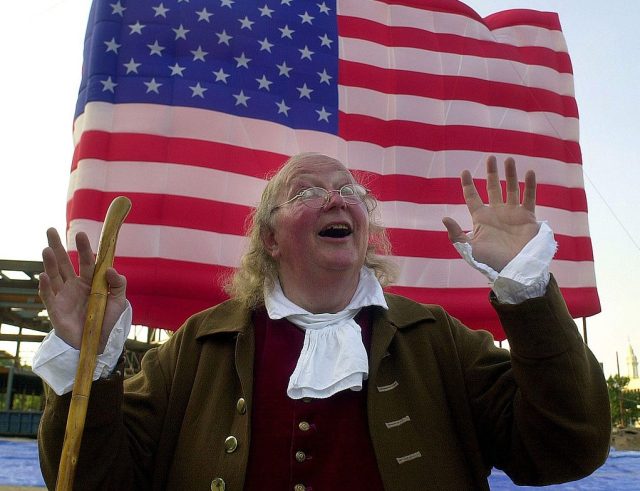
'The ink spilled on the much-ballyhooed “Founding Fathers” could fill Boston Harbour.' (William Thomas Cain/Getty)





The ink spilled on the much-ballyhooed “Founding Fathers” could fill Boston Harbour. There’s Thomas Jefferson, the sphinx-like figure of American politics, a man who can be read as the origin point for nearly all of American political culture. Or else there’s Alexander Hamilton, who weirdly operates much the same way, albeit in eerie opposition to his Monticello rival, the industrializing ying to Jefferson’s agrarian yang. Together, anyway, the Founders serve as inscrutable screens onto which Americans can project their ambitions for a massive national government — or a small-state utopia — all while validating their personal ambitions and rags-to-riches dreams.
If, however, the mythic figures sit atop their dueling perches, guarding the entry point to America’s political psyche, inside the sanctum lies the most sacred relic of all: the US Constitution. Yet that relic is not the guarantor of liberties that most Americans imagine. Rather, it’s the legal scaffolding of an elite-led counter-revolution — the same one that today lets tech billionaires drop power-guzzling data centers into communities that never asked for them.
In individualistic terms, America remains the most economically “free” country in the world, but also among the most atomized, alienated and unequal. Most Americans don’t realize, however, that it didn’t have to be this way. After all, how many have ever heard of Shays’s Rebellion — a massive class revolt led by ex-revolutionary soldiers, one that almost toppled the government and could have saved working people from 230-plus years of Constitutional tyranny?
To be clear, 1776 is nothing to be ashamed of. Indeed, the Revolution was arguably the greatest democratic uprising in world history. Much of that national mythos is worth preserving. Three cheers for the war against the Brits. Yet if the struggles from Lexington to Yorktown remain the quintessential Anglo-liberal uprising, a genuine David-and-Goliath triumph, selling that narrative has meant omitting what happened to the common foot soldiers of the Revolution itself.
The glorified writers of the Federalist Papers — John Jay, Alexander Hamilton, and James Madison — explicitly didn’t want mass democracy. During the Constitutional Convention, launched in spring 1787 and convened meant to hammer out the document’s details, Hamilton pushed for a president serving “during good behaviour”. In other words: an elected king enthroned for life, much like the Supreme Court. Hamilton and his friends also pushed for a congressional veto on all state legislation, in effect allowing for total national and elite-led control of local government. That was shadowed by other elitist institutions, notably the Senate and the Electoral College. Voting, too, was to be the preserve of the propertied few: discounting women, slaves, and poor white men, the franchise in the early US encompassed just 6% of the population.
The true heroes of the early US, then, were the Anti-Federalists. An everyman group of farmers, ex-soldiers, and small property holders — none of them have ever received Broadway hagiographies or had their faces plastered on dollar bills. Yet they were the families who fought and died for the Revolution, risking their lives to overthrow the British and who now expected government both by and for the people.
How did the wealthy merchants and bankers pushing for the Constitution respond? By economically destroying the little guy. Due to governmental dysfunction — and the fact the poor and propertyless were locked out of voting — a large percentage of veterans remained unpaid for years after the redcoats left. Even worse, many had mortgaged their homes and farms to finance the fight for independence, with the government promising repayment that never materialized. Little wonder these men rose up, under the former colonel Daniel Shays, to resist the injustices of debtors’ prisons and restore what they saw as the Revolution’s democratic spirit.
Not that Shays himself was some permanent rabble-rouser. Born not far from Boston, he fought at Lexington, Bunker Hill, and Saratoga, was wounded in action, and handed a ceremonial sword by none other than the Marquis de Lafayette. It’s a sword Shays was later forced to sell to cover his debts. By the autumn of 1786, the veterans and common folk of western Massachusetts had had enough. Armed bands of farmers — mostly veterans — marched on the county courthouses and shut them down by force, reasoning that a court that can’t convene also can’t foreclose on their neighbors and friends.
And so, for a few months, these insurgents effectively governed the western half of Massachusetts. The Commonwealth’s authority simply evaporated under popular pressure. Then, in January 1787, Shays led roughly 1,500 men against the federal arsenal at Springfield, aiming to seize its weapons and turn them against the state governments, which they believed had been captured by wealthy coastal merchants and big farmers. They never reached the gates. A militia — privately financed by a syndicate of Boston merchants, since the bankrupt state couldn’t afford one — met them with literal cannon fire. Four Shaysites fell dead in the snow. Upon seeing the ruthlessness with which these hired guns pursued them, some of the Shaysites are said to have died from fright. The rest scattered, before being hunted across the hills through a brutal winter.
What would Shays have done if he and his rebels had been able to take the arsenal at Springfield? In an interview with the Massachusetts Centinel, the colonel suggested that, once the rebels were armed to the teeth, they planned “to march directly to Boston, plunder it, and then destroy the nest of devils, who by their influence, make the Court enact what they please”. Given the scale of the betrayal of these revolutionary soldiers — and seeing how American business have dominated the country’s government since — it’s hard to argue against him.
In the end, though, the country’s greatest ever class rebellion ended in failure. Shays himself was eventually pardoned, though would later die in drunken poverty. But the fright it put into the propertied classes endured. Word of the uprising reached Mount Vernon, and a rattled George Washington was coaxed into running for the presidency. Meanwhile, the rebellion’s shock directly spurred the wealthy establishment’s drive for the new constitutional order, replacing the radically localist politics of the revolutionary era with a system designed to stabilize property relations and restrain popular democracy.
It worked. All the attention on slavery and race in American history overshadows the essential fact that, in most cases, the poor and propertyless were not allowed to vote until the Jacksonian era, some 40 years after the Constitution’s passage. Nor does the document’s malign influence, or the resonance of Shays’s Rebellion, end there. Far from being a quaint historical curiosity, the revolt’s failure was both the spur for today’s legal order and the decisive turning point in American political development: with the Constitution amounting to, essentially, an elite-led counter-revolution where the democratic energies of 1776 were deliberately caged to protect bankers, creditors, and commercial elites from popular pressure. The Presidency, the Senate, the Supreme Court — all these elements were explicitly designed to curb democratic energies and ensure that property holders were protected from the “factionalism” of the “mob”.
The anti-majoritarian architecture built in 1789 continues to imprison American governance to this day. Beside the absurdity of the Supreme Court’s Citizens United decision — which allows money to be treated as legally protected “speech” — nothing illustrates this better than the data-center boom. No one except tech billionaires wants these things: certainly not in their own communities. And yet they pop up everywhere, including the now-notorious “Stratos Project” in northern Utah, funded by investor Kevin O’Leary, and which would immediately require more power than the entire state uses in a year. Just like the spread of Walmart in earlier decades, often against the will of the communities the shopping centers invaded, the spread of data centers is enabled by precisely the tyranny of property holders the Constitution was built to make possible.
The shadow of the nation’s Constitutional counter-revolution extends to nearly all the great economic problems of American life. The same logic that crushed the Shaysites — creditor over debtor; centralized elite over localist self-rule; property rights over political rights — runs through American political economy to this day, from the Wall Street bailouts after 2008, to wars fought for corporate interests, to the relentless algorithmic extraction of the gig economy.
If the civics-touting Right remains in hock to the Constitution, the Left’s critique isn’t much better either. For all the supposed radicalism of the 1619 Project, Nikole Hannah-Jones’ undertaking was merely a continuation of the trend among elite storytellers and academicians who ignore class entirely, and instead seek to turn the Founding into a different kind of myth useful to their political project. For Hannah-Jones and rich readers of the New York Times, certainly, it’s useful to make race and gender — not class — the Founding’s dominant feature.
How, then, might we build a better tomorrow? In the first place, by recognizing that the Constitution wasn’t totally hopeless. The Bill of Rights, of course not pushed by Hamilton, Madison and the other Federalists, enshrined John Locke’s idea of limited government into law, and opened an eventual pathway for liberal democracy globally. In other words, then, the future rests not on the DSA socialism of Zohran Mamdani, nor on the Sanderistas, but on returning to the localist tradition Shays tried to defend. It’s a tradition Anti-Federalists sought to preserve as much as possible: hence their insistence on an extensive list of governmental “thou shalt nots” throughout the Bill of Rights. Yet if this exists entirely in the realm of what political theorists call “negative rights” — in other words freedom from rather than freedom to — this is ultimately a mischaracterization of the Anti-Federalists and their politics. Without our Anti-Federalist strand, the fight to end property restrictions on the right to vote, which propelled Andrew Jackson into office, would never have been completed. Franklin Roosevelt’s New Deal probably wouldn’t have been possible either.
If, in other words, fighting the Constitution means encouraging “localism”, that’s less abstract than the term implies. For instance, it would mean turning antitrust law, mostly dormant for two generations, against the tech monopolies, just as trustbusters once stymied the railroad barons. It would also mean encouraging right-to-repair laws, letting people own the machines they buy outright, while keeping banks accountable to the towns they lend in — instead of hands-off regulation-haven states like Delaware.
More generally, reviving the American Revolution means reducing the power of the national government over the states: both the intention of the 1776 revolution and the only way a true democracy can function. Recall, again, that the revolutionaries were committed to small-“r” republican governance, which meant as many people as possible participating actively and often in the political process. Pretending that the system we have now is a “democracy” in line with the intentions of our 1776 founding is in itself a betrayal.
The time for change, in short, is now. Tech monopolies and their ruthless gaming of the legal system are gutting whatever’s left of the Revolution’s democratic spirit. The trillionaire class that AI’s rise will produce is the final boss stage of the elite-led counter-revolution that began in 1787. As we speak, the elite are exploiting the supremacy of property law provided by the Constitution to ensure technology serves no one but their makers, keeping the few rich and the many surveilled. Technology itself, though, remains neutral. The material conditions of the present — remote work, decentralized production, drone-assisted agriculture — may, practically for the first time since the Revolution itself, revive the localist, democratic spirit the Constitution was designed to suppress.
Whether this happens depends on something the localists have been trying to tell us for 40 years. In his 1985 book Habits of the Heart, Robert Bellah warned that a republic organized around private accumulation forgets the language of the common good — and loses the civic muscles self-government actually runs on. To paraphrase Michael Sandel, we have traded the citizen, who helps govern the forces that rule his life, for the consumer, who is merely ignored by them. That trade, in a sense, is the counter-revolution’s deepest victory: a whole people taught to mistake being unbothered for being “free”. The key question now is whether Americans can recognize their own revolutionary inheritance before the counter-revolution completes itself and all working-class children are illiterate, device-addicted serfs who own nothing and “like it”.
B. Duncan Moench is a writer and scholar of American political culture. He also writes the Producerist Substack.
 DuncanMoench