




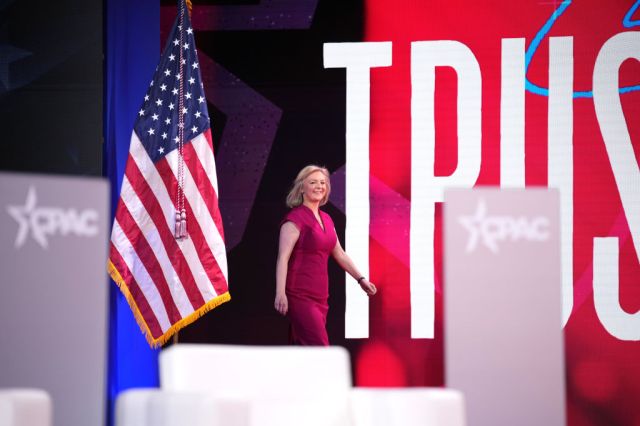
Liz Truss at the 2025 CPAC in Maryland. (Andrew Harnik/Getty)





What is a conservative? For Michael Oakeshott: someone who prefers “the familiar to the unknown” and “present laughter to utopian bliss”. For Roger Scruton: someone who wants to protect repositories of shared knowledge “rather than pull them down”. But for anyone emerging, bewildered and blinking, from this week’s inaugural CPAC Great Britain, the answer might not have been so clear. After two and a half days of sermons on the fall of the West, and panels with titles like “Taking on the British Deep State”, it was easier to define what this bombastic new brand of conservatism is against — socialism, political Islam, “the Blob” — than to glimpse any kind of positive vision.
In a sense, that’s unsurprising. It may have been the brainchild of former prime minister Liz Truss, but the Conservative Political Action Conference is a fundamentally American import, and this week’s gathering in central London borrowed its presentation and language from MAGA and the US Christian Right. Thursday morning began with a prayer session led by Judd Saul, introduced over tannoy as “the founder of persecuted.com”, who bellowed at attendees still bleary-eyed from the previous night’s World Cup heartbreak that “the West has turned away from God.”
Subsequent speakers entered to booming beach-club music and flashing overhead lights. Former Reform UK candidate Matt Goodwin started his speech by thanking Donald Trump and JD Vance “for calling out what is really happening in this country”. Jack Posobiec, an American Right-wing activist, claimed from the stage that “God has a plan for Donald Trump”, exhorting supporters to “restore God to the very core of Western civilization”. While “GB” might have been tacked on to the end, this was, in spirit if not in scale, CPAC for an American crowd. Attendees were as likely to have come from Palm Beach as Paddington, with US lobbyists enthusiastically discussing how they’d save Britain from destruction.
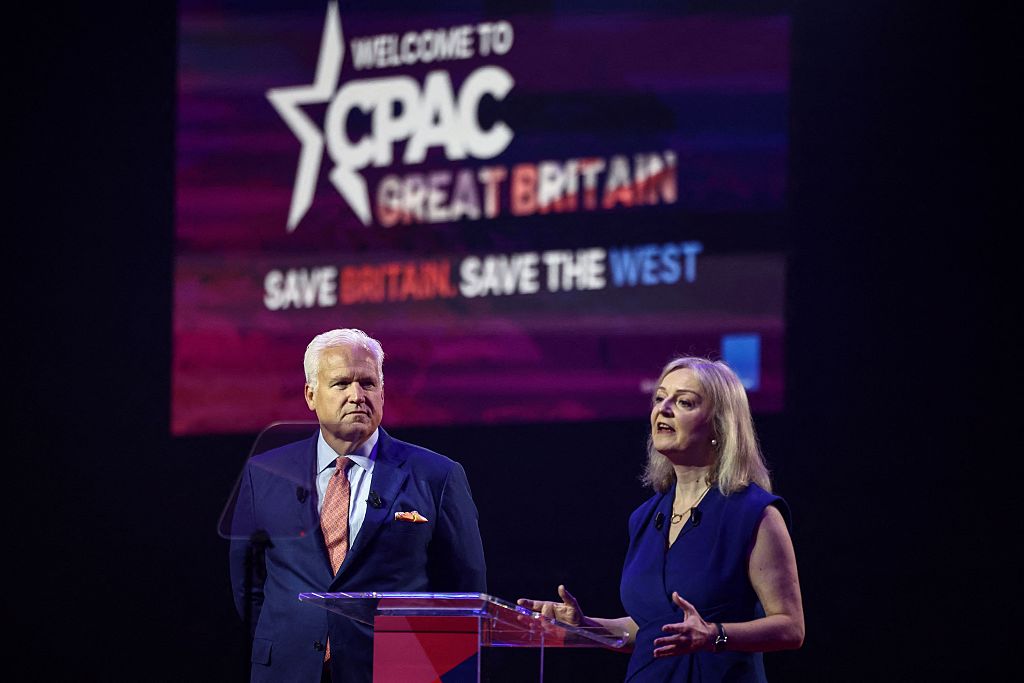
Amid it all was Truss herself who, having lost her seat at the general election two years ago, has reinvented herself as an American-style culture warrior, appearing at CPACs from Maryland to Texas. Yet whatever her own enthusiasms — she recently claimed Trump was “right about everything” — it’s safe to say that the former PM doesn’t command Don-level support. Among most Britons on the Right, she inspires not adulation but a kind of morbid curiosity, like a Victorian circus act which, in place of physical contortions, finds novel ways to blame the “deep state”.
At CPAC GB, Truss giddily addressed near-empty rooms in a hotel next to the O2 Arena, taking aim at the “socialists, Marxists, communists, whatever you want to call them, [who] want to destroy our country”. “It used to be honorable to love your country,” she continued. “Now it’s honorable to love illegal migrants.” Never quite shaking off her much-clipped 2014 “pork markets” speech, Truss still has a habit of shouting the wrong parts of her sentences and grinning at otherwise serious moments. After the “illegal migrants” quip, she took a moment to let the joke land, with the audience remaining largely uncooperative.
That indifference is partly a function of how quickly politics now moves. Truss had already been replaced twice in Downing Street, and with a third new prime minister arriving on Monday, CPAC felt more and more like a sideshow, whatever her claims that Andy Burnham would be turfed out of office before 2029, another victim of “40 years of massive state failure”.
Of course, for 25 of those 40 failed years, including Truss’s 50-day tenure, the UK has been governed by the Conservative Party. This isn’t a chink in her argument but a central part of it. The party of which Truss is still a member has, she claimed, been “ideologically captured” by “DEI”. Other speakers agreed. According to CPAC chairman Matt Schlapp — the husband of the gloriously-named Mercedes Schlapp, a one-time Trump official who also spoke at the conference — the party “doesn’t deserve the label of ‘conservative’”. Given all this, former Tory leader Iain Duncan Smith appeared hopelessly out of place when he spoke about “post-Brexit regulatory reform”, his earnest suggestions mere filler before the juicy stuff on radical Leftist takeovers.
The Conservatives, then, had no place at the Conservative Political Action Conference. In fact, contempt for the Tories stretched almost as far as hatred of Keir Starmer, and warmer receptions were reserved for Reform UK politicians including Goodwin and Suella Braverman. Kemi Badenoch’s platform, in this telling, is part of the “uniparty”; Nigel Farage and crew are the insurgents who can reverse Britain’s decline. If there was one dominant theme of CPAC GB, it was the pitting of the Right against the liberal-progressive establishment.
This antagonism extended beyond the established political parties to the mainstream press. Truss described the BBC as “basically state-controlled media, churning out propaganda 24/7”. She called for a “parallel media” to battle the institutions, given that “a lot of the truth about what’s going on in Britain is suppressed.” Anyone liable to be brainwashed by Adolescence should instead “go on X” and “watch independent podcasts”. Truss suggested, cadging a phrase from the identitarian Left, that “they need to educate themselves.”
In the event, her media enemies were largely absent. Reporters from national papers were in short supply, and the BBC nowhere to be seen. In their place was a new class of correspondent, the “citizen journalist” or “newsfluencer” — young, enterprising content creators on the political Right with names like BasednBougie. They stood a few feet apart from one another in a foyer outside the auditorium, armed with selfie sticks and mini tripod stands and portable lights, speaking into their phones as the remnants of a dying trade looked on. Young Bob, a rising online activist who turned 18 earlier this week, observed that the CPAC attendees “are quite old, and they’re the same old people who would consume anything the Right-wing gives.” He described himself not as an influencer but as “a random geezer on the internet”. The parallel media envisioned by Truss has already arrived.
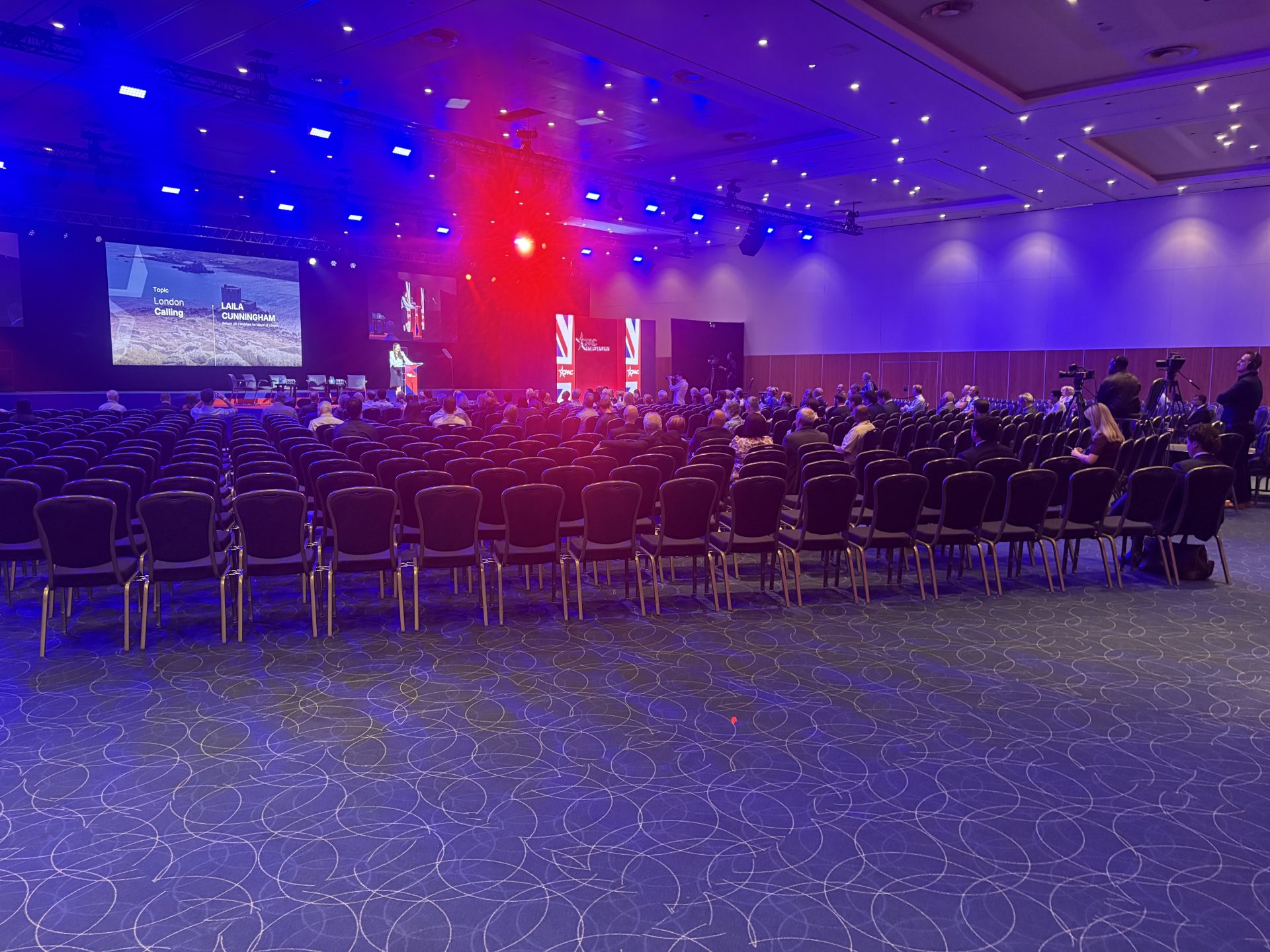
Yet if CPAC GB is so in tune with this new information landscape, the question remained: where was everyone? In a conference room with roughly 500 seats, most sessions were well under half-full. Pricey tickets might have been a factor — the priciest ran at £10,000 — giving proceedings the feel of a corporate function rather than a grassroots rally. Ditto the fact that the bulk of the conference took place during the working week. One attendee complained that it “felt more like an elitist Westminster networking event with flashing lights” and “very few ‘normal’ people”. A faultlessly polite American man in his twenties handed me a magazine whose cover piece was titled “Conspiracy for global control”. Other articles intriguingly pointed to the “Deep state behind the deep state” and “The conspiracy against God”.
There’s also the possibility that British conservatives are simply spoiled for choice on the jamboree front. CPAC is just one of a constellation of Right-leaning, acronymed conferences to emerge in Britain in recent years, from NatCon to PopCon to ARC — or, with its own blend of deafening entrance tracks and high camp, there’s always Reform’s annual party conference.
As the event progressed, Farage increasingly felt like the ghost of CPAC future. Each speaker, including ex-Cabinet ministers and former European presidents, felt small compared to him. Truss, too, seemed less stateswoman than compere, engaging foreign delegates in the intricacies of the Westminster swamp. As for attendees, they seemed bound by admiration for the man they universally called “Nigel”. He was booked to appear at 4:30 on Friday afternoon, almost exactly coinciding with the closure for nominations in next month’s Clacton by-election.
When the British Trump finally arrived, the auditorium, sparsely populated until that point, filled almost to capacity. Around two dozen Reform staffers patrolled the edges of the room, as mainstream journalists who’d studiously avoided covering the rest of Truss’s festival descended on Greenwich. An announcer welcomed the man who found himself on the wrong end of “a kangaroo court in Parliament” to a standing ovation several times the volume of anything Truss received.
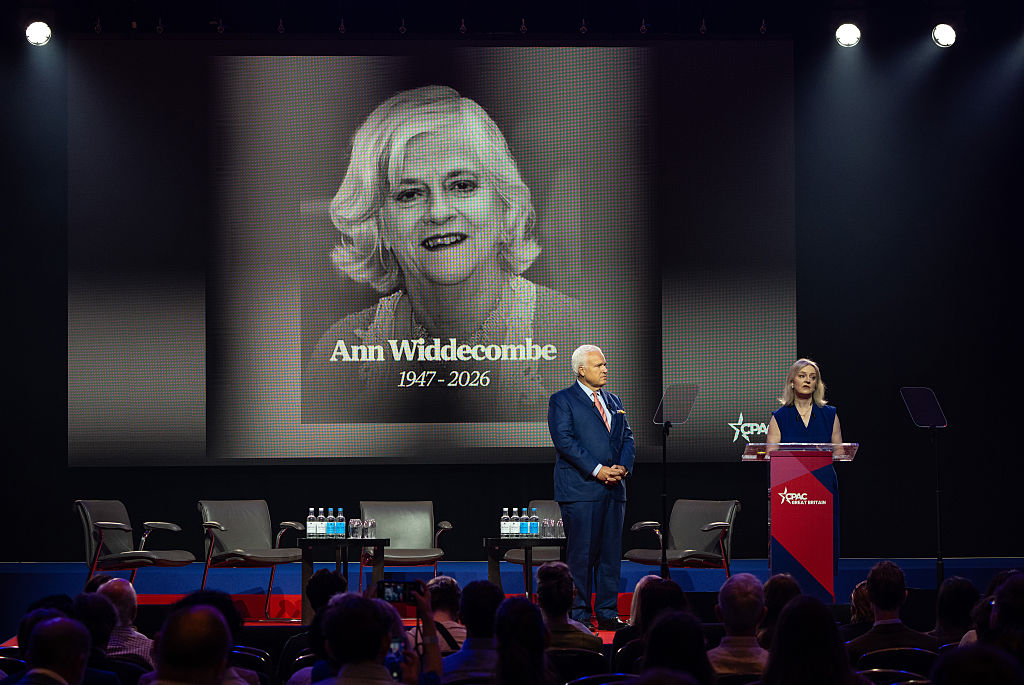
Scrutiny over his finances has already produced a darker Nigel than the chirpy showman we’re used to; during a tense confrontation earlier this month, he accused Sky News of “harassing” his family, later posting online that its reporters were “liars”. Just as Truss did at CPAC, Farage has drawn a dividing line between the political establishment and pliant press on one side, and his own populist revolt on the other. Tensions have risen further following the killing of Reform spokeswoman Ann Widdecombe last week, with some CPAC speakers preparing for battle in response. “This,” Truss stated bluntly, “is a war”.
And, to an extent, Farage’s speech echoed the uncompromising tone that preceded him. Rather than a call for unity on the Right, or a broader celebration of conservative values, Farage delivered what could fairly be described as a Reform party political broadcast. “We are the dominant force on the Right of British politics,” he announced. “I don’t believe the last Conservative government can ever be forgiven.” More cheers from the crowd. Farage’s speech also came with a New World twang. Comparing his recent financial travails to the US President’s treatment by his political opponents, he claimed he had been “demonized” by the British establishment.
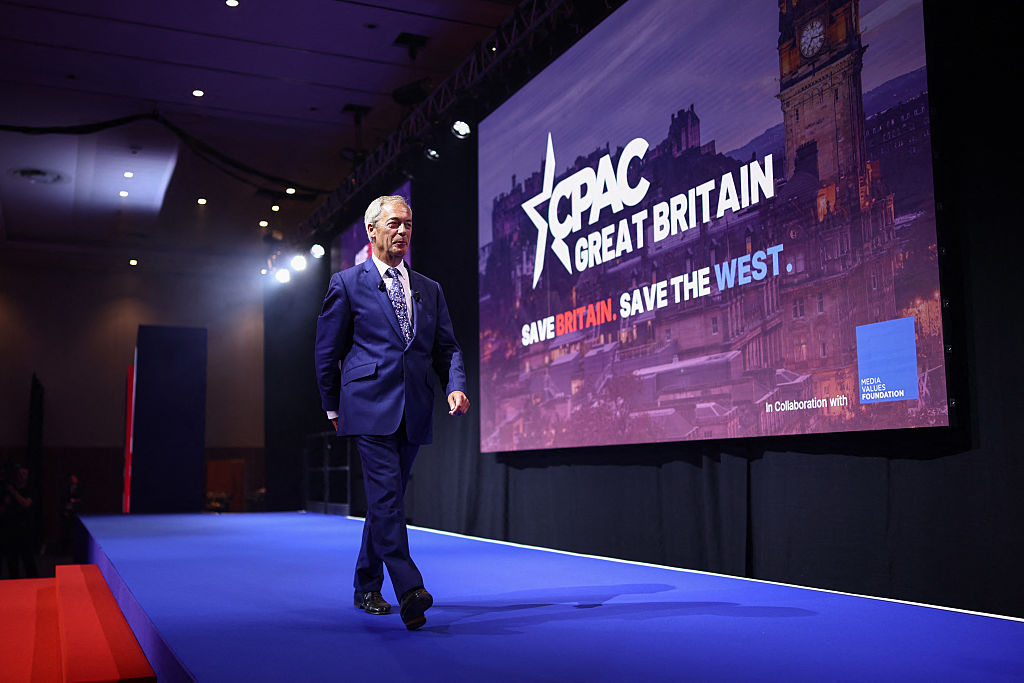
Yet where Truss and the visiting Americans had positioned the coming fight as rooted in Christianity and “Western values”, Farage’s focus was ultimately on Britain itself. He was angry that the UK was “a decade away from turning into a third-world country”, and insisted that “we are engaged in a battle for the very soul of our nation.” Burnham, for his part, was “utterly vacuous” — the “great chameleon of British politics”. Tonally, too, Farage was different. After two days of MAGA playacting, his speech was serious and statesmanlike. He set out a clearer vision of British conservative values than any of the America-brained attempts that came before, praising those “who actually believe in family, community and country, and decency and democracy and free speech, and putting the national interest first”. The rapturous response only drew greater contrast between his popularity and Truss’s.
When I emerged from the scrum which followed Farage’s speech, I saw representatives from the Conservative Party and Rupert Lowe’s Restore Britain in the crowd, as well as Ukip leader Nick Tenconi. The British Right had stayed away for most of CPAC GB, only to gather together for the leader whose celebrity has blocked out all other ideological challengers.
The foyer was almost deserted the next morning, the exhibition stalls for Christian charities and interventionist think tanks untroubled by visitors. We sat through more of Judd Saul’s prayers, and a fireside chat with the Schlapps — in which Mercedes said she’d cut her daughters out of her will if they “become crazy Leftists” — before Truss closed off the show. “Our country has been taken over by the progressive Blob,” she declared, in case we’d missed it. “And we’re only going to be able to fight back by building a movement.” The hall, though, remained largely empty, the real movement on the British Right having left with its leader the previous night. The British fightback may have begun, but Truss’s conservatism is stuck on the wrong side of the Atlantic.
