




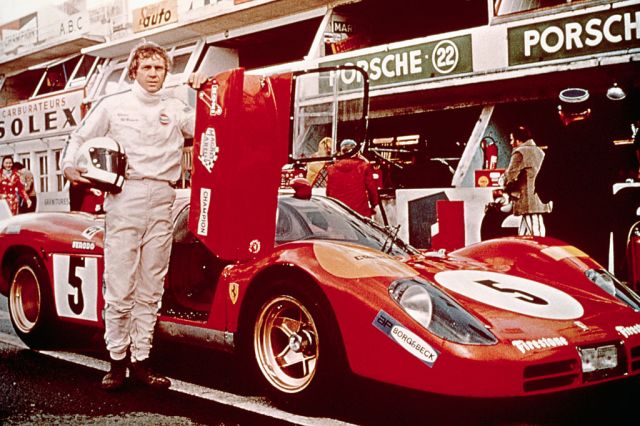
Steve McQueen and a Ferrari at Le Mans (John Springer Collection/Corbis/Getty)





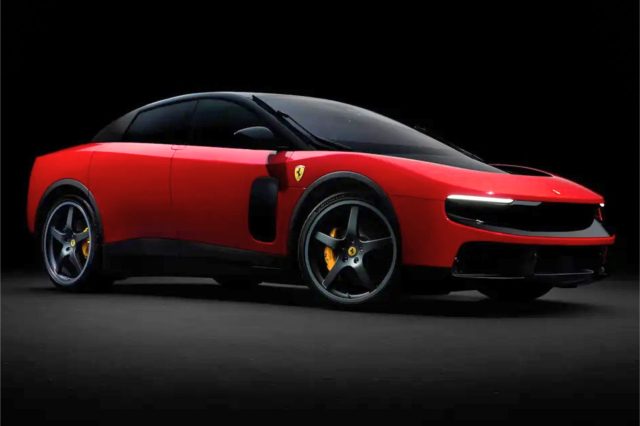
Accustomed to near-universal adoration for its internal combustion and hybrid supercars, Europe’s most famous manufacturer cannot have anticipated the collective snort of derision that greeted its first battery-electric model, the Luce, in May. Unprecedentedly negative coverage in the mainstream press, and the kind of social media vitriol usually reserved for singers, left a substantial dent in Ferrari’s share price, with the outpouring of scorn quickly becoming a story itself. Former company chairman Luca di Montezemolo said that the new car risked “destroying a legend” and that he wished the manufacturer’s logo could be removed from its nose. On 23 June, Ferrari announced the departure of its marketing chief.
Never before has a new sports car prompted such an international response — even the fallout from Jaguar’s disastrous rebrand in 2025 was largely domestic. People all over the world hated the Luce’s appearance, which was uncharitably compared with that of a much cheaper Japanese EV, and the ill-advised launch event, which for some reason involved the Pope. Interestingly, the public questioned who and what the Luce was for.
Interesting, because a majority of participants in this online pile-on can be assumed to be outside Ferrari’s target audience; with an expected price of around £500,000, the Luce is even more expensive than the manufacturer’s core V12 models, which the haters also can’t afford. But all of these people still feel as though they have some relationship with Ferrari and its products, and the disappointment and widespread confusion that met the Luce immediately upon its launch was still bad news for a brand supported almost entirely by this consensus on desirability, which in turn is based largely on good looks. The Luce will be commercially successful, but its reviled appearance has broken a link in that chain.
It’s an upending of an industrial phenomenon that predates living memory. Italy’s century-long advantage in car design is systemic rather than purely stylistic; fueled by the historic trading wealth of its northern cities, the country’s bicycle and weapons factories spawned over a hundred known car-building workshops (and probably hundreds more fleeting startups that were never recorded) at the end of the 19th century and the beginning of the 20th, when the internal combustion engine gained mainstream traction. These small outfits were artisan producers, manned by skilled craftsmen drawing on knowledge from established local industries, which would build a rolling chassis, including drivetrain and engine, before taking it to a nearby carrozzerie, or coachbuilder, for bodywork to be added.
Some of these bodywork specialists emerged from the nascent car industry, but many more were long-established suppliers of traditional broughams and state coaches to the European aristocracy, including the noble houses of pre-unification Italy. Both horse-drawn carriages and early motor cars were effectively the preserve of landed families and extremely successful businessmen, all of whom invested — both directly and through high-value commissions — in what could be described as the burgeoning supercar industry. This process created a geographical concentration of small industrial suppliers, specialized labor pooling, and finance, as well as an ecosystem that rewarded forward-thinking design.
That might sound like a whole lot of the automotive cliché that is “heritage and pedigree”, which it sort of is. But over that 100-odd years, Italian car designers were becoming the best in the world at doing a specific thing — communicating the theatre of internal combustion in products optimized for desirability. Taut bodywork shrink-wrapped over hard points of a car’s physiology, with bulbous affordances for carburetors and sharp vents clawed into steel; an elongated and exaggerated nose to illustrate a longitudinally-mounted V12, or a pair of muscular haunches sculpted around a twin-turbocharged V8 at the rear. Italian car designers understood what people wanted, and want it they did.
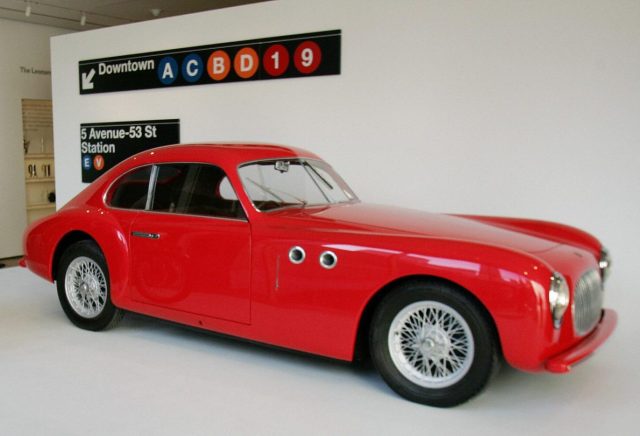
The concurrent evolution of Futurism (inspired to some extent by Marinetti’s 1908 car crash) thrust the values and attributes of this violent new industry into the cultural mainstream, in Italy and around Europe. Artists imagined a world built in the image of this grand new technology, forged in the furnaces of industrialized northern Italy, a snub to antiquity and a direct rejection of the region’s horse-drawn Renaissance past. The seminal “modern” car and the first to enter MoMA’s collection, the Cisitalia 202 GT, was designed by Carrozzerie Pinin Farina (later Pininfarina) and became the blueprint for postwar “grand tourers”, conveying its capabilities and purpose with its long, low bonnet, set-back cabin and integrated coachwork hewn from a single sheet of aluminum.
By then, Mussolini’s deliberate investments in car manufacturing, car infrastructure and car racing — enshrined in extensive car propaganda — formed a substantial part of Italy’s self-image. One of the era’s engineering and motorsport heroes, a young Enzo Ferrari, had risen to mainstream fame running Alfa Romeo’s racing team, which was named Scuderia (stable) Ferrari, and which borrowed a distinctive prancing horse motif from the plane of noted WW1 fighter ace Francesco Baracca, who had in turn cannibalized his family coat-of-arms. The intersection of mechanized warfare, motorsport, and the rapid popularization of driving propagated Italy’s obsession with the automobile and the meteoric ascent of its car industry.
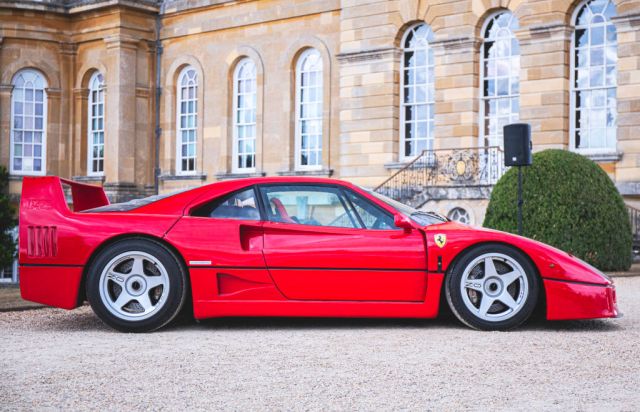
Forty years later, the F40 — a coked-up, wedge-shaped, 200mph hypercar with gaping air intake ducts and an exhaust that would occasionally spit flames during downshifts — became another fossil-fueled masterpiece, communicating to bystanders that it was built to noisily break the law. Designed by Pininfarina, it appealed to a new, brash species of capitalist, but used identical raw materials; internal combustion is an inherently violent and complex process, and, a lifetime after the emergence of Futurism, Italian car design could still make its furious business legible to the passer-by.
The Emilia-Romagna region went on to birth Ferrari, Lamborghini, Pagani, Ducati and Maserati, and following Italy’s post-war miracolo economico, the original artisan coachbuilders evolved into full-service design consultancies. Global manufacturers would outsource the aesthetics of new models to these organizations. Even humdrum household cars, like the original Volkswagen Golf and Ford Fiesta, were designed in Northern Italy by descendants of the region’s metalworking tradition. It’s hard to know what a 20th-century carrozzerie would make of 21st-century EV architecture, if an example could be rolled back in time, down a cobbled Turin street and through the doors of an oily workshop. It’s not clear what any of the industry’s great designers would choose to draw the casual observer’s attention to, in the absence of any clear mechanical drama or tense, contorted metalwork. The motor or motors of an electric car can go pretty much anywhere, and in the case of the Luce are somewhere unremarkable, behind the wheels and out of mind. The large battery is a graceless plinth on which to plonk a car-shaped effigy, and while the powertrain does need cooling, to an extent, this does not take place in a fun way; an electric car won’t gulp gallons of oxygen through aluminum nostrils like a petrol one does, nor exhale scorching air from its gills. The sports car, its societal meaning, and our expectations and understanding of its form, were for a hundred years defined by the needs of internal combustion. Without that rationale, Ferrari was bound to lose its edge.
That isn’t to say that an electric vehicle gives its designers a creative blank canvas. Regulations (primarily pertaining to safety but to a lesser extent efficiency) meet with practical considerations and manufacturing limitations to inform a car’s shape more coercively today than ever before. Mandated minimum radii (that is, pedestrian-protecting limitations on pointiness) make cars’ bodywork seem less chiseled than those of the past, hoods must be a certain height, and pedestrian impact must be mitigated. Flourishes like pop-up headlights and angular front edges have been banned, and the tiny cabins that gave older Italian GT cars their delicate proportions are now impossible to mass-produce legally due to the carefully regulated geometry that defines a new car’s interior. Lights have to be in certain places, pillars must be a particular thickness to conceal rigid roll protection structures, all compromising a car’s appearance. Globally, road fatalities are falling, a phenomenon due partly to these individually minuscule, iterative improvements to industrial design, but the result is homogeneity and aesthetic compromise. It is, quite literally, why we can’t have nice things.
Ferrari revisited the coachbuilding tradition by commissioning a Californian agency to create its Luce, a first for the company; all other production Ferraris have been designed in-house or by one of the Italian design firms. Founded by Sir Jony Ive (known for his work on the iPhone) and joined by Marc Newson (who has tried his hand at everything from shotguns, to airline seats, to public conveniences), San Francisco-based LoveFrom represents the 21st-century tech design tradition that emerged indirectly from Silicon Valley. Ferrari chose to outsource both the inside and outside of the Luce to them, with the brief to design a practical five-seater: clearly a mobility tool rather than the exotica that Ferrari has a century of confidence in creating. It’s a decision that consciously subverted the relationship between Ferrari, internal combustion, and Italian design, instead applying the Ferrari badge and some of its cachet to an electronic device, designed elsewhere, for an as-yet undefined generation of customers.
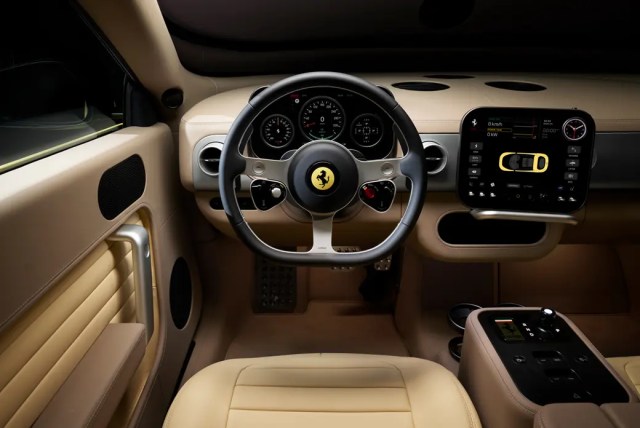
It is easy, when asked what beauty is, to point at something unappealing and say, “not that”. To an extent, that’s what’s happening with the Luce — it’s difficult to articulate what it is about the photographs that disappoints people, and hard for the layman to comprehend why an iPhone-inspired Ferrari feels so aesthetically jarring. There isn’t much for anyone to read, just a smooth, sealed box containing electronics, that neatly conveys its purpose as a comfortable and reasonably fast vehicle for several people and their luggage, like a Nissan or Ford might. Journalists physically present at the Luce’s Rome launch event (all, on some level, conscious of the need to be invited back) insist that the Luce is better in real life, which is probably true. But like a trance DJ releasing a breathy acoustic album, Ferrari and LoveFrom’s technical performance play second fiddle to the expectations of the crowd.
It would almost certainly be an easier sell if the Luce did something interesting. Its specifications are relatively impressive, with 1,035bhp produced by several motors, a 0-62mph time of 2.5 seconds, and a top speed of 193mph — all moderately unusual for a five-seater. But Chinese manufacturers have built tons of cars with four-figure horsepower, and a sub-three-second sprint time is no longer that cool. EVs deploy torque immediately, with none of the dithering or thermodynamic flamboyance inherent to internal combustion, but that means that any mainstream manufacturer using an electric powertrain now has access to similar technology. The cars you can buy second-hand from ring-road dealerships are almost as quick as the Luce, which robs Ferrari of its mechanical swagger, and in turn changes the foundations of its design language. Carrozzeria LoveFrom didn’t have enough raw material to work with when presented with the Luce, given that a Chinese-made SUV can achieve the same kinetic feats. Unlike historic performance cars, separated from the mundane by superlative stats, the Luce doesn’t really have anything to say.
As cars become appliances with largely indistinguishable raisons d’être, historic brands seem to be searching their archives for a time when they were truly successful; often, this turns out to be the second half of the 20th century, where cars were aspirational household acquisitions and domestic car manufacturing was a source of national industrial pride. But aesthetics alone won’t sell a car, as Honda found out with its daftly-named “e”, which was a cute, chunky EV based loosely on the (‘iconic’) Mk1 Civic, but which cost too much and which had too small a battery. Consumers aren’t swayed by heritage any more, and in the electric era, manufacturing giants with identities rooted in internal combustion are scrabbling to retain their relevance.
It is therefore difficult to say what Ferrari could have done differently. Regulations prevent it from returning in any meaningful way to its design tradition without resorting to naffness or pastiche, and the absence of a petrol engine neuters its ability to communicate the mechanical drama that defined its notoriety for decades. So it’s left with the Luce, a Ferrari-themed mobility solution, designed overseas, seemingly reviled by the sorts of people who will never own one, but probably popular enough with the super-rich, who might. The first 88 Luce allocations made available in China were purchased immediately. In the short term, Ferrari NV will be fine, and will sell every Luce that it builds, but the absence of raw head-turning allure brings a new directionlessness to the wider Ferrari mythos and historically hegemonic European industrial tradition that affects all of us, whether we’re driving these storied machines or merely gawping at them as we walk through wealthy neighborhoods. If the latest half-million-quid Ferrari isn’t cool, even to hoi polloi, then the age of the sports car — and by extension, a consensus of desirability that lasted a century — is waning, just as horses faded from our streets a century ago.