




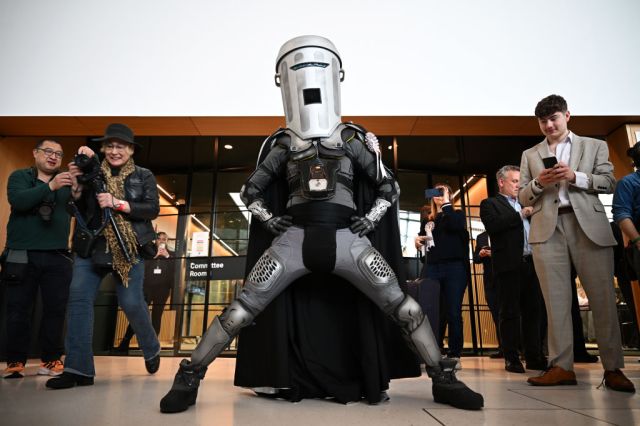
'A defender of democracy.' (Leon Neal/Getty)





Nothing better illustrates the state we are in than the fact that this summer the country’s most convincing democrat is a pseudo-aristocrat cosplaying as a receptacle for household waste. Count Binface — the nom de guerre of the comedy writer Jonathan David Harvey — is likely to be Nigel Farage’s only opponent of consequence in Clacton.
This was never part of the joke. Harvey has stood against each incumbent prime minister and London mayor since 2017. Like the licensed fool of old, Binface existed to puncture pretension from the safety of the margins, his purpose corrective rather than competitive. Yet in Clacton, the fool finds himself inheriting the responsibilities of a ruling class missing in action. Binface is the establishment. Après Binface: le déluge.
The popular misconception is that the character belongs to that all-too-familiar, dreary, disillusioned British genus of affectionate political nihilism. The nation has a talent for converting disappointment into panel-show persiflage, stretching from That Was the Week That Was to Have I Got News for You. But Harvey is a more interesting figure than that. He is a stand-up and writer with background in television comedy, and credits that include the Westminster satire The Thick of It. But he is, at heart, a defender of democracy; he has spent two decades anatomizing political absurdity without ever surrendering to the fashionable conviction that politics itself is absurd. Astonishingly, he remains a radical.
Comedy, by Harvey’s own account, was first an escape from a difficult childhood with a bibulous, domineering father, then a way of surviving the sudden death of his diabetic, morbidly obese brother. His memoir, A Fan for All Seasons, chronicles a painful year spent wandering from sporting event to sporting event after discovering Dan’s body in his London flat, searching in the rituals of spectatorship for a way of making grief publicly bearable. One begins to understand why someone so preoccupied with civic ritual should eventually end up standing in elections dressed as a piece of municipal infrastructure.
It was only after this sporting odyssey that Harvey emerged in the political arena, confronting Theresa May in Maidenhead in 2019. (He initially adopted the “Lord Buckethead” persona which had previously been wheeled out by a rotating cast of performers.) He later recalled: “Thursday night I was in a sports hall in Maidenhead. Sunday morning, I was flown first class to New York to appear on John Oliver. It was the weirdest experience of my life.” It would have been an excellent point at which to become a professional ironist. Harvey chose a more curious vocation instead.
The easiest posture in our age of institutional exhaustion is cynicism. But it has its costs. As David Foster Wallace observed, “irony is the song of a bird that has come to love its cage”. Harvey’s bin cosplay has resisted that temptation. And for every daft Binface pledge — nationalize Adele; make Piers Morgan emission-free by 2030, etc — there is an decent one. It’s hard to maintain that British life would not be improved if we were indeed to ban the use of speakerphones on public transport. At one hustings, Harvey remembers a voter saying: “I can’t believe Binface is making the most sense of all the candidates.”
His gloriously absurd manifestos conceal beneath their delirious surface an unexpectedly coherent political disposition: abolish the House of Lords; clean up Britain’s rivers; build houses; invest in public transport; return the Parthenon Marbles; tie ministers’ salaries to nurses’ pay; house the homeless before the royal family acquires its seventh palace; make Thames Water executives swim in their own excrement-encumbered effluent. Much of this is of course indistinguishable from old fashioned municipal socialism.
His jokes may be bait. But the politics are earnest. When Harvey promises to build “at least one affordable home”, the punchline is not the number but the implied accusation that every supposedly serious politician’s housing pledge has become less believable than his own. The target is never democracy but bad government.
But most revealing of all is Harvey’s attitude to elections themselves. Asked by the Big Issue why people should vote, he scarcely mentions Count Binface: “I’m more interested in the idea that people vote at all because democracy is a very precious thing.” Every Brit, he argues, should treasure the right to stand for election, “no matter how idiotic the get-up”. The campaigns raise money for Shelter. Eradicating homelessness is repeatedly described as one of the manifesto’s “key tenets”. The publicity is only a means to that end. This is an almost embarrassingly unfashionable creed. Strip away the “intergalactic space warrior” mythology and what remains is recognizably social-democratic — not revolutionary in the Marxian sense, certainly, but possessed of that civic egalitarianism of a Cromwellian vintage which assumes the commonwealth ought to be run in the interests of its citizens rather than, say, Bangkok-based crypto speculators or someone called “Posh George”.
Confronted with the possibility of becoming Farage’s principal opponent by default, Harvey’s first instinct was not triumphalism but disbelief. He told the Guardian he had been preparing for a relaxing return to his supposed home planet, Sigma IX, before Farage “self-detonated”, forcing “a swift intergalactic handbrake turn”. Asked what he would do if Clacton actually elected him, he merely replied that he would “do my very best to represent them”. He came close to campaigning for the removal of Clacton pier before somebody pointed out that it was by the sea, not in the House of Lords.
The striking thing here, though, is that Count Binface risks being the the last social democrat standing. Britain’s Overton window, never a particularly capacious aperture by continental standards, has in recent years contracted still further. Labour has shown the Corbynites to the door with the brisk efficiency of a club steward removing a spivvy guest, while the Conservatives have hurriedly buried whatever bizarre ideological enthusiasm it was that briefly animated the Truss interlude.
The dispiriting upshot has been the better part of a decade governed, if not by a formal coalition, then by something rather more insidious: a pensée unique so pervasive that party labels increasingly resemble matters of branding rather than belief. In 2023, the Economist christened its heroine “Ms Heeves”, a composite stitched together from the managerial instincts of Rachel Reeves and Jeremy Hunt, much as an earlier generation spoke of “Butskellism” to describe the comfortable convergence of Rab Butler and Hugh Gaitskell.
These days, it might be appropriate to speak of Starmenoch or even Burnoch. But the invidious comparison flatters the present settlement. Butskellism at least presided over an argument about the distribution of prosperity; today’s orthodoxy contents itself with administering degrowth more competently than the other chap. SW1 remains as theatrically adversarial as ever — PMQs still proceed with all the decorum of a boxing match — but the ideological chasm between the front benches has narrowed to the width of the despatch box itself.
One may quarrel indefinitely over fiscal rules, denouncing a tax-to-GDP ratio of 35% as Bolshevism and 32% as neoliberalism; or over the precise degree of performative cruelty to be directed at asylum seekers. But anything touching the larger architecture of Britain’s political economy — the distribution of wealth; the ownership of land and capital; the country’s constitutional settlement; even the purpose of the state itself — is ruled out of order.
Increasingly, the electorate has declined to play along. Brexit was one expression of the new peasants’ revolt; Reform is another. Equally eloquent is the subtler protest of abstention. Turnout, a stately 84% in 1950, settled into the high 60s through the 2010s before slumping to barely 60% at the election that carried Starmer into Downing Street.
Seen in one light, the Clacton caper is proof of the point that Farage has been making all along — namely that British politics is controlled by an Establishment cartel that is now engaged in an all-out coordinated war against both him and his politics. Farage resigned his Commons seat after the Parliamentary Commissioner for Standards opened investigations into his failure to declare a £5 million personal gift from his sugar daddy, the crypto-Croesus Christopher Harborne. Rather than await the slow ecclesiastical processes of Westminster discipline, which might eventually have ended in suspension and a recall petition, Farage leapt ahead, testing himself against the people of Clacton instead. He also reminded them that: “I could go out and try and make some real big money. I could go to the USA, where I’ve got plenty of offers”, which will no doubt go down extremely well on the Essex seafront.
The open question is whether the response of Britain’s sensible parties in declining to stand against him is the tactical masterstroke that their press cheerleaders seem to think. Kemi Badenoch dismissed the contest as a “fake” election, while Labour, the Lib Dems and the Greens unanimously refused to lend legitimacy to Farage’s stunt. And yet together the exnominated parties have conspired to prove Farage’s core point — that they are indeed “all the same” and will do anything to preserve the status quo. Labour in particular has form here. When Farage first descended upon Clacton in 2024, Labour HQ set about stripping resources from its own local campaign, dispatching its characterful candidate, Jovan Owusu-Nepaul — who was “getting more retweets than Keir Starmer”, according to a party source (shocker) — to more electorally profitable territory in the West Midlands and leaving local activists aghast that the party appeared content to grant Farage an unobstructed run. Even then, the instinct was less to defeat Reform but to contain it.
One hesitates to improve upon an opponent’s script so generously. For years Farage has insisted that Westminster is not a genuine arena of political disagreement but a single interchangeable establishment, united less by ideology than by its instinct for cartel behavior whenever an insurgent threatens the settlement. One might have expected his centrist adversaries to resist the caricature. Instead, they have enacted it with touching fidelity. Against the dismal backdrop of this de haut en bas consensus, Harvey’s intervention becomes easier to understand. He is doing what the establishment doesn’t dare to do, which is actually to participate in democracy.
Meanwhile, he offers a critique of political celebrity. At precisely the historical moment when every ambitious politician has become the curator of an increasingly elaborate personal brand — Farage himself used the word “influencer” in his Clapton speech — Harvey performs the opposite maneuver. He abolishes the individual altogether. The bin is an anti-charisma machine. It is commonplace and probably entirely accurate to note that Farage is the 21st century’s canniest political operator as well as its most recognizable figure — and without Farage, Reform would be nowhere. Against all this, the bin performs an act of almost monastic self-abnegation.
It asks a question almost indecent in its simplicity: if a proposal sounds perfectly sensible when uttered by a man dressed as a bin, why has Westminster spent so many years insisting that it was impossible?
Pratinav Anil is the author of two bleak assessments of 20th-century Indian history. He teaches at St Edmund Hall, Oxford.
 pratinavanil