




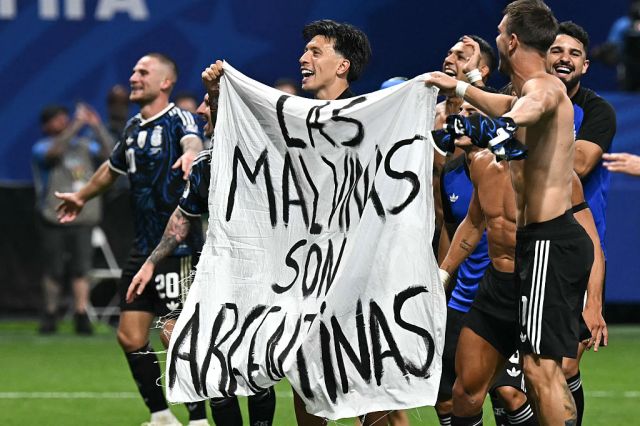
Players holding a banner reading: “the Falklands are Argentinian”. (Paul Ellis/AFP/ Getty)





Argentina’s win over a faint-hearted England — in a decisive comeback of the sort now all but routine for the South American squad — should banish much of the “VARgentina” chatter that dogged the defending champions, after suspicious refereeing decisions in their previous knockout-round games. Seeking in vain a reprise of the siege tactics of the Three Lions’ 10-man win over Mexico in the cauldron of the Estadio Azteca, or to emulate the defensive dark arts of Paraguay, England made sure Argentina needed no intervention from FIFA officials to turn the tables in the dying minutes of the match in Atlanta. All they needed were Messi’s gilded feet.
But victory for the Albiceleste is unlikely to alter the light in which the Argentine team has come to be seen internationally in this edition of the cup — one so different from that of four years ago in Qatar. Then, the Argentines’ pluck, and their star Messi, were easy to love as they wended their way to a third world championship, a journey that ended in a thrilling final against Mbappé’s France. The country was suffering from runaway inflation and seemingly without direction under its hapless Peronist president Alberto Fernández. Argentina deserved a win, it seemed, and its team earned one.
Now, New York magazine dubs Argentina the “surprise villains” of this Cup, while The New York Times reports on how other nations hope they’ll lose. What changed? Under Javier Milei’s new management, Argentines still suffer plenty: both economically, as the effects of Milei’s shock therapy sink in, and in football, where experiencing the trials and tribulations of the national squad is a kind of civic religion. “One must suffer”, fans like to say. “Without suffering, it’s not worth it”.
With the great exception of Messi, Argentina offers little inspiration in the way of tactics or technique. But the grit of its players and fans is boundless and enviable, and as debate spreads over whether Argentina’s neighbor Brazil owes its recent footballing retreat to evangelical Protestantism’s advances, perhaps this secularized Catholic cult — the Stations of the Cross reimagined as knockout-round progression — is helping power Argentine prowess in an age when South American football struggles to compete with the money and training of the European juggernauts.
But this gospel of suffering is mostly for domestic consumption. Abroad, perceptions of Argentina follow its association, under Milei, with Trump’s America and Netanyahu’s Israel. Latin Americans have long chafed at some Argentines’ superior touting — neither really accurate nor welcome in principle — of their society’s European character. But the current political moment has drawn wider attention to certain darker elements in the national culture.
Back in 2022, in the woke era’s waning years, it was possible to sympathize when, after a Washington Post op-ed asked why Argentina’s national squad lacked black players, the Twitter account of Milei’s party — at the time boasting only three lawmakers — dryly responded: “Because we are a country, not a Disney movie”.
Today, posts like this appear in a more sinister aspect, as another World Cup brings out the worst in Milei’s movement, now in power. “It’s such a drag to be black these days”, top Milei aide Santiago Caputo posted after Brazil lost to Norway, drawing an ugly line under a longstanding racial animosity in some quarters toward Argentina’s northern neighbor, with its large population of African descent.
Just as Argentina’s sclerotic state comes close to resembling the caricature that libertarians elsewhere falsely imagine government to represent, a deep (if far from universal) streak of anti-black racism pervades Argentine society. It creeps into everyday language: negro de mierda (“shitty black person”) is a common term of abuse, directed at people of all races, while quilombo, a colony of runaway slaves, some of which still exist today in Brazil, is a ubiquitous term for chaos and disorder.
A World Cup whose European squads count many non-white players, symbols of the migration of recent decades, has provided further grist for the mill. For an Argentine streaming channel aligned with Milei’s movement, “population replacement” explains Germany’s footballing decline; a provincial official belonging to his party calls France “the African team”. Milei himself recently declared that Europe’s migration policies had brought it “to the brink of extermination”. It’s an irony that a country forged, like all societies in the New World, by the collision of different peoples — indigenous, Spanish, Italian, Lebanese, Jewish, to name a few — could be held up as “conservative” on questions of immigration and national homogeneity against Europe, erstwhile land of the ethnostate.
But if Argentina’s turn to the Right has colored the way the rest of the world sees the team, it has done nothing whatsoever to puncture the love that Argentines, whatever their politics, cherish for their squad. What explains that? After all, other countries in Latin America, where the Right has lately won power, have seen political polarization tear into support for the national team. Many Left-leaning Brazilians are only now returning to old habits of wearing the jerseys and waving the flag, after Jair Bolsonaro’s movement made the yellow-and-green shirt a Right-wing uniform for the better part of a decade.
This year, the same phenomenon arrived in Colombia, when Abelardo de la Espriella — now the country’s president-elect — used the national jersey at his rallies. Espriella’s socialist rival accused him of appropriating a symbol that belonged to the nation at large, and a judge banned him from wearing the shirt, though that didn’t stop him from winning Colombia’s election last month.
How did Argentina, so long notorious for political grievances that creep into every corner of society, keep politics out of football? Winning is a universal balm, of course, but there is more to the story. The team does its best to stay out of politics, and has kept Milei at arm’s length as he tries to make the squad’s success his own. It helps that not everyone in the Argentine footballing world likes the changes Milei wants to make to the way football is regulated.
Evangelical Christianity, with its emphasis on morals and individual prosperity, is one force that draws players on the Brazilian and Colombian national squads toward Right-wing politicians — but the movement is relatively weak in Argentina, where Christianity has always been a feebler force than elsewhere in South America. Another key difference is that in Argentina, the political Left is dominated not by socialism, with its internationalist tendencies, but by nationalistic Peronism. The old grudge over the Falkland Islands — which resurfaced at the conclusion of last night’s match, when players raised a banner declaring the “Las Malvinas” rightfully belonged to Argentina — is nurtured almost more lovingly on the Peronist Left than on Milei’s Right, with its suspicious sympathies for Margaret Thatcher.
Ironically enough, one historical reason for this nationalistic unity has to do with immigration. As in the United States, socialism flourished in Argentina in the 19th century, but mainly as a second language, among recently arrived immigrants in an industrializing society. It was kept out of the political mainstream by an entrenched native elite, and when popular demands finally broke through decades later, they did so in a version shorn of international commitments. In this sense, Peronism in Argentina was Latin America’s answer to New Deal liberalism in the United States.
Whatever the causes, the effects are clear enough. Right-wing officials and the Peronist opposition jockey to see who can cheer the boys on louder, and no one has a second thought about donning the white and light blue. Countless Argentines who don’t share the views of Right-wing streamers see no reason why they should be associated with them. They want to bring home a fourth trophy, to suffer and celebrate as one. To be loved by your own is to disdain what the rest of the world thinks.
Nick Burns is associate editor at The Hedgehog Review and was previously editor at Americas Quarterly.
 NickBurns