




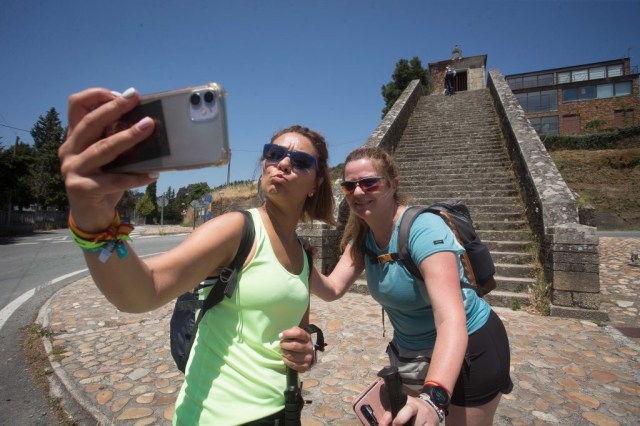
Pilgrims along the Way are increasingly secular. Credit: Getty





Less than a week after graduating from college, I packed my backpack and boarded a plane to Porto, Portugal, to walk the Camino de Santiago, one of the most ancient and popular Christian pilgrimages in the world. I was prepared to offer up anything to the Lord — foot pain, sore muscles, my uncertainties over whether I’d really feel closer to God when I was done — but I wasn’t prepared for the skepticism I would encounter from other pilgrims. The three stated aims of the Camino are self-discovery, health, and spiritual discernment. Though raised Protestant, I’ve spent the past few years exploring my faith, particularly through attendance at Eastern Orthodox services. But for many of the pilgrims I walked with, spiritual discernment seemed to come last. It was fairly typical to see pilgrims crowd the entrance of the small chapels along the way, await the stamp in their credentials, then step behind the altar for a photo and leave again in a minute, never looking at the space they claimed to visit.
The Camino de Santiago is the name for over 200 recognized pilgrimage routes mostly on the Iberian Peninsula, which cover anywhere from 60 to 500 miles, though there are 12 primary paths. It is also having a cultural moment, amplified by social media and a stream of TikTok influencers. My motivation for going, however, resisted the internet entirely. I wanted to align myself with the things that really matter: to gain perspective on four chaotic years of college, to process the recent death of my dad, and to refocus before starting a full-time job in the fall. I read all the same popular websites and travel guides as the secular pilgrim, but I quickly noticed that my awareness of the spiritual dimension of the Camino’s routine was unusual.
I began the Portuguese Way in Vigo, Spain — 15 miles north of the Portuguese border — and walked roughly 86 miles to Santiago de Compostela. I also incorporated a spiritual variant involving a boat ride up the Ulla River — because it was popular, sounded mystical, and I could find an abundance of information about it (online, of course). And I brought to the Camino the prayers and the orientation toward the divine that I had practiced back home. Each day, as my body assumed the posture of the pilgrim — struggling lungs, hinged hips, steady footfalls — this heritage came to my aid. I repeated the Jesus Prayer, a short Orthodox petition for mercy as I walked, and my footsteps joined its rhythm. My backpack bore a ceremonial shell with the sword-cross of Saint James the Apostle, a symbol of the pilgrimage since the Middle Ages, which lightened my burden, reminding me that my journey had been shared by millions throughout the ages. The repetition of the hours — wake, walk, drink an espresso, walk some more, and attend Mass in the evenings — became a kind of prayer of its own — and this habit of prayer was encouraged and reflected by the environment.
Not everyone, however, was on the same journey. The Camino has been circulating on social media in part thanks to the 2023 re-release of Emilio Estevez’s 2010 film The Way, and his concurrent announcement that he is planning a sequel. In the movie, Estevez’s father, Martin Sheen, plays a grieving American father traveling to retrieve the body of his estranged son, who was killed while walking the Camino. He is joined by a crew of unlikely companions — each walking for reasons that have nothing to do with God — and ends up completing the pilgrimage himself in a journey of self-discovery.
Most of the TikToks and Instagram reels in which influencers now document their “day in the life” on the Way are in the same vein: non-religious, or not explicitly Christian. “Film for the dad lore album,” reads an Instagram caption written by Gabe Escobar, a model and content creator known for his spontaneous travel vlogs, while he stands in front of the journey’s culmination: the Cathedral of Santiago de Compostela in Galicia, Spain. Escobar has said he’s not religious, though he is drawn to the beauty of the tradition. His daily videos detail the trials of solo hiking — trouble finding food, dehydration, foot pain, loneliness — accompanied by photos of beautiful vistas and happy smiles.
The numbers reflect the widespread secular interest. In 2025, over 530,000 pilgrims received the Compostela, the certificate of completion given out in Santiago to pilgrims who have completed at least the last 62 miles on foot, a 6% increase from 2024. That figure is nearly ten times the figure from 25 years ago, with over a thousand pilgrims receiving the Compostela every day.
The majority of people I encountered along the Way were secular and wellness pilgrims. And it should be acknowledged that they were generous companions. In the city of Pontevedra, I shared cervezas and pimientos de Padrón with a woman named Catherine, who was willing to discuss matters of the spirit with a sincerity that would embarrass most dinner parties. She had recently quit her job and broken up with her long-term boyfriend, and felt like the Camino would help her make sense of the rupture in her life. She told me all of this within an hour of meeting. Though she was raised Catholic, she rejected the institution of the Church, and described herself as the classic “spiritual but not religious.”
Another young guy I met at an albergue, who was traveling with his girlfriend, told me he was trying to do every route of the Camino, but that the churches themselves were “problematic” because the iconography of Saint James inside them was “Islamophobic.” He was referring to the representations of Santiago Matamoros — James the Moor-Slayer — which greet the pilgrim inside the cathedral, and in smaller churches all along the route. The apostle is depicted astride a white horse, sword raised above cowering Muslims, an image that originates in the legend of the Battle of Clavijo, in which James was said to have miraculously appeared to lead Catholic forces to victory during the Reconquista, a campaign to take back the Iberian Peninsula from Muslim rule. It is a stark image of violence and conquest, and a sore spot for the Church today, leading some cathedrals along the Camino to remove the statues entirely.
Doubting the legend or the relics may be chalked up to ordinary skepticism, but rejecting the images inside the church is a different kind of act. To the pilgrim making it, it is a form of moral clarity, a rejection of violence and religious triumphalism, which fits neatly with contemporary commitments to social justice. I heard such claims used as a justification for continuing to walk a route that pilgrims associated with real violence. People are walking the Way in a spirit of resistance.
The problem, however, is not that fellow pilgrims are not doing the Camino for the right reason — that is between them and God. It is rather that in conversation after conversation, I found a profound mistrust of the Church and the history that had established the route in the first place. The crisis, for me, came in realizing that the kind of personal growth most pilgrims wanted out of the walk was not merely indifferent to but at odds with the union with God that the Way was built to produce. One form of growth asks you to become more fully yourself through self-improvement, while the other asks you to be undone, to surrender as the pathway to transformation.
Self-improvement can be a positive goal, to be sure, and to seek change through transformative experience is not wrong. Saints throughout history have left their belongings and their communities, embarked on pilgrimages, and been transformed — by the desert, the pillar, the monastery, the mountain. There is a desire within most of us, in an age of information overload and the exhaustion it produces, for some shortcut to clarity, and the Camino presents itself as one. But treating this self-knowledge as the goal, rather than the byproduct, is a mistaken understanding of what its transformation is for.
A challenge for the religious pilgrim, made difficult by the secular pilgrim’s logic, is not to confuse self-knowledge, however hard-won it may be, with knowledge of God and being in communion with Him. The pilgrimage, done well, prioritizes these two things properly. It strips away the routine of comfort that binds us to the material — through fatigue, blisters, hunger, loneliness, and thirst — so that what is left can be aligned with the vertical axis of the divine rather than the horizontal axis of the self. What I saw on the road, again and again, was pilgrims seeking the horizontal, when the route had been built to point upwards.
Unbelievers are helped in their skepticism by the status of the Camino as legend. The Apostle James was martyred in Jerusalem, beheaded, as recorded in the Book of Acts. The Camino commemorates a legend, not confirmed by the historical record, that his disciples carried his body by boat to Spain, near what is now Santiago de Compostela. This legend appeared only in the 9th century, when a hermit named Pelagius reported following a field of unusual stars to an abandoned Roman-era burial ground and found remains that the local bishop, Theodomir, declared to be James’s and those of his two disciples. In 1075, King Alfonso VI began building a church over the spot to house the relics, and pilgrims have been walking to it ever since. My path along the Ulla River is said to be the one they took.
This background makes for a kind of plausible deniability employed by both Catholic and secular pilgrims. One can walk the entire route and arrive at the cathedral without having to affirm that the bones inside are real, providing a means of transformation without any demands of belief attached. And for the pilgrim already inclined to distrust institutional religion, the issues surrounding Santiago Matamoros offer a clean exit.
And yet the Way did not work only on the religious pilgrim — it was a kind of gift to all who embarked on it, even the unbelievers, and this might be the strongest evidence for what the Camino still is, underneath what it has become. One day, I walked with a woman who had done the Camino before. She told me she no longer believed James’s body is actually in the cathedral, and yet, upon arriving, found herself overwhelmed by it regardless. She lacked adequate explanation, though she tried. On another day, I met a woman who said she had been raised Catholic but was now agnostic. She told me that she had been reading the same poem — a Polish poem called “Pilgrim” — to herself each morning since the second day of the walk, unsure why she had started or why she continued. I also kept meeting a Polish family, first at the airport, again in the port city of Vigo, then at a roadside cafeteria, who told me that in Polish custom, meeting the same people three times means you must share a coffee. I felt something of the Camino’s own logic in that: by coincidence or by choice, in sharing a story, a coffee, or a bunk bed in an albergue, we found a kind of communion with each other, as if we were all simply meeting again, somewhere along the way, coming home.
The Camino raises a question that secular pilgrims don’t expect to be asked, one gesturing toward an encounter that can’t be conveyed through the internet.
I felt this acutely on my final day of walking. My body was running on too little communal albergue sleep, and the last of my reserves ran dry with roughly six uphill miles still to go. I ducked into a chapel in the historic town of Padrón, to rest my legs, pray, and rehydrate. While I was admiring the interior, trying to talk myself into the last stretch, I noticed a small angel holding a heart carved with my dad’s initials. That glimmer of the familiar, on a day I had nothing left, carried me the rest of the way.
It was a reminder that nothing on the Camino is the result of hard work alone. Every step is, in the end, a gift: the body carries you; generous patrons have built and maintained the road; between towns, strangers leave fruit and water. Ultimately, grace keeps you going on the day you would rather stop. The secular pilgrim is attuned to graciousness and hospitality, but as far as I could tell, the secular framework has no category for gift in the deeper sense — it can’t account for the poem the woman reads with no explanation, or the feeling of awe upon arriving at the bones whose authenticity one has doubted. It can account for effort, for achievement, for personal meaning made from an experience, but it has no place for the unearned or the miraculous. Gift is precisely what falls outside the framework of self-transformation, and it is what the Camino keeps insisting on, through nothing more dramatic than daily repetition of walking and fatigue, which regularly calls forth the mercy and friendship of strangers, even to those who did not come looking for it.
I am not Catholic. I attended the Pilgrims’ Mass at the Cathedral of Santiago de Compostela as a respectful guest and sat in shared reverence alongside people I had walked with — some for only a few hours, others for days. I did not cry or fall to my knees in awe upon reaching the cathedral. If anything, it felt more like a mixture of gratitude mixed with grief: gratitude for the thing itself, grief that so many arriving with me had been handed so little equipment for understanding what the thing was.
When self-transformation is the destination, the self remains at the center, perhaps to be enlarged, maybe even clarified, but it is still the organizing principle of the journey. The pilgrim returns home more herself, her pack lighter, her tolerance for discomfort improved. This is an accomplishment, right? But it is not what the tradition that built this road had in mind. The great pilgrims of the Church did not walk in order to become more fully themselves. They walked in order to become less themselves, specifically, to arrive at a place where the self, spent and humbled, might finally be available to something other than its own reflection.
The cathedral received us all, believers and unbelievers alike, and this, I suspect, is both the Camino’s great gift and its peculiar danger. It receives everyone. It transforms the terms of no one’s arrival. You have walked the Way, and you have reached the cathedral, and you are offered a next step. Whether to take it or not is up to you.
