




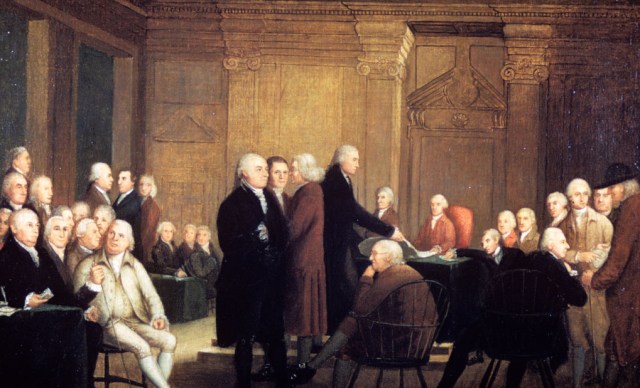
The legacy of the Second Continental Congress has been stolen. Credit: Getty






We may now speak of an ancient America. You’ll forgive me such bold pronouncements, for there isn’t the time to waste trapped in tired registers of speech, and I have several more shockwaves to get through before we’re done. Furthermore, the ambition to push my country’s mind into new modes overrides all possibility of modest thought and all hope of modest deliverance. Add to this motive the jolly of no ordinary birthday: We the People have reached our 21st century and are now old enough in the eyes of arbitrary law to grow brave on the vintage Madeiras our Founding Fathers left aging in the cellars of the republics plural, for 13 republics and counting we were meant to be, never the one. With this intimation you may catch on the air of my intoxicated breath the first whiff of America’s founding hornswoggle and her hogsheads of secret history. But I warn you, there are secrets in the swigs of these old wines that some of our fathers are illegitimate and so some of us are illegitimate Sons of Liberty. I should know, for I have been conducting vigorous research among the casks and deliver myself presently to the top of the cellar stairs, fresh from a choice cache of reds, with a maximum of confidence and high patriotic focus, not to mention every wine-lover’s intention of pouring generously. But I said we may speak of an ancient America, so let us speak.
After 250 years, we have hurtled such a distance from our origins that the histories, philosophies, and intentions of our founders equal the lost secrets of Greece, the sacked libraries of Alexandria, the aborted steam engine of Rome and an Industrial Revolution a millennium early, all of it abandoned to Barbary. The year 1776 is an ancient date to the American eye staring across the dilation of our epoch’s accelerated speed. For we did in but two centuries what historically took most civilizations 1,000 years, and we are a little warped from the pace. You think I speak of the betrayals of the Constitution, and while there is certainly much of that, I am speaking of what the Constitution betrayed. I am speaking of a betrayal equal to discovering that Romulus did not kill Remus with any masculine honor, but sent a goon to sneak up on him with an icepick while he slept, and lay in an anxious sweat until dawn when the head was delivered to his slick and clammy bed. I speak of a revelation equal to learning there was an even more ancient and mysterious people slipping the sock up the boot of Italy before the Romans did.
Half the mystique of anciency is the intimacy it shares with oblivion: there is awe in what has been lost, and will never be known. We await bold innovations in physics to storm limbo, for like the particle horizon round our domain in the universe, there is a shrinking horizon to the past which knowledge can make very few enduring incursions beyond. For instance, where it was once casual knowledge to any Roman, today we are left to wonder, “Who were these Etruscans who came to Italy before Rome; whence these Italianate people who gave Rome her Tarquin kings, her arch, her Cloaca Maxima, and her regal purpura; these people who taught the Romans how to read portents in the lightning and in the thunder, and predicted down to the century their own nation’s 1,000-year lifespan and the eventual Roman eclipse; who wrote from right to left against the arrow of time in a lost and still unsolved language; who sailed defensive navies so powerful, they terrified a Greek people fresh from Ilium; whose protectionist polity was structured to preclude the doom and ruin of imperial expansion; yes, who were these Etruscans and their confederation? For political morphology tells us that republics decline and fall into empires, but a daring charge into Etruscan and, now, American oblivion reveals a new morphological truth: confederations precede republics. On this note, I lift to your lips the first sip of the olde vino.
* * * * *
The uniform perception of American history tells us that we declared independence from Britain in 1776, fought a revolutionary war that ended in victory in 1782, became the first glimmering modern republic by ratifying our noble Constitution after a good-humored and lively debate in 1789, and, because we were in an expansively democratic mood, added in the handy first 10 amendments, the Bill of Rights, in 1791. This myth is our Romulus, and everyone from Ken Burns to the folks of the 1619 Project take it for fact.
Anarchist-anthropologist David Graeber on the Left and Fox News’s Sean Hannity agree that the Constitution but resolved the chord of the 1776 Revolution. But this is a Romulus myth that hides its integral fratricide. The seven years between 1782 and 1789 are short enough, I suppose, to give no hint they were seven of the only eight years that the United States of America actually existed. For America’s original constitution was not the Constitution. Decorum, please, with your wine, sir! It is an ancient vintage — don’t be so surprised to find it spiked with a little of the Eleusinian ergot. Your mind must be open for this historical trip. You are going to be asked to think in plurals and simultaneities and the paradox of their attendant contradictions. Drink deep.
No, gentlemen, I say again, slowly for the timorous: America’s first constitution was not the Constitution, but the Articles of Confederation and Perpetual Union, created by the same Second Continental Congress that issued the Declaration of Independence. The astute among you will note the word “Confederation” right up there near the front of the name, conveying a definite impression of the type of government the document describes. No, this was not one of Benjamin Franklin’s elaborate jokes in the vein of his “Fart Proudly” columns. Rather, the word “Confederation” names precisely what America was established to secure for all time: a loose confederation of 13 independent, sovereign states.
Whereas the Constitution has taught us to think in singulars — one nation, indivisible — our true nature is plural and decentralized. There are geologies to a nation’s psyche, and the idea that a citizen of Maine can cast a vote for president that will affect the governance of the citizens of Arizona 2,500 miles and 300 million people away, is so entrenched a modern American expectation that the pre-Constitution psychology is nearly incomprehensible. Attempt to take in America’s original intent: if you were a citizen of, say, Massachusetts in 1784, that was your country. You did not have weighing on your mind the election of a national president in Washington, DC, but rather the election of your governor, lieutenant governor, and legislators. In 1776, the separate states of America were not the vestigial provinces and administrative arms of Washington they are today, but sovereign countries. And these 13 original countries each had their own constitutions. They printed their own money. They regulated their own commerce. They levied their own taxes. They banded their own militias. They decided the boundaries of their own liberties. They decided their own political structures, and there was no national government that could or would intervene. Contrary to the high-school-history fairy tale promoted by the likes of filmmaker Ken Burns — in which America was a rambunctious gaggle of independent states just yearning deep down to be one people under a common yoke, and learning step by improbable step to get out of its own libertarian way — the opposite was the case. The Revolution of 1776 was not fought to replace one entrenched central power with another, but to dissolve the principle of central power altogether. For the oppression that spurred the rebellion was the totalism of a distant monarch and aristocratic parliament, enforced by a standing army. American militias did not take up arms or turn their farms into battlefields to dissolve the sovereignty of their home state and establish a new central government, nor to simply swap nomenclature: a king for a president, Parliament for Congress. No, the movement was genuinely a revolution in that it aimed for the decentralization original to Western Civilization, and succeeded in restoring mankind to a governance like the confederations of Etruria and pre-Socratic Greece, the latter the very structure that birthed Western philosophy in the Tragic Age.
The Articles of Confederation were commissioned by the Second Continental Congress on June 11, 1776, the same day Thomas Jefferson began work on the Declaration, that first masterpiece of American-English prose. They were drafted by a committee of 13 members, one from each state, including John Dickinson from Pennsylvania and Samuel Adams of Massachusetts. The committee finished its work in 1777, and the Articles became the de facto law of the land until official ratification in 1781. What Jefferson expressed in poetic precision, the Articles expressed in political precision. More than an equal masterpiece, they are the definitive text of America’s original intent. The Articles established a one-year president of Congress, a presiding officer who was already a member of Congress elected by Congress with no veto or other executive powers; congressional term limits with officials under the power of recall by their state legislatures at any time; no standing army or power to conscript soldiers; no power to compel taxes directly on the people or states nor alter or override state constitutions; and a unanimous majority of all states to amend the Articles. Power over the actions of the state rested with each of the separate states, and the national Congress was there merely to mediate matters such as border disputes or to coordinate response to threats such as foreign invasion. “Weak and ineffectual,” says Ken Burns — “As intended!” answer the Patriot Dead. Yes, we’ve woken some ancient spirits.
Now, it may be the wine talking, but I would just love to saddle you and ride you horse-breathed through a bit of history, for you simply will not get this education anywhere else and a gallop of 18th-century air is good for the constitution. But this anticipates.
* * * * *
In 1782, the West was won and the plural republics of the United States, having dissolved central power for all time, settled into a dream of perpetual confederal union under the Articles. But two antagonistic forces were in the wings preparing a sleight of hand: a large national debt held by chafing creditors, and Lin-Manuel Miranda — sorry, Alexander Hamilton, the nation’s first secretary of the Treasury. That is, with the Articles’ weak powers of national taxation, the states were not exactly racing to pay off their war debts. This doubly roiled the monied class of bankers, lawyers, merchants, and reintegrated Loyalists, who made their fortunes under London’s central power and now couldn’t sleep at night for all the moolah they were missing out on, because with Red Coats gone, there was no more central power to exploit financially, nor monarch around whom to form a new aristocracy. There was no purse string because there was no purse — as intended.
Lucky for these chafers, Hamilton and James Madison, the future president, were dreaming up just such a wealthy national government and colluding in secret with other “founders” about reshaping the country into a polity that looked familiarly British, familiarly overthrown — and reeking of windfall. Madison engineered the national Annapolis Convention in 1786 under the guise of discussing the federal Congress’s powers over interstate commerce. Only five states bothered to show up. Madison and Hamilton used this gathering to foment national anxiety. In Hamilton’s “Annapolis Report” and Madison’s “Vices of the Political System” memorandum, lax dispassion was spun into a deeper national crisis about the union of the states, then used as a pretext to call for another national convention “with the sole and express purpose of revising the Articles of Confederation,” specifically and unambiguously its powers of taxation.
If powerful cards had been gathering in the hands of the wealthy, the time to play them came in 1787 at what was then known as the Philadelphia Convention. (Bad boy, Ken Burns — this was not called the Constitutional Convention until the late 18th century! Go to your crate!) Madison and Hamilton enjoyed leverage in the selection of delegates and the fomenting of ulterior motives. Several pro-Articles politicians declined to attend, citing the Convention as extra-legal, finding the Articles sound, and confident in the track record of past conventions that states wouldn’t even show up. Virginian Patrick Henry declined based on the power of his nose. “I smell a rat,” he said, an accurate reading, but a miscalculation that freed Madison to hand-select ardent nationalist delegates in Virginia — aristocrats who would go on to propose such pro-democratic statutes as life tenancy for presidents and for congressmen.
According to the historians Charles and Mary Beard’s analysis of the portfolios of the Convention members, the majority of these delegates were lawyers, merchants, large landowners and creditors — the ones who held much of the public debt and, buying citizens’ debts for mere pennies on the dollar, stood to make exorbitant sums if the debt could be paid off in full. If a new national government could be created, these creditors were poised to become aristocrats. Madison then secured the key that unlocked the convention hall: a retired, wooden-toothed, tight-lipped general who never won a battle, George Washington. General Washington, who retreated his way to victory, had previously refused to attend, but he too much enjoyed his role as American statuary and omen. It is not hard to court a statue and, by putting Washington on display, Madison legitimized the Convention in the national eye.
Despite the pretext of amending the Articles, Madison arrived weeks early in Philadelphia with a draft of the future Constitution in hand and established a nationalist bloc, including Virginia, Pennsylvania, and various other states, with the sole intention of subverting the Convention and dissolving the Articles of Confederation. On Day One, Hamilton proposed a strict measure of secrecy. Guards were posted at the doors; publishing or communicating about the proceedings was prohibited. It was then, in secret, that the plan to replace the Articles outright was raised.
Operating like a modern, private, extra-legal corporation, the secret treasonous proceedings took four months before the public was alerted that the Articles had not been amended, but rather dissolved and replaced with what was called simply “the Constitution” — conspicuously with no Bill of Rights yet in sight. Furthermore, the new document bore striking resemblance to the monarchical system it had just overthrown. The president was an elective monarch with alarming powers, including to “refuse his Assent to Laws” (veto) and make “Judges dependent on his Will alone” (nomination of judicial officers) — two points that were among the declaration’s stated grievances against English monarchy. The Senate was designed to have an aristocratic makeup similar to that of the House of Lords, and the ambiguously expansive “Necessary and Proper” and “Supremacy” clauses equaled Parliament’s 1766 Declaratory Act, which established no limit to Parliament’s power over the colonies and first inflamed America to revolution. To name a few more betrayals of the Revolution, the language of the Constitution gave this new central power unlimited direct taxation and established a permanent standing army in peacetime.
This last English resemblance seems like nothing today — we have had a standing army forever, what of it? But it was arguably the biggest fear of revolutionary Americans. In the 18th century, standing armies were recognized as the coercive forces of dictatorial empires. Militias were the republican American solution: it was the duty and the honor of the common man to defend his state, a principle that thwarts imperial expansions. Whereas standing armies create occasions for their own use and can be used to suppress citizenry, militias are the citizenry and organize themselves only for common defense in legitimate existential crises. Militias are citizens and laborers who disband to private life at the end of conflict, unlike career soldiers and officers. Most important, they answer to themselves and their state, not a national executive branch. Under the pseudonym Centinel IV, Pennsylvania dissenter Samuel Bryan summed up the Constitution in the local press: “An evil genius of darkness presided at its birth, it came forth under the veil of mystery, its true features being carefully concealed, and every deceptive art has been and is practising to have this spurious brat received as the genuine offspring of heaven-born liberty.”
* * * * *
So the Constitution rendered the American Revolution an American reformation of British tyranny and centralization. If you can beat ’em, join ’em. Madison knew that very few state legislatures would ever agree to dissolve their own sovereignties under a Westminster replica, and so concocted a novel ratification process. The Constitution was sent to state conventions, only nine of which had to assent in order to bind all 13 states forever. The state conventions were assembled with fresh delegates, not state legislators, and framed to the public as therefore allowing “the people” to ratify the document.
Now, not only did the Constitution enumerate a system of central power almost identical to Britain’s, it was to be shoved down the victorious revolutionaries’ throats. In Pennsylvania, Gouverneur Morris — the leader of the state’s nationalist bloc, a man who argued the president should serve for life and pick the members of the Senate, who he also believed should serve for life — argued for accelerated speed in the assembling state conventions and ratifying the Constitution. According to Madison’s Notes on the Debates in the Federal Convention of 1787, published in 1840, Morris’s “object was to impress in stronger terms the necessity of calling Conventions in order to prevent enemies to the plan from giving it the go by. When it first appears, with the sanction of this Convention, the people will be favorable to it. By degrees the State officers, and those interested in the State Governments, will intrigue and turn the popular current against it.” Things were so speedy in Morris’s Pennsylvania that dissenters who refused to form a quorum were forcibly escorted to the state house by a sergeant at arms. The state legislature had not seen the Constitution. During the proceedings, the dissenters were prohibited from voting, and their objections were not entered into the official record.
This is the moment when Madison and Hamilton began issuing the pro-Constitution propaganda now known as The Federalist Papers, which coerced and frightened the public into support. The authors framed the manageable issue of paying back debts as an existential crisis whose only solution was to undo everything the Revolution had achieved, save official reattachment to Britain. Of course, there was an outcry, presently muffled by Ken Burns and PBS. Recognize now the voice of our true fathers, those who argued against the Federalists and their Constitution: the anti-Federalists. Think, for a moment, how easy it is to lay your hands on a copy of The Federalist Papers. Now ask if you have ever seen a bound copy of The Anti-Federalist Papers — the public-essay responses to The Federalist Papers. It is so obscure a collection of texts that my copy is a 10-by-10-foot, 30-pound print-on-demand paperback. My mailman dragged it to my door by rope. The only copy of the complete papers issued by a publisher costs $450, from the University of Chicago Press, in PDF form only. Yet these are the writings of America’s true founders. These are the disquisitions of America’s original intent, and original dissent, and today they read with the prescience of Nostradamus.
The true founders were stolen from us, and the nation was deceived as to Madison et al.’s intentions partially through language. These men (and woman: Mercy Otis Warren of Boston) did not call themselves “anti-Federalists” — the Federalists burdened them with that epithet as a smear. For up until the end of the Convention, the terms “confederation” and “federation” were used interchangeably. A supporter of a confederal system — the original system established by the Articles of Confederation — was a “Federalist” or “Confederalist,” and it meant the same thing. Thus the Philadelphia Convention was alternatively referred to as the Federal Convention without indicating profound seismographic change. By branding their opponents anti-Federalists, the supporters of a central (federal) government made them seem like the ones attacking the gains of the Revolution, when the opposite was true. Timorously, I float renaming the anti-Federalists the Confederalists, but one must sail a narrow straight between accuracy and the unrelated implications of “Confederate” and “Confederacy.” So let us continue with the scurrilous though historical “anti-Federalists,” for now.
Chief among these men were the Founding Fathers Patrick Henry and George Mason of Virginia; George Clinton, the first governor of New York and fourth vice president of the United States; the New York merchant Melancton Smith; the Founding Father and fifth president, James Monroe; Massachusetts writer Mercy Otis Warren; the Maryland super-lawyer Luther Martin; and attorney and Founding Father Robert Yates of New York. The anti-Federalists, often using pseudonyms of ancient republicans — Agrippa, Brutus, Cato, Centinel IV, Cincinnatus, Columbian Patriot, Philadelphiensis — predicted that the Constitution would lead to civil war, an imperial presidency, the dissolution of individual liberties, a military-industrial complex, limitless taxation, soaring debt, a congress of distant self-enriching aristocrats, and no constraint on the growth of power.
“What, then, are we to think of the motives and designs of those men who are urging the implicit and immediate adoption of the proposed government?” asked Bryan (“Centinel IV”). “Are they fearful that if you exercise your good sense and discernment, you will discover the masked aristocracy that they are attempting to smuggle upon you under the suspicious garb of republicanism? In many of the states, particularly in this and the Northern states, there are aristocratic juntos of the well-born few who had been zealously endeavoring since the establishment of their constitutions to humble that offensive upstart, equal liberty.”
Despite their tragic foresight, the anti-Federalists failed to stop the Constitution. They failed, too, to embed themselves in the collective memory of modern America. However, their dissent was powerful enough to force the adoption of the first 10 amendments to the Constitution in the form of the Bill of Rights, a codification of the republican principles of the Articles of Confederation. Many of the supposedly liberty-loving “Federalists” fought tooth and nail against the Bill during ratification and for years afterward, claiming the amendments were redundant and their principles already implicit in the Constitution. Yeah right! Now you may spit out your wine, sir! The Bill of Rights has, of course, been the only legitimate constraint on the entropy of the federal government, the only bulwark we have against censorship and mass surveillance, and even so it buckles.
The anti-Federalists conceived of their Bill of Rights as educative on civil liberty for the succeeding generations of Americans. The amendments “can inspire and conserve the affection for the native country, they will be the first lesson of the young citizens becoming men, to sustain the dignity of their being,” said Melancton Smith. It is the most cited element of the Constitution in legal cases, the foundation of Americans’ conception of their identity, and the basis of international human-rights charters, so ahead of its time that Europe has still never caught up to the First Amendment and routinely and shamefully imprisons its citizens for reposting memes or disparaging religions. Imagine America without these protections. As I write, Congress is trying to do away with the Foreign Intelligence Surveillance Act’s requirement that the government obtain warrants for surveillance of private citizens, and is trying to forever wed America’s military and intelligence to a foreign nation — that is, replace its yearly funding of the Israeli military with a permanent coordinating office for the purpose in the Pentagon. Compared to the Bill of Rights, it is the Constitution itself that has dissolved: the president may declare war at will, the national-security apparatus forms an illegal fourth branch of government that cannot be voted into or out of power, and so on.
* * * * *
And does this not create a psychosis in a people: to be lied to, to have buried deep in the unconscious the truth that we are bastard children, that our fathers are false fathers and our true ancestors are hidden from us? The original 10 amendments are our ancient identity, and yet we do not know the names of their authors. We do not quite know they existed. The anti-Federalists and their spirit have entered the roll call of oblivion.
But must we repine? Yes, a little. A little. We must grow drunk. For in our cybernetic age, our synapses grow in arbitrary patterns around unnecessary phone-related cerebrations. We have formed new habits of mind around addictions to stagnation — and only alcohol can destroy enough brain cells to return us to our original minds. So let us drink deep in our cups, and see the paradox of our psychology.
Firstly, our debates today about “original intent” begin only after our original intent was forever dissolved. This is not unmystical on the part of the villainous Federalists. The Federalists were the last men of this Earth to create a myth. The Theory of Inflation (cosmic, not monetary) teaches us that pre-creation is subject to different laws of physics, so by dissolving the Articles and creating anew, the Federalists called down the deific power to alter the American language, tamper with and rewrite our history, banish the memory of an entire generation of souls, and forge a new American psychology.
Nations have psyches. By consolidating 13 countries down to one, our illegitimate fathers created a single, distant, and unnatural center over which 340 million Americans and counting now shall fight until the end of time, impotently, through two accepted factions that are really but two wings of the same party. Our legislators and officials are aristocratic and do not represent the people but the interests of the ruling class. But this travesty aside, the unnatural American center severely simplifies our openness to political possibility and creates a messianic impulse. It creates a righteous instinct to centralize everyone else. What is more American than to think, “I alone am right, and not only are you wrong, but I have the power to implement what I know to be right over you, even though you are thousands of miles away in an alien clime”?
As America expanded into an empire, this centralized psychology followed in lockstep. What was wokeness but the most recent patriotic reflection of the American psyche? What was American democracy but a projection of the fragile American psyche that had to be defended over the course of the past century in such far-flung places as Korea, Vietnam, Afghanistan, Iran, Iraq, and Kuwait? What is more fragile than, say, a Brooklyner’s temperament, which can only be pacified by forcing blue-collar Texans to use preferred pronouns? No American mind can sleep at night unless the entire world operates according to its wishes — to centralize individual beliefs over a vast foreign territory is America itself!
The gravitational field of our fabricated constitutional origin bends all thoughts of what is politically possible to its centralized target and gelds all heterodox political thought. This explains horseshoe theory: it is the consolidation of political possibility into a straight line, warped in a curve around an arbitrary gravitational center. Thus, the Marxist gazes across and is startled to see the libertarian. The uniform perception of a singular origin also works backward in time: the hack historian collectivizes all evils and attributes them to a singular point. The sins of the fathers are applied backward to a false singular origin, a false singular consensus. So whereas Pennsylvania and all of New England had already abolished slavery in their states by the Convention in 1787, they are held equal in guilt to the secessionist South. It becomes educative to tell the children of our nation that all of America is slaverously evil.
Once every other generation a historian tries to breathe life back into the anti-Federalists, but even here their breath hiccups in the false language of American centralization. Herbert J. Storing’s What the Anti-Federalists Were For, the last to attempt it in 1981, critiques our real fathers for being united in opposition of the Constitution, but without being collectively for anything. Of course, lack of a positive consensus is only a defect in a centralized framework. The anti-Federalists were united on heterogeneity. The political structure they agreed upon was a confederation, in which they enjoyed the freedom of not having to be in agreement across state lines on anything at all. In fact, the nature of a confederation necessitated they not be in consensus on imposing a national structure, for such a power was not within the mandate of state constitutions. This is the very soul of decentralization.
Yes, the modern American mind is centralized, and we also do suffer under the psychosis of false origin and treasonous birth. Add to this the historical fact that centralization kills thinking and leads to postmodernism. Consider: Western philosophy, born in a confederation of disparate Greek city states, was destroyed by Alexander the Great’s centralization of empire. Also, the Hellenistic centralization of learning in Alexandria severed the connection between philosophy and praxis in the city state, and ushered in the defeatist, solipsistic era of Greek postmodernism in the form of the Cynics and Skeptics who ran the Greek Academy until Rome’s capitulation to censorious Christianity and the Dark Ages, in which even Etruria’s arch was gambled away. The American consolidation of 13 countries into one under a single authority was a quasi-imperial act, and killed all political possibility save for accelerated consolidation. Everything we’ve achieved since has been but a caged stride.
Are you ready to wonder at what America would look like if it had remained a confederation? This is where the ergot kicks in. Perhaps we would have grouped into separate confederacies. Perhaps Aaron Burr would have succeeded in making himself king of Mexico. There being no prohibition on how the states could arrange themselves, perhaps some states would have gone monarchical, while others on the same border went Marxist and still others pushed the bounds of libertarianism further into direct democracy. Perhaps a decentralized confederation is the only political structure in which those red herrings Marxism and libertarianism can be captured. Perhaps Virginia would today be an aristocratic republic and Massachusetts a liberal monarchy. Perhaps it is the bloated gravity of central government that bends the political spectrum into a horseshoe, whereas all forms of government are supposed to exist coterminously, in a constellation. Perhaps the southern states would have resolved slavery of their own volitions, and without ruinous reconstruction imposed upon them, consequently never imbedding in themselves such deep resentful racism. Perhaps Europe would have fought World War I to an even draw all by its lonesome without American interference, and so the scales wouldn’t have been so tipped against Germany that it elected a genocidal Charlie Chaplin impersonator to lead it into even worse rubble. Perhaps, then, the Soviet Union would have collapsed much more quickly and organically, with less harm done on its outskirts. Perhaps now, we would have decentralized finance, without the middlemen of bankers and creditors, such a structure could exist again. Perhaps, when we get to Mars, we could….
But we must end on the road to this mystery, these cellar stairs down to the founding casks. For if spacetime curves all straight lines and the universe goes on forever, we may find ourselves tracing a circle and thus rounding back on our beginnings, our Greek and Etruscan confederal origins. They once bordered each other on the Italian peninsula, the Etruscans and Greeks. On the boundary of these nations, just as Etruria’s confederation began to wane to Rome, the pre-Socratic philosopher Parmenides was born and lodged the first recorded argument against oblivion. Nothingness does not exist, he said, for that which is not can’t be. The closest counter-argument we have is the oblivious American mind, which can never hold a memory long. But suppose the physicists are right, and something comes from nothing. Come, let us revel. Watch your head on the stairs.
 BarneysRubble0