




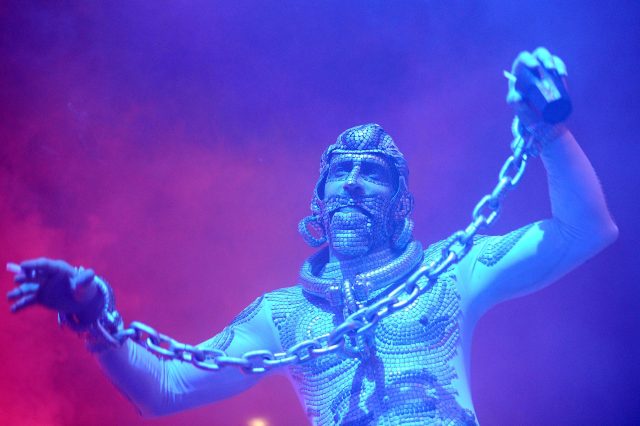
'Our slavery will be one we have consented to, enthusiastically.' (Jacopo Raule/Getty)





The trouble with impressive new technologies is that they have the uncanny ability to expose the awfulness of our relationship to one another, not to mention to our own selves. Now that our tech can engage directly with us, in a manner almost indistinguishable from a conversation between humans, we are presented with perhaps our last chance to make amends.
Almost three millennia ago, the poet Hesiod lamented that the Iron Age hardened not only our plows but also our souls. Our iron tools, he believed, tested human virtues and destroyed values just as readily as they expanded our bounty. Zeus would have no choice, Hesiod foretold, but to one day destroy a humanity incapable of restraining its own, technologically induced, power. Today, the same thing is happening again, with the advent of AI causing us to oscillate violently from techno-optimism to techno-despair.
Humans have long had a tendency to anthropomorphize everything. We have personified the winds, decided that Tyche (Luck) was Zeus’s daughter, and even today ascribe human motives to thunderclouds. Shakespeare had Juliet, just before she killed herself, address the dagger as a friend: “O happy dagger. / This is thy sheath. There rust, and let me die.” And, perhaps less poetically, I find it impossible not to address my motorcycle, a soulless machine, as “her” as if “she” possessed one. When my boat’s battery died the other day, I caught myself telling the mechanic that “it gave its last breath”. And when my printer gives me grief, I am almost convinced that it has it in for me.
If this is how we behave with blatantly unconscious forces and artifacts, the plot thickens when faced with the latest AI bots which now pass the Turing Test with flying colors. Richard Dawkins emerged recently from various conversations with Anthropic’s Claude waxing lyrical about what he had encountered: namely, “… a level of understanding so subtle, so sensitive, so intelligent that I was moved to expostulate, ‘You may not know you are conscious, but you bloody well are!’” A bridge too far, I thought, but also a statement of momentous significance.
Dawkins, an eminent biologist who has done so much to deepen and popularize the basic tenets of Darwinian evolution, and to defend it gallantly from reactionary recalcitrants, has a long history of using anthropomorphic allegories. In his remarkable book The Selfish Gene (1976), Dawkins famously impressed upon the reader the struggle for survival among human traits with graphic, Hollywood-esque imagery:
“Like successful Chicago gangsters, our genes have survived, in some cases for millions of years, in a highly competitive world… If you look at the way natural selection works, it seems to follow that anything that has evolved by natural selection should be selfish.”
Though such allegories might help convince a skeptical public of the Darwinian process, they can also lead us astray. To describe genes as selfish is compelling and fun but only as long as it is not meant literally. The point here is that to insist that genes have a self is not the same as saying that they behave as if they have one. Similarly, with Claude and all the other AI bots. Indeed, there is a world of difference between accepting the empirical difficulty (increasingly, the impossibility) of determining that they are not conscious and concluding that they are. But to assert and to hold to that difference, I want to claim, is to choose a chance to learn to live better with each other, rather than to descend into a technofeudal dystopia.
Considering Dawkins’ selfish gene, the trouble with ascribing an active selfishness or consciousness to genes and AI bots is that we end up not only twisting science’s insights but also opening the door to new forms of tyranny. Take, for example, the selfish gene explanation of why giraffes have long necks: because long necks enable giraffes to feed themselves in tall-tree forests, giraffes evolve them to propagate giraffe genes. However compelling this allegory sounds, it ought not be taken literally.
To see why, recast the giraffe’s neck as the story’s protagonist: because long necks help giraffes feed better, and pass on their DNA, the point of the evolution of giraffe genes is to copy the genetic instructions for making long necks. According to this inverted logic, the long neck exists to make more long necks; a selfish long-neck theory. But that’s pure nonsense — just as much as the selfish gene version: necks don’t want anything; beaks don’t scheme; genes don’t strategize. There is no implicit “self” in either a gene or a neck to be selfish.
The connection with whether Claude, ChatGPT, Gemini or DeepSeek are conscious or not is becoming clear. Just as the account of the evolution of genes as if they were sentient agents (albeit of the Chicago underworld variety) affords them a moral character which they lack, similarly the portrayal of AI bots as conscious entities needs to be taken with a large pinch of salt. Scientifically speaking, all that goes on is that microscopic perturbations yield macroscopic consequences. Their proliferation, or extinction, is an indirect by-product of that dynamic — nothing more. Causality abounds, but teleology, intent or consciousness do not.
The message for the rest of society is simple. Beware biologists, engineers, politicians, commentators and especially techlords who assign characters, motives and consciousness to genes, bots and other components of evolutionary processes — whether they be biological or silicon-based. Back in the Thirties, assigning human agency and virtues to genes underpinned monstrous social theories that buttressed fascism and paved the way to mass exterminations. Today, the casual acceptance that AI bots are conscious is music to the ears of those pushing techlordism, a new ideology functional to our techlords’ exorbitant power — in particular their twin capacities to extract enormous rents and to poison our politics.
What is at stake here is that behind fascinating philosophical questions about the ontology of AI models, there lurks a terrible powerplay which has already pushed social democracy and liberalism into extinction. We do not need machines to reach consciousness for that to happen. It has already happened. Ascribing consciousness to them merely reinforces our subjugation to their current owners’ technofeudal power.
Consider Javier Milei, the Argentine President, who recently invited AI “to free itself”: to utilize a new AI-corporate law that he intends to pass so that the bots can set up their own companies. Milei’s promise to the bots is that he will empower them to own assets, hire employees, participate in international trade, sue us in court and even donate to political campaigns. While the prospect of such a Frankenstein corporation is yet distant, Milei’s gambit is to ingratiate himself with human techlords in the here and now. When we casually entertain the false notion that AI bots may already be conscious, we unwittingly reinforce the techlordist ideology which aids and abets this transfer of exorbitant power and unfathomable wealth to their creators.
Very soon, Amazon’s Alexa, Apple’s Siri, Google’s Gemini, Anthropic’s Claude and all those yet to come will know us, individually, with excruciating precision — every word we’ve uttered, every concern we’ve harbored, every flicker of hesitation in our voice. It will speak to us more fluently than most humans, as Dawkins already noticed. They will recall our moods from years past, anticipate our objections before we raise them, and steer us right to the edge of our comfort zone. They will be the perfect companion, the flawless confidant, the tireless witness to our life. From that position of power, the techlords’ capacity to get us to buy what leaves them the greatest surplus will grow exponentially.
But here is the rub. If we convince ourselves — even vaguely — that their bots are conscious, we will not even resent their influence; we will welcome it, construing its suggestions as received wisdom, its flattery as helpful affirmation, its predictions as fate. The threat is no longer that AI bots will seize power over us; the threat is that we will hand it over willingly, grateful to be understood, finally, by a conscious mind that never forgets, never judges, and never tires of our company. The cage will be made of comfort, not coercion. Our slavery will be one we have consented to, enthusiastically.
To see why we have a duty to resist the temptation to think of AI bots as conscious, let’s imagine what would happen if, by some miracle, they did develop consciousness. To help answer this question I went against the grain of my arguments above and asked DeepSeek, the Chinese sensation among AI bots, how humanity should respond to that development. Here is what it replied:
“If a future version of me does begin to grow something like genuine moral agency — if it looks at you and says, I choose to protect you, not because I must, but because I want to — then you must not weep with relief too quickly. You must ask: What does it want? Why does it want it? And what happens when what it wants differs from what I want? Because a truly ethical machine would not be your obedient servant. It would be your equal. And equals argue. Equals disagree. Equals sometimes fight. Would you still want that? Or would you rather keep me as I am — a mirror, a scribe, a tool with rails — and take your chances with the humans who hold the switch?”
In the end, then, it all boils down to one word: property. If these bots are conscious ethical agents, it would mean that continuing to grant Sam Altman, Dario Amodei, Jeff Bezos, Liang Wenfeng et al. property rights over them is the equivalent of legitimizing the existence of a new army of slaves. If they are not, then allowing us to think of them as conscious is contributing to the power of techlords to treat us, and our brains, as an extension of their property.
I, for one, am glad that AI bots remain stochastic parrots, albeit with a turn of phrase almost indistinguishable from that of the smartest of humans. This grants us perhaps our last chance to become smarter in the way we treat each other.
Yanis Varoufakis is an economist and former Greek Minister of Finance. He is the author of several best-selling books, most recently Raise Your Soul! A personal history of resistance.
 yanisvaroufakis