




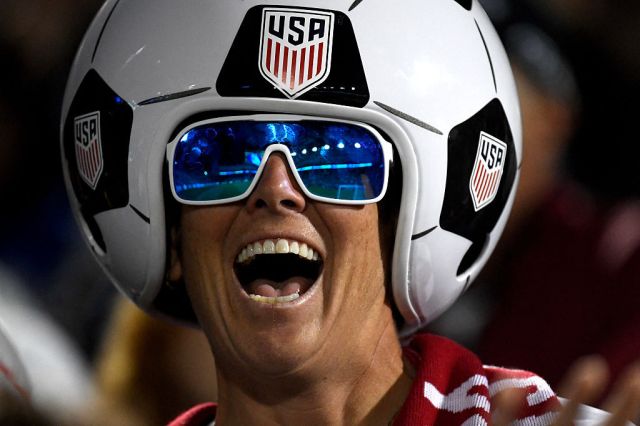
'For the diehard US soccer fan, it wasn’t supposed to go this way.' (Jason Connolly/AFP/Getty)





As the United States prepares to host the World Cup for the second time, it’s worth grappling with an uncomfortable fact. The Yanks are highly unlikely ever to become a footballing power — at least not playing any version of “football” that doesn’t involve gladiator pads and concussion-inducing helmets. And the reason has almost nothing to do with tactics or a shortage of home-grown talent. Rather, its footballing struggles come basically down to money, and how the beautiful game has been ravaged by those most American of innovations: ruthless capitalists and competitive suburban parents.
Hosting a World Cup normally confers an enormous advantage. The bookmakers shorten the odds on Germany, Spain, Italy, or Brazil the moment they’re handed the world’s most popular sporting tournament. Yet America’s chances currently sit at 60-1, lagging behind both Japan and Morocco — nations that have never lifted the trophy, from continents that haven’t either. Thirty years after America first staged the event, the world’s richest country is still a long shot on its own turf.
For the diehard US soccer fan, it wasn’t supposed to go this way. In the late Eighties, when FIFA first awarded the tournament to the US, the sport was routinely degraded as “un-American” by the country’s sports media. For decades, commentators had mocked it as a “girl’s sport” played by “skinny boys” too timid for the nation’s manly and militaristic alternative. Meanwhile, the rest of the planet remained equally baffled by America’s ultra-violent, heavily padded “hand-egg” offshoot of rugby.
Until recently, indeed, this mutual incomprehension gave soccer a peculiar charge inside the US itself. For Gen Xers and Millennials, the game felt rebellious and punk precisely because mainstream America neither liked nor understood the allure of fútbol. As for the dullards — so the self-flattering story went — they liked helmet-ball for its very ferocity. Before there was MAGA, there were the Nascar fans who voted for George W. Bush and stuck Dallas Cowboys decals on their lift-kit pickup trucks. They listened to Rush Limbaugh and sports-talk radio and mocked the “snowflakes” who played soccer as they planned their next study abroad trip.
As with all stereotypes, there was indeed something to these narratives. In the early 2000s and 2010s, just watching the Premiership in an American bar felt somehow like flipping conservative voters the proverbial bird. We were a different kind of America, the kind that understood the world beyond our borders. Soccer fans were the hip, educated, urban men and women who appreciated craft beers and flew Real Madrid flags in their backyards. Soccer served as a class marker and culture-war indicator long before it became a national pastime for wine moms and heavily tattooed tech bros.
As with most of the 20th century, there was a moment when liberal America imagined all this would resolve itself in their homeland’s favor. Shortly after the US reached the quarterfinals of the 2002 World Cup — dispatching not only Mexico but also Luís Figo’s Portugal — it became fashionable to call the country the sleeping giant of world football. Reporting on wannabe American soccer hooligans in the mid-2000s, as I did early in my career, the notion that the US would eventually reach the heights of Brazil and Germany was indeed seductive.
Give the West’s largest nation a sport that was rapidly becoming its most popular youth activity, fold in tens of millions of new Central and South American immigrants, then add the presumed superiority of African-American athletes, and the US was thought to command one of the deepest soccer talent pools on Earth. Once the Bo Jacksons and Deion Sanders of the next generation chose soccer over football and baseball or basketball, so the thinking went, American dominance was destined to follow.
Yet despite the fact that it’s easier than ever to watch the big European games on American TV, this just hasn’t happened. Forget the betting odds: only the most delusional members of the “American Outlaws” club, as Team USA fans style themselves, believe their boys can so much as reach another quarterfinal, let alone lift the World Cup trophy on 19 July. Some perspective is owed here. Only eight nations have ever held the World Cup trophy, so it’s not so surprising that America has failed to crash the party. There are other problems too. The Yanks, for all their wealth and new attention to the sport, still increasingly field a squad of questionable provenance: at least five regular starters were born and raised in Europe, hold EU citizenship or dual passports, and learned the sport at European academies. Major League Soccer, for its part, may have grown from a laughing stock into a genuine business. Yet in sporting terms it remains a fifth- or sixth-tier league — one that attracts the world’s best only as a lucrative retirement home.
Unsurprisingly, as with everything in the States, these problems come down to money. To see how, it helps to revisit the most ambitious attempt to explain American soccer’s backwardness. Back in 2001, the scholars Andrei Markovits and Steven Hellerman published Offside: Soccer and American exceptionalism framed around Werner Sombart’s famous question: “Why is there no socialism in the United States?” They argued that the same cultural forces kept football marginal. Nativistic Americans, the authors found, prefer individualistic and militaristic games that mirror the country’s political culture. The premise was sharp even if the execution was not. The book often reads as verbose and sluggish where, given the topic, it should have been as brisk as an Mbappé run down the left flank. Who could make a topic like soccer practically unreadable? Academics, that’s who.
In the early 2000s, the scholars’ thesis at least matched the evidence. Now, though, football is popular from sea to shining sea, yet the national team still languishes. Landon Donovan — the finest player the country has produced — recently put the blame on American soccer’s youth system. His complaint centers on the win-at-all-costs mentality that seemingly grips the system. Parents and coaches, Donovan argues, “get obsessed with winning just as much as the coaches do because they’ve been told that’s what’s going to get their child to college and professional — and it’s all bullshit”. In truth, of course, children don’t need to be the next Pelé in kindergarten; they just need to develop a feel for the game that scoreboards can’t reward.
It’s here where the money comes in. Youth sports in America are now a $40 billion industry — and private equity has quietly captured a great deal of it. Firms such as Juggernaut Capital have rolled up hundreds of local clubs into national conglomerates; 3STEP Sports, backed by Juggernaut, controls more than 1,500 events serving more than two million athletes a year. The tactics are the familiar ones of private-equity extraction: junk fees, long contracts, mandatory and expensive travel circuits. What was once an affordable neighborhood activity has been re-engineered into a maximum-extraction machine, with elite youth club soccer now costing many families upwards of $5,000 a year per child.
The footballing consequences are precisely what one would expect. In nearly every successful footballing nation, the sport remains rooted in working-class life: children play informally and constantly, and the most gifted are then handed to expert coaches for technical training. But just as with the country’s dysfunctional healthcare and university systems, American youth soccer puts profits and protection for entrenched bureaucrats first, and outcomes a distant second. It filters for the affluent rather than those with the most ability — the cost of participating has climbed some 46% in just a few years, and lower-income children now play high-level youth soccer at roughly half the rate of their wealthier peers — and then hands the survivors off to mediocre coaches who are rewarded for winning under-12 tournaments rather than developing players to their full potential.
Markovits and Hellerman argued that American soccer developed along totally different lines from the country’s more mainstream sports. Given the tremendous strength of US nativism, early on soccer was seen as dubiously foreign: both in origin and application. (As late as 2014, Ann Coulter was arguing that the growing popularity of soccer reflected the moral decay of the country.) Yet as that early hipster fandom implies, the opposite ended up happening. Study-abroad trips are expensive, and far from becoming a blue-collar pastime like basketball, American soccer ultimately remained the purview of white suburbanites. Though the US has grown the technical capacity to compete at international soccer, those in charge of running our youth system have optimized the program to extract maximum revenue from bougie parents — hardly conducive to honing talent.
Altogether, then, out from the dugout the real American exceptionalism emerges — the nation’s perennial institutional corruption and un-abashed mammonism. The US didn’t fail to fall in love with soccer because Americans hate immigrant games. Over the past 30 years, it did indeed fall in love with fútbol, only to then do to the game what it does to almost everything else, turning a public good into a luxury for the wealthy alone. Soccer might be a sport that’s harder to make individualistic in the way Americans are accustomed to. But, given proper time and attention, the country’s notorious knack for enterprise has found a way of making it as money-grabbingly American as the Superbowl.
A nation that demonizes politicians who promise public childcare — and that financializes childhood itself at every turn — can’t be surprised when it struggles to manufacture world-class strikers. The raw athletic talent is almost certainly lurking out there, in the immigrant neighborhoods and the public parks. It’s just that we’ve built a machine to price those kids out. Then, we wonder, every four years, why the sleeping giant never wakes.
B. Duncan Moench is a writer and scholar of American political culture. He also writes the Producerist Substack.
 DuncanMoench