




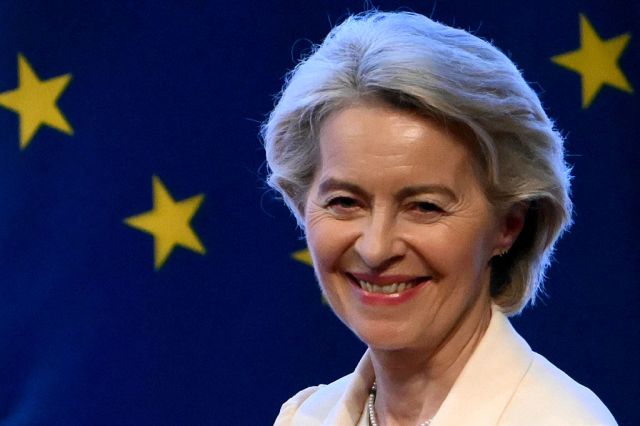
'Each crisis has served as a pretext for the Commission to assume more authority.' (Luis ROBAYO / AFP via Getty Images)





The Multiannual Financial Framework. Even for a body as jargon-prone as the European Union, the phrase feels almost bewilderingly dull. Perhaps that’s the point. For hidden amid the technical language of the EU’s new budget is a kind of technocratic coup — one that promises more power for the Commission, less for member states, and which would ultimately make Brussels even less accountable than it already is today.
Over the past decade, the EU’s institutional balance has already tilted heavily toward the Commission, which has extended its reach into areas once considered the preserve of national governments — from fiscal policy and public health to foreign affairs and defense. The mechanism has been consistent: each crisis — the sovereign debt crisis, Brexit, the Covid-19 pandemic, the Ukraine war — has served as a pretext for the Commission to assume more authority, make “emergency” decisions and lock in permanent changes to the exercise of EU power. None of this has required formal treaty changes. It has occurred surreptitiously, outside the arena of democratic debate, through what scholars have called “integration by stealth”. The result has been a creeping “Commissionization” and supranationalization of European decision-making, with a corresponding erosion of national sovereignty and democratic accountability.
Now the Commission is using negotiations over the EU’s next seven-year budget — the aforementioned Multiannual Financial Framework (MFF) for 2028-2034 — to push this process further still. And precisely for this reason it is keen to wrap up a deal by the end of the year. Brussels insiders are acutely aware that the French presidential election of April 2027 could produce a government led by Jordan Bardella of the National Rally — a party hostile to the integrationist agenda underpinning the new MFF. Since the framework requires unanimous approval in the Council, a Eurosceptic France could strangle the budget at birth. The unstated but operative goal is to seal the deal before that risk appears. That this is never said openly only underscores the contempt for democratic deliberation that now pervades the process.
What, then, is the package that the Commission is so keen to sign into law? It is a framework totaling almost €2 trillion, equivalent to around 1.26% of EU gross national income (GNI) over the seven-year period. The European Parliament, never shy about spending other people’s money, wants to push that to 1.38% of GNI. But neither institution really admits the structural tensions buried in the figures. The EU must service roughly €750 billion in bloc pandemic debt, the repayment of which is now being permanently integrated into the regular EU budget. The Commission’s own proposal earmarks €149.3 billion for repaying the so-called “NextGenerationEU Recovery” and “Resilience Facility” funds — a sum that amounts to nearly 10% of total MFF commitments.
This matters because of what it reveals about the true nature of NextGenerationEU (NGEU). What was sold to European publics as an exceptional, one-off response to the Covid crisis is now the fiscal template for the Union’s future. The pandemic fund set the precedent: the EU can borrow on capital markets, distribute grants to member states, and then embed the repayment into the general budget for decades to come — all without anything resembling a proper democratic mandate. This is arguably what the “unprecedented” EU fiscal response to the pandemic was always about: normalizing common debt as a mechanism for tilting the institutional balance of power decisively in favor of the Commission, downgrading member states and locking in a structural shift in European integration. Indeed, the EU has since repeated the trick with a €90 billion package for Ukraine, again funded through joint debt backed by the common budget. The “historical exception” has quietly become the norm.
To repay its vast debts, the Commission has proposed a package of five “new own resources”: a corporate levy on companies with annual turnover above €100 million; taxes on tobacco and electronic waste; and adjustments to revenues from the EU Emissions Trading System and the Carbon Border Adjustment Mechanism. Together, these are projected to generate roughly €60 billion a year. This projection, however, should be treated with skepticism: for many of the proposals, revenue estimates are rough at best, and the actual yield will depend heavily on (unresolved) questions of implementation. More fundamentally, adopting “new own” resources requires unanimous agreement among member states and ratification through national constitutions, a high bar that previous Commission attempts at revenue reform consistently failed to clear.
If the new taxes fall short, the fallback is a compulsory levy on member states. The existing “Own Resources Decision” — another wonderful piece of EU lexicon — already empowers the Commission to call on national governments for additional GNI-based contributions to cover NGEU repayments, on top of regular program spending. In other words, if the new revenue streams underperform, the bill lands automatically on national treasuries, decided not by sovereign parliaments, but by the remorseless logic of the EU’s debt repayment. At any rate, EU debt now functions as a de facto tax on member states, bypassing the normal channels of democratic budgetary control. The tension between net contributors and debtors is already producing open fractures: Sweden’s European Affairs minister has flatly stated that the budget’s size “must come down significantly” and that there is “no such thing as free money”, even as several southern and eastern member states — including Italy, Spain and Poland — have suggested postponing part of the debt repayment plan.
The structural changes to the budget architecture compound this problem. The Commission hopes to reduce the budget’s headings from seven to four, collapsing 52 separate programs into just 16. This is presented as “simplification”. Politically, though, it’s something else entirely: centralizing fiscal control and stripping away the granular program categories whose very specificity constrained the Commission’s ability to reallocate funds on a whim. The old system’s structure, dense and bureaucratic as it was, functioned as a form of democratic constraint: money earmarked for a specific purpose is harder to redirect than money pooled under a broad heading.
Fewer programs and broader headings mean more executive flexibility and less parliamentary oversight. Nowhere is this power shift more visible than in the proposed National and Regional Partnership Plans (NRPPs). Under this model, cohesion policy, agriculture, fisheries, migration and border management would all be merged into single bilateral frameworks negotiated directly between the Commission and each member states, as opposed to the current system of separate programs, each with its own rules and oversight structures. Regional and local authorities — who currently have a formal role in overseeing the existing programs — would invariably be marginalized. The Parliament would be sidelined. The Commission, meanwhile, would gain a uniquely powerful position, exercising conditionality over each national plan through the so-called rule-of-law mechanism, set to become a structural feature of the bloc’s budget. If the Commission deems a government non-compliant with the rule of law — as understood, of course, by Brussels — funds cannot simply be frozen; they can be redirected to civil-society organizations and “European values” programs approved by the Commission itself. This amounts to the creation of a system of permanent EU-managed political pressure.
Then there is the question of where the EU budget money actually flows. The new AgoraEU program — a merger of the Creative Europe and CERV (Citizens, Equality, Rights and Values) programs — is allocated €8.6 billion: more than double the combined budgets of its predecessors. The CERV strand alone, now rebranded CERV+, sees its budget grow from €1.55 billion to €3.6 billion, even as it remains under direct Commission management. This is the funding stream from which hundreds of NGOs, operating in the fields of “democratic values”, civil society advocacy and media support, draw their operating grants. It goes without saying that these organizations are, by design, institutionally dependent on Brussels and reliably aligned with its agenda. In a recent book, I show how European programs and funds have been progressively oriented towards the diffusion of so-called “European values” — and very often towards the promotion of the EU and the integrationist project as such — through the direct funding of NGOs, think tanks, academic institutions, media outlets and educational projects, to the tune of hundreds of millions each year, with the effect of blurring the boundary between support for civil society, institutional communication and outright political propaganda. And now this EU-funded propaganda complex is poised to grow even more powerful.
The two areas where European citizens most directly feel the EU’s presence — the common agricultural policy and cohesion funds for structurally weak regions — are the budget’s biggest losers. This has received surprisingly little public attention, with the debate still largely confined to the technocratic language of net contributions and distribution keys. That framing obscures what is really going on: the construction of a European fiscal executive. For decades, the German-led integration model held that political deepening should proceed without genuine fiscal union. The Maastricht criteria, the Stability and Growth Pact and the no-bailout clause were expressions of this philosophy: prompting integration through common rules, not through common debt or centralized budget policy. That order, however, is now being dismantled, one “exceptional” instrument at a time. The reality is that the Commission no longer treats the budget as a limited distribution instrument but as a strategic policy-making tool for expanding its control over key policy areas — and, increasingly, for imposing its will on recalcitrant member states.
The stakes become clearer when you consider what the Commission has actually done with the powers it has already accumulated. During the pandemic, it ran a €71 billion vaccine procurement program behind closed doors, signed contracts that handed pharmaceutical companies full intellectual property rights and blanket indemnity against legal claims, likely overpaid by tens of billions of euros, and then stonewalled every attempt by MEPs, auditors and the European Ombudsman to scrutinize the contracts — while the EU’s own Public Prosecutor opened a corruption investigation that remains ongoing. In the ongoing Ukraine war, it has devised and imposed sweeping sanctions packages with minimal consultation of member states and committed the EU to an open-ended maximalist war strategy — including the provision of lethal weapons through a repurposed “peace facility” — that no European parliament ever voted on. It threatened incoming elected governments it disliked with financial consequences. It used “disinformation” as a pretext to build a censorship architecture — the Digital Services Act — that gives Brussels effective leverage over what European citizens can read and say online. And it has consistently used financial conditionality to penalize governments whose domestic politics it disapproves of, redirecting funds away from citizens and toward Brussels-approved “civil society” organizations when it judges a government non-compliant. The new MFF doesn’t just continue this pattern, it institutionalizes and permanently funds it.
All this is especially frustrating given Europe’s weak geopolitical position. It is technically true, after all, that a geopolitically capable, strategically autonomous Europe requires a centralized fiscal capacity. But the EU is not a democratic federation capable of exercising such capacity accountably. It is a structure in which an unelected Commission holds agenda-setting power; the Council operates behind closed doors; and the Parliament has no power to initiate legislation. Handing this structure even greater fiscal autonomy doesn’t solve the EU’s democratic deficit: it deepens it. It is time to acknowledge that the EU’s failures are inherent to the supranational model itself. Attempts to address these shortcomings within the current framework, typically by pursuing “more Europe”, will only make things worse — with grim consequences for European governments and their citizens.
Thomas Fazi is an UnHerd columnist and translator. His latest book is The Covid Consensus, co-authored with Toby Green.
 battleforeurope