




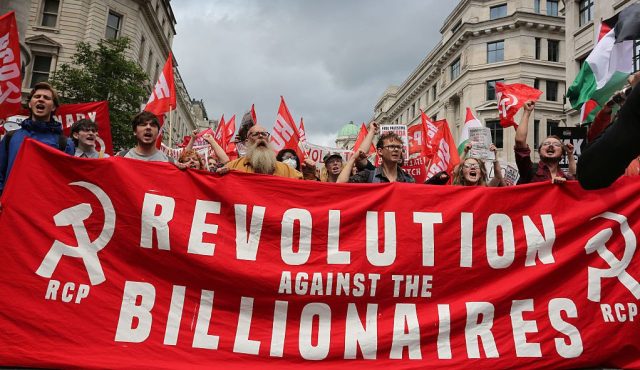
Is the tide turning against the ultra-wealthy? (Martin Pope/Getty)





Academics need to get out a bit more. That, at least, is the impression one might form from the recently-released report of the Global Justice Project, the fruit of a research team led by the star economist Thomas Piketty, whose monumental study of global inequality Capital in the 21st Century made him a household name.
A handsome and detailed study, the report offers a set of ambitious proposals that could only have from the minds of people enjoying the comfort of tenured positions: cap the growth of western economies at current levels; raise investment by rich countries in poor ones to 10% of GDP (a 25-fold increase over current aid levels); ensure per capita incomes converge to a common average across the world by 2100; reduce the consumption of material goods; cut the working week in half; tax the rich to equalize incomes across the globe; create a new international currency regime. Have these people spent any time canvassing in a by-election? Do they have any idea how this will sell in Peoria, Illinois?
In short, it seems difficult to picture this supposed action plan making it into the daily grind of retail politics. Not surprisingly, mainstream economists have been quick to pounce, the widely-read blogger Noah Smith calling it “total nonsense”, the taxation expert Dan Neidle dismissing it as “potty.”
And yet: step back and reflect on the document, and you see that Piketty and his co-authors might just be onto something. However impractical their solutions may appear, the authors have channeled an emerging zeitgeist in this age of polycrisis. The old neoliberal orthodoxy has fallen from grace but, like a zombie that keeps coming at you no matter how many times you kill it, it still dominates policy. The document at least offers an alternative vision of where things might be going.
One striking thing, missed in the rush to dismiss this as fantasy, is the fact many of the things the report calls for in the future have already begun to happen. Cap economic growth in the developed economies at current levels? Check. Western economies have been slowing for decades and several have now approached virtual stasis. Indeed, there are signs that growth ultimately produces degrowth, regardless of what governments do. As I found in my recent book, economic growth triggers a cycle of behavioral and social changes whose effect, when aggregated, is to progressively inhibit a society’s economic dynamism while imposing new costs on that society, with the strength of these effects rising as a country grows richer. Western economies are now close to peak productivity. The one principal exception to the broadly-based slowdown of the rich countries is the US — but it has continued expanding thanks not to some internal dynamism, as is often supposed, but because of a massive run of debt-fueled stimulus. Take that added input out of the economy and the US too would be no outlier at all. In fact, real per capita income is already going backwards for all but the wealthiest Americans.
Raise investment in developing countries? Check. It’s not nearly at the scale that the authors call for, but investors have been pouring money into developing countries for decades, lured by the higher average returns on offer in comparatively low-wage economies. Although the business story of the last couple of years has been about the “American exceptionalism” that has powered the boom in New York’s stock markets, the really exceptional performers have been in the developing world. Turkey’s stock market is up 40% over the last year, Taiwan’s has doubled, and Ghana’s has increased by over 130%. Forget AI, the big money’s in the Global South.
Bring about a global convergence of per capita income? Also check. This mirrors the investment wave in the ascendant global periphery. While incomes within rich economies have diverged in recent years, the gap between rich and poor countries, which peaked at the turn of the millennium, has been steadily narrowing. For a while this finding was skewed by the extraordinary rise of China, but in recent years other countries have begun rising rapidly as well. Whether incomes could converge on a common level is another matter, and some war-torn countries have got stuck on the banks of the development stream. But all told, the old distinction between First and Third Worlds looks set to grow less relevant with time.
Reduce the consumption of material goods? Check. Consumers in Western countries have been substituting experiences for things for decades, with the result that the material intensity of developed economies has steadily declined. That is to say, the material component of each dollar’s worth of economic consumption is falling as people buy less stuff and spend more money on things like health and beauty, dining out, streaming videos and taking vacations. With most of the world economy’s future economic growth coming from developing countries, rising incomes are already causing a shift away from goods and towards services in consumption.
The other key proposals in the GJP report do not, when placed in the context of the century-long transition the authors envision, look all that unrealistic. Cut the work week in half? The average work week in Western countries has already nearly halved since the Industrial Revolution, so there’s no reason not to expect this trend to continue. It really comes down to whether productivity increases are used to raise income or free time: Americans have been more inclined to favor the former, Europeans the latter. This helps to explain the supposed “poverty” of Europe one reads about in the US business press; but outside of America, people have happily accepted more time off as a fruit of development.
Tax the rich to equalize incomes? There is a rising populist tide in many Western countries that advocates wealth taxes and greater limits to oligarchic power. With Elon Musk, a man described by one polling analyst as “political kryptonite”, on track to become the world’s first trillionaire, public patience with the ultra-wealthy is wearing thin.
Create a new international currency regime? Although the Western-based dollar order remains in place, it is rapidly eroding at the margins as the world moves towards a more pluralistic monetary system involving bilateral exchange, alternative payment systems like China’s CIPS, and the shift away from dollar reserves into other currencies.
In sum, it may be that the world economy is already moving in the direction advocated by the Global Justice Project, but organically rather than as a result of policy or an international revolution. Mind you, on current trends, the world will still face an ecological crisis. Many will take issue with the assumptions made in the report regarding the extent and impact of future climate change. However, there is little serious doubt that on current trends, the world faces a future of increasingly severe ecological crises. These, in turn, will hamper economic growth. Even though the material and energy intensity of production and consumption are declining, the sheer growth of both in the developing world over the next century will blow through all targets.
So in that regard, the Global Justice Project is a timely intervention. Admittedly, it doesn’t land at a propitious time. Western politicians are retreating from global campaigns, sweeping visions and anything that smacks of social engineering. It’s all about bringing gas prices down now. Thus as an action program, which it purports to be, the document seems out of touch with the times. In the chapter on political strategies the authors acknowledge there will be pushback from powerful vested interests to their proposals, before admitting there is “no magic bullet to address this issue, except trying to be more convincing and as precise as possible regarding the benefits of the GJP.” Erm, OK.
The problem, even for those who share Piketty and Co’s aims, is that there’s little evidence that the average citizen is moved by grand schemes. Indeed, as the success of Zohran Mamdani in New York attests, even self-declared socialists succeed best when they connect with voters around local, visceral issues, Mamdani’s focus on rental costs and grocery prices being no less ideological than Vladimir Lenin’s pledge of bread, land, peace and electricity.
But still. As an intellectual agenda, the document offers something sorely lacking in most modern political discourse, namely: ambition. Most mainstream economic commentary amounts to either fatalism that anything at all can be done, or a Pollyanna-ish optimism that technology will magically solve everything. The first option is a cop-out on the part of intellectuals whose job should be to solve problems; the second is as fanciful a belief as the most utopian assumptions in the radical literature.
Yes, the energy-intensity of our economy has dropped dramatically as our technology becomes more efficient. But rather than bank those efficiency gains we have spent them. When, for instance, gas demand drops because our cars are made more efficient, we’ve spent the savings on adding bells and whistles to the cars, the result being a reduction in our carbon use that is much less than imagined. And that’s before we factor in the ravenous demand for energy that AI data centers are expected to add.
Building a sustainable path to the future will require both technological progress and human change. Economists have so far focused largely on the first and neglected the second. Even if it doesn’t provide the right answers, therefore, the Global Justice Project is at least asking the right question.
John Rapley is an author and academic who divides his time between London, Johannesburg and Ottawa. His books include Why Empires Fall: Rome, America and the Future of the West (with Peter Heather, Penguin, 2023) and Twilight of the Money Gods: Economics as a Religion (Simon & Schuster, 2017).
 jarapley