




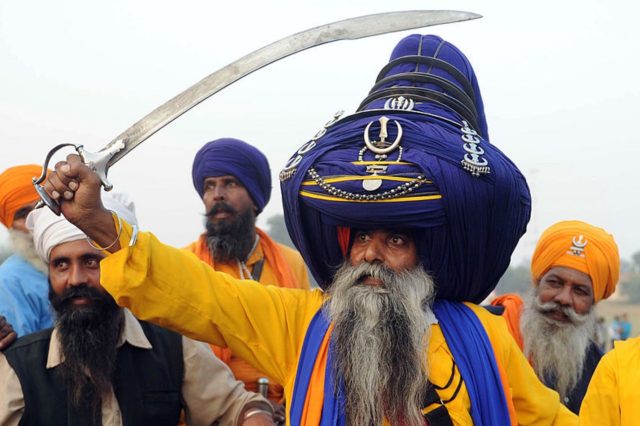
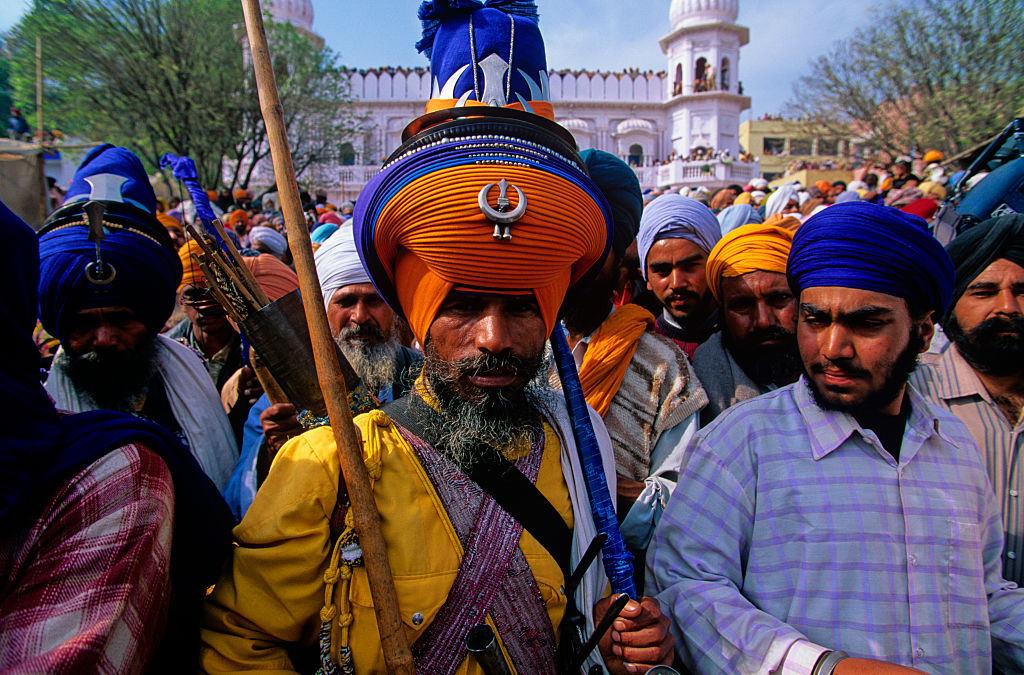
'They have a special, almost theological, relationship with steel itself.' (NARINDER NANU/AFP via Getty Images)





The air was thick with incense and tension. The hall was already bustling, as men and boys gathered under the shadow of ceremonial weapons and the resonant boom of a Sikh war drum. Some looked as though they were preparing for battle, wearing empty bandoliers and tactical camouflage vests, four-foot swords hanging by their sides. I was invited to sit and eat at the free kitchen, just like at every Sikh temple, as I watched the foyer fill up.
Yet as more and more people arrived, a man with a quizzical look approached me. He asked if I was a journalist. When I said I was, he told me that this was a private event, and that nobody would talk to me anyway. The meeting’s outcome, he added, would be publicized on social media. When I asked where exactly, he smiled and answered glibly. “The same channels where you found out about this meeting.” I wasn’t going to argue, shuffling past a thronged mass of conical turbans towards the door.
I had come to the Shri Guru Hargobind Sahib Ji Chauni Temple, in a quiet Coventry suburb, in search of the Nihangs: a fearsome Sikh warrior order. You likely haven’t heard of them — but you’ll almost certainly have heard of Vickrum Singh Digwa. He’s the man who stabbed Henry Nowak on a Southampton street last December, and whose resulting conviction for murder has generated one of Britain’s periodic fights about multiculturalism and belonging.
These debates have now raged for weeks, but one thing has remained largely unnoticed: a passage in Judge William Mousley’s sentencing remarks, where he paused to explain that Digwa belonged to the Nihangs, the same Sikh group I’d encountered in Coventry. This matters, and far beyond Vickrum Digwa — for the Nihangs are in many ways a symbol of our troubled moment.
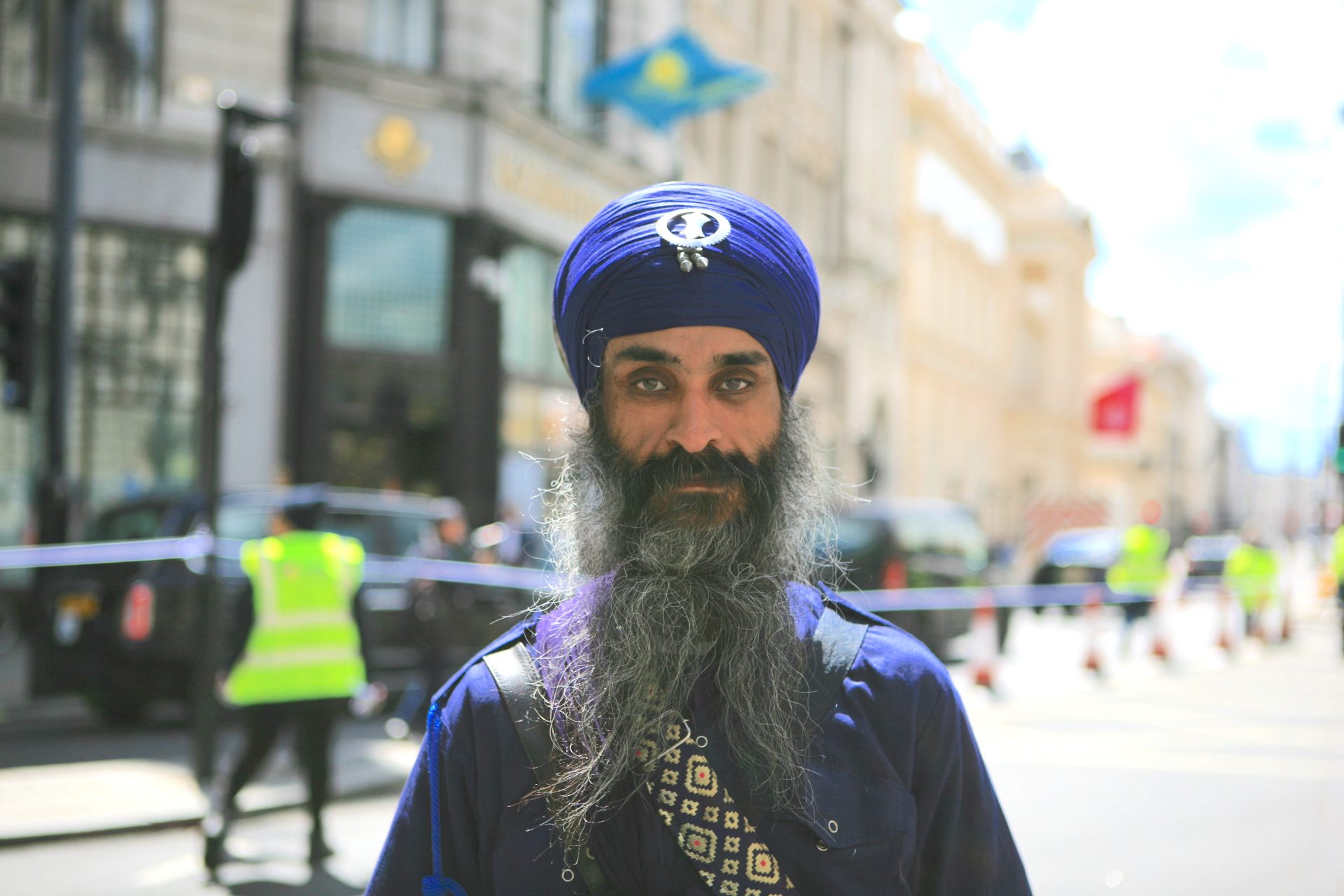
Only about a quarter of the world’s 25 million Sikhs are baptized. These so-called Khalsa are the only Sikhs required to wear the religion’s “five Ks”, including uncut hair (kesh), the steel bracelet (kara), and the now-infamous kirpan blade. The Nihangs are a minority within this minority. Today, there are estimated to be somewhere between a few hundred thousand and a million worldwide, concentrated in the Punjab. In the UK, the movement has a few hundred adherents.
The word “Nihang” itself means “crocodile” in classical Persian or “without attachments” in Sanskrit. Both translations evoke the order’s martial roots. Formed in the 18th century, as a vanguard against Muslim Mughal persecution, the Nihangs embodied an ethos that fused spirituality with steel. “When all other means have failed,” wrote Gobind Singh, the tenth and final living Sikh guru in 1705, “it is righteous to unsheathe the sword.”
And so it proved, with the Nihangs long acting as the shock troops of Sikh military power. These irregular formations fought the Mughals, held mountain passes against Afghan invaders, and were so notorious that the British later issued shoot-on-sight orders against them. G.H. Hodson, a colonial officer who fought them in the mid-19th century, described how one Nihang “rushed to meet me like a tiger. I never beheld such desperation and fury in my life.”
Clothing was crucial to this fiery reputation. Their appearance, then and now, is extraordinary. The traditional Nihang outfit is deep navy blue, the color chosen by Gobind Singh after campaigning against the Mughals at the turn of the 18th century. Over this, and as I saw in Coventry, Nihangs wear towering conical turbans, the dastar bunga, ringed with steel quoits called chakram. They have a special, almost theological, relationship with steel itself, which they call sarbloh, the “all-iron”. Crafting their weapons from steel, they even eat their food with sarbloh utensils, viewing the metal as infused with divine strength and martial purity.
It’s precisely this glimmer of violence that makes the Digwa case so distinctive. The killer carried two knives the evening he stabbed Henry Nowak. The first — a small, curved kirpan under his clothing — is the ceremonial blade required of all Khalsa Sikhs. Its carrying is protected under British law, provided the blade doesn’t exceed nine inches. This is familiar territory: even before the Nowak case, and all the public debate that’s followed, the kirpan exemption had been debated, defended, and litigated for decades. What made Digwa unusual was that second knife. It was an 8.2-inch pesh-kabz, a straight-bladed dagger designed to pierce chainmail armor and worn visibly. Though it’s also sometimes worn by other Khalsa Sikhs, this other blade is especially associated with the Nihang. Digwa himself wore it to work. He wore it in public. He had told himself that this was part of who he was.
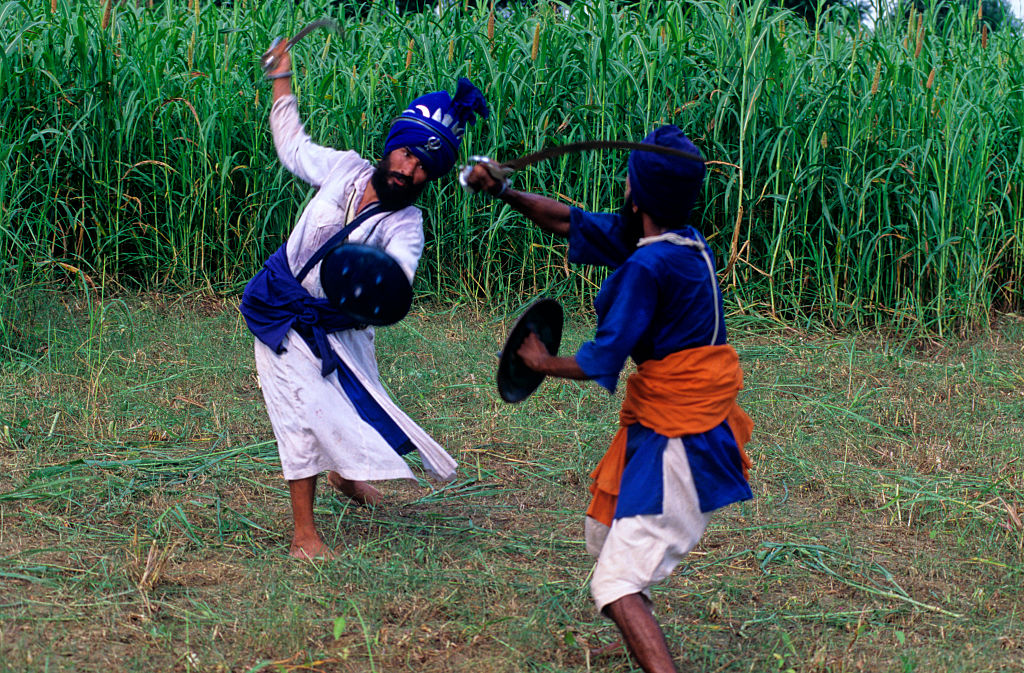
Professor Gurnam Singh, a sociologist at the University of Warwick who gave evidence at the trial, said that over the last 30 years there has been a trend among younger Sikhs towards wearing the kirpan with pride. Many, he explained, see it as an act of resistance to erasure — a way of insisting on a visible identity in a country that often wants minorities to be present but inconspicuous.
Other commentators have linked this resurgence to the “manosphere” phenomenon of young men looking for meaning, not dissimilar to those Muslims drawn to jihad. I heard hints of this in Coventry, as I listened to the chatter among excitable teenage Nihangs, a group affectionately known as bajungis (young snakes). “Well, I’m with the bumbaclaart Buddha Dal,” one proudly told his mate. He was referencing his Nihang sub-order, but the strange blend of Jamaican street talk and Punjabi hints at a boy in search of an identity. “Well look at me,” I heard another kid say, like everyone else dressed in Nihang robes. “Do you think any gora [white man] is going to approach me now looking like this?”
Of course, it’d be wrong to equate Vickrum Digwa with all Nihangs, let alone all Sikhs. To wear that second blade without discipline, without years of study and submission to the order’s internal hierarchy, is a kind of borrowing that the tradition itself would not easily recognize. No less important, carrying the kirpan symbolizes a duty to defend the weak, meaning it should never be drawn lightly, or used on the unarmed.
Judge Mousley, to his considerable credit, understood this distinction, and indeed made it the crux of his sentencing. He accepted that carrying the pesh-kabz under Nihang tradition might initially have constituted a good legal reason for having it — a religious and cultural justification sufficient to meet the threshold of the knife-carrying exemption. But, he added, that reason must have come to an end the moment Digwa removed it from its sheath. He used it offensively. Then he lied about it, letting Henry Nowak die handcuffed on the street.
Little wonder Kamalroop Singh, a Sikh scholar and representative of the Buddha Dal Nihang order, says that though Digwa often turned up at Nihang events, he was not an official member — describing him instead as a “fantasist Nihang”. Other Sikh leaders make a similar point. “We’ve seen all Sikhs of whatever background or order roundly condemn the actions of Digwa,” says Gurpreet Anand of the Khalsa Jatha British Isles, the country’s oldest Sikh temple, “and there is a concerted effort to ensure nothing like this happens again.”
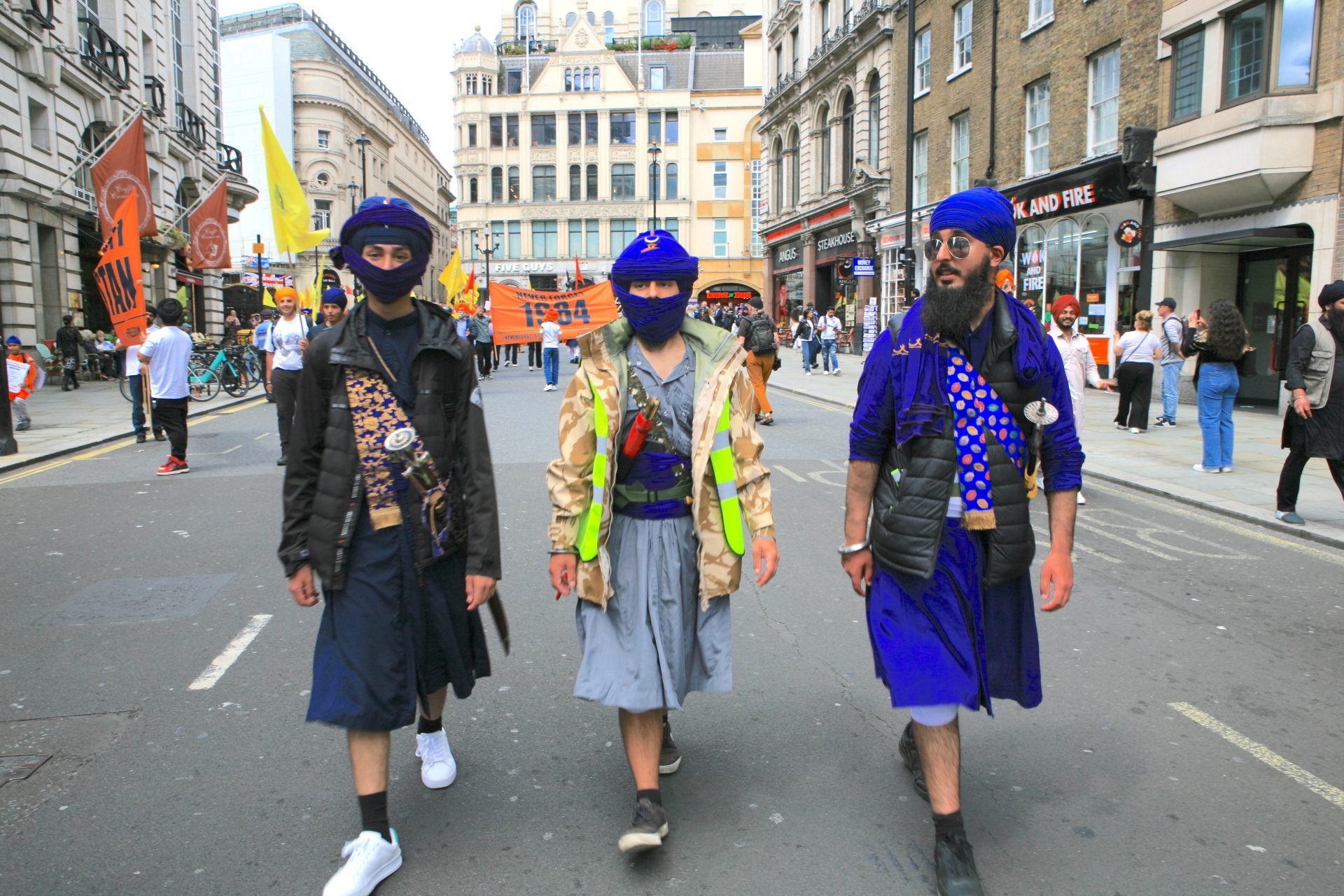
Yet these fair-minded condemnations don’t change the fact that for Khalsa, even those who only wear a single blade, the kirpan remains non-negotiable. Shamsher Singh, of the National Sikh Youth Federation, which supports the creation of a Sikh homeland in Punjab, describes the knife as a sign of “Sikh sovereignty”. “If the Government wants to ban the kirpan,” he says, “many Sikhs would continue to wear it, as our right to wear the kirpan doesn’t come from English law, it comes from our own sovereignty which predates our encounter with the British.” It’s a view echoed by another prominent Sikh leader, who tells me he’s personally informed Keir Starmer that if the kirpan were banned “the UK’s jails will be filled with Khalsa Sikhs”. The Nihang tradition is even more uncompromising. Not merely a cultural identity, but a martial order with a code of conduct, its weapons are instruments of a discipline that is both physical and spiritual.
All this is taking place in Britain, a country where arms are politically and legally charged in ways that headdress or dietary practices obviously aren’t. Taken together, the Nihangs are an object lesson in the challenges of balancing minority rights with the demands of the liberal state — especially when some members are political far beyond the kirpan.
In India, Nihangs have occasionally attacked Christian pastors and worshipers. In Britain, some have gravitated towards Tommy Robinson, which is ironic given his self-declared Christian credentials. A few even joined the now-defunct English Defence League in its short-lived “Sikh Division”. Any links are tenuous, issue-specific and individual rather than institutional, especially given the Nihangs are traditionalists by nature. The nexus that does exist stems primarily from shared opposition to radical Islamism. Sikh street gangs, like the Shere-Punjab in Birmingham, were originally formed to fight white racists in the Seventies. In later decades, though, some elements morphed into a vehemently anti-Muslim campaign amid fears that Sikh girls were being groomed and forcibly converted, especially at so-called “Daytime Bhangra” music gigs. More recently, groups like Sikh Youth UK have openly supported Robinson, claiming they’re fighting Muslim grooming gangs.
Once again, more mainstream Sikhs are keen to distance themselves from these trends. “This alliance is limited to a vocal minority of Sikhs,” emphasizes Shamsher Singh, “some of whom were members of the English Defence League, much to the horror of most Sikhs. It’s a short-sighted strategy by these misled Sikhs who are only serving to divide their own communities.” All the same, a sect born resisting Islamic persecution in India still finds itself entangled, in its fringes, with anti-Islam currents in Britain, while also being associated with a killer whose actions have damaged the broader Sikh reputation as a “model minority”.
So what of the future? One possibility is that the shock of the Nowak case nudges the Nihangs closer to the Sikh mainstream, away from performative militancy and into a quieter, more clearly bounded expression of faith. Another outcome, though, is that the fringe hardens, drawing strength from grievance, street culture and ever-stronger alliances with Britain’s anti-Muslim Right.
Whatever happens next, I find myself returning to those overheard conversations in Coventry. The slang, the bravado, the football talk, the half-played identities — it all felt like the talk of boys trying on a future, measuring themselves against one another, against history, against the gaze of strangers. In that sense, the Nihangs are not only an old warrior order but a contemporary one too. That isn’t because they’ve solved the problem of identity, but because they embody just how unsettled identity has become. Here was a tradition built for a world of empires, still speaking in the language of honor and swords, now being carried forward by young men in a Britain shedding all its old certainties. Whether that leads to greater integration, harder fragmentation, or some uneasy balance between the two may depend less on theology than on what those boys decide they’re trying to become.
The British state will eventually need to decide whether it wants firmer legal clarity around the kirpan, or whether it prefers the current ambiguity, in which a sacred object can become a lethal weapon. That decision will matter beyond the Nowak case, for it digs to the core of what multicultural Britain is prepared to tolerate, what it is prepared to regulate, and whether pluralism can survive without some common rules that even the most distinctive traditions must respect. In our country’s restless search for cohesion, steel alone can’t forge belonging.