




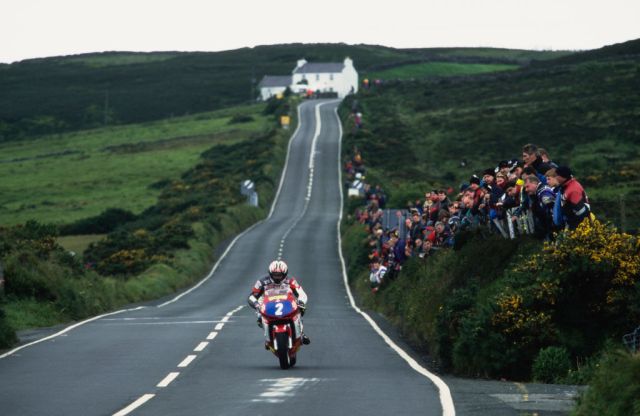
'Competitors hurtle through country roads, villages, towns, and up a mountain'. (Frank Peters/Bongarts/Getty)





“Those who risk nothing, do nothing, achieve nothing, become nothing.” Etched into the black marble of a Bradford gravestone, these words commemorate the life and victories of David Jeffries. He was an icon of the track — a racer, a record holder, and nine time winner of the Isle of Man TT. Aged 26, he won three TT races. Aged 29, he set the lap record, completing the TT course — all 37.73 miles of it — in a mere 17 minutes, 47 seconds. Aged 30, he died, broken upon the stone wall of 29 Woodlea Villas, a house in the Manx village of Crosby.
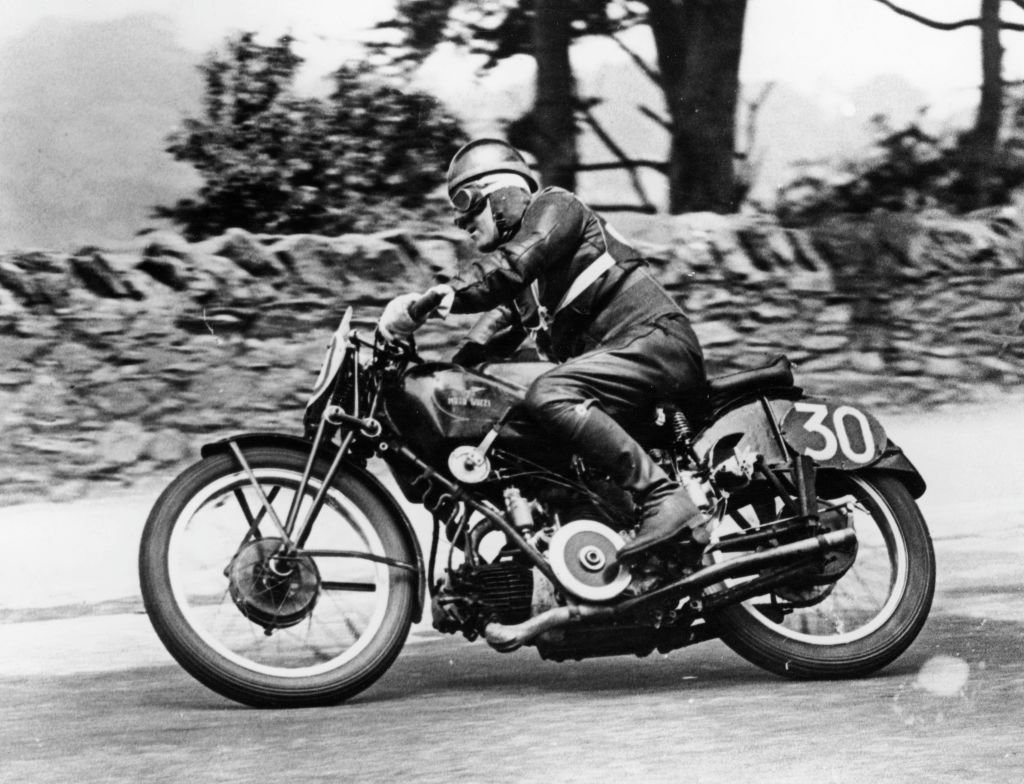
The Isle of Man’s Tourist Trophy (TT) is the most dangerous motor competition in the world. It has killed more than 270 of its competitors and crippled many more; since the birth of the TT, only two years have gone without fatalities. Formula 1 drivers race upon purpose-built circuits, places provided with run off zones, safety barriers, and specialized road surfaces; the TT has none of these. Reaching top speeds of more than 200 mph, competitors hurtle through country roads, villages, towns, and up a mountain.
They must pass walls, trees, houses, and horses; spectators, furniture, telephone poles and iron railings. They must negotiate more than 200 bends and kinks to the course; blind turnings and hairpin corners; airborne jumps and fearsome plunges; corners so tight that their knees hang centimeters above the tarmac — and they do all of this knowing that if they get it wrong, if they miscalculate an angle or a turning or a bump in the road, they may die. It is a competition almost entirely run and raced by amateurs, mechanics, builders, farmers, plumbers. None do it for money; winners can expect to receive a mere £26,250. They are doing it instead for something else: the thrill of speed, of risk, and of victory; the regard of other racers, and the call of tradition.
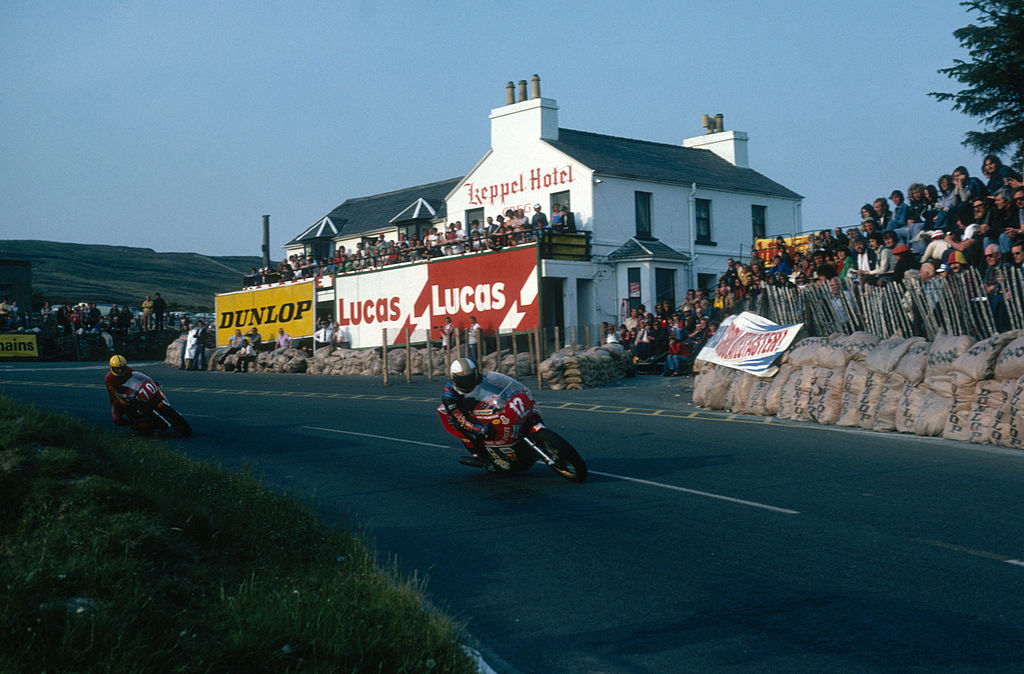
Now finishing its 114th year, the TT is an arena of danger and glory, the subject of films, documentaries, and songs. The central event of an entire industry, it is also a testing ground and product exhibition. Generations of motorcycle builders used the TT as a benchmark, a standard against which to measure the performance of their models; companies have lived and died based upon how their vehicles performed on the track. Through the TT, we can tell a story not only of courage, meaning, and myth, but also a story of manufacturing — of Britain’s long reign as workshop to the world, and its precipitate collapse to foreign competition.
The TT was born in exception. In 1903, the British government banned motor vehicles from traveling at more than 20 mph; speed enthusiasts were obliged to look elsewhere. Possessed of its own legal system, and pleased to accept financial incentives, the Isle of Man was the perfect place in which to stage the races and trials so earnestly sought by the motor industry. The first TT was held in 1907 and — wars and pandemics aside — it has been going strong ever since. It dominates the island’s annual calendar, and is the backbone of its tourist industry. On average, 40,000 fans and 10,000 motorcycles visit the island. There are many more visitors than hotel beds; residents rent out their homes, guest bedrooms, and even their fields, charging tourists for a spot to pitch their tent. To accommodate the racing, schools have a two-week summer half term. The course itself transforms; spectator stands are erected, barriers put up, livestock fencing inspected, the road itself repaired and swept.
What is it that drives the contestants up onto the mountain? A lonely impulse of delight; a tumult on the roads. Stuart Barker, interviewing TT riders for his 2022 book Ragged Edge, found that they spoke of the thrill, the buzz, adrenaline; the feeling, as 1950 winner Geoff Duke put it, of “elation and absolute wonder of going down Bray Hill for the first time”. For some, the risk is the point; as observed by TT racer Guy Martin, “You have to take the risk to get the buzz.” For others, it is a matter of history and tradition, with brother following brother and sons following their fathers. Beside tradition, besides the thrill and the adrenaline, riders are also attracted by the magnitude and prestige of the TT, the “pure kudos” of the event, its status as the “ultimate” challenge.
To win in the TT is to participate in a century-long tradition, and to rank with and among the legends of the course. The TT’s great contests are the stuff of legend: the 1967 Senior race between Mike Hailwood and Giacomo Agostini, say, or Hailwood’s comeback some 11 years later. So too are they emblems of endurance and will. Consider the determination of Robert Dunlop, who arrived for the 1998 TT on crutches. Right arm and right leg crippled from a TT crash four years earlier, he had broken his collarbone and re-broken his leg only three weeks before the event. Not only did he join the Ultralightweight race, but he won it; victorious, he cast his crutches into the crowd. Or else there’s Conor Cummins. Thrown from his bike and sent tumbling down the mountain, he sustained a broken back, arm, pelvis, and torn ligaments, yet returned and, 12 years later, took second place in the 2022 Superstock race.
The most successful riders ascend into myth. In pubs across the Isle of Man, hanging on a wall someplace behind the bar, sit the icons of a votive cult — portraits of Joey Dunlop. The victor of 26 TT races, Dunlop, who was Northern Irish, dominated the track for a quarter century. A statue of him can be seen on the TT course, overlooking the Bungalow Bend; last year, 25 years after his death in Estonia, TT organizers arranged a tribute lap in his honor. This week, his life-sized image decorated the walls of the grandstand bar, along with other TT greats, figures like John McGuinness, Michael Dunlop, Dave Molyneaux. So too are they etched into the route itself; each of these men has a corner of course named after them. Through competition, meaning is inscribed into the landscape.
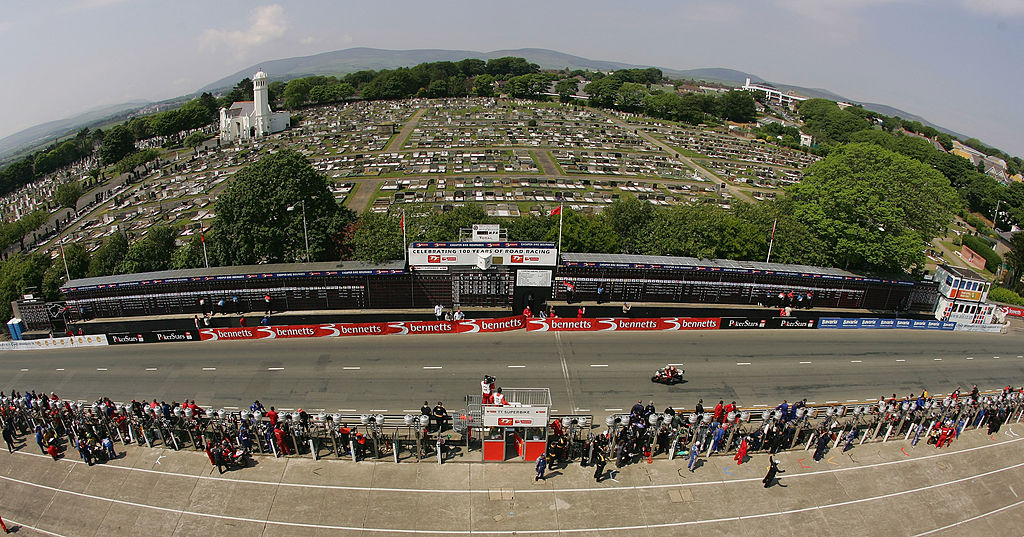
TT races end where they begin: in the shadow of the grave. Directly opposite from the TT grandstand is the Douglas borough cemetery. Yards from the dead, winners are brought to the podium, there to be adorned in a giant laurel wreath, one so large it must be slung across the chest and under the shoulder. In some respects, the TT is not an event in history — it is an event before history, an extrusion of premodern values within a risk-averse, money-centric liberal order. By joining the TT, ordinary men and women, the vast majority of whom are amateurs, trade the risk of death for the thrill of life, and for the chance of glory.
“I don’t want to grow old and regret things I didn’t do. What do you do in life? Do you sit around wishing you’d done stuff, or do you get out there and do it?” These words were said by James Hillier, a TT competitor in our own era; said in a different register, their message is still older. In the Iliad, the hero’s existence is defined by the choice between a long and obscure life and a short, glorious one. Sitting in his camp, Achilles must choose between the pleasures of home, and the immortality of renown; it is a choice between death, and between life. The Trojan hero Sarpedon puts it a different way; were it possible to go on ageless and immortal, he would not go on fighting. “But now, seeing that the spirits of death stand close about us in their thousands, no man can turn aside nor escape them, let us go on and win glory for ourselves, or yield it to others.” Risking their lives, embracing the thrill of risk, the danger of injury, and the glory of competition, TT racers affirm, in their own startling way, the existential choices all of us face.
The TT is one of the great cultural events of British life. Despite this, it is oddly underappreciated in mainstream British culture. Too Northern, perhaps; too working class. A festival for mechanics and motorheads, taking place far from the power centers of the South East. In a sense, this too has a heritage. From the earliest days of the industry, British motorcycling had clear class connotations, seen as the domain of young men, of factory workers and laborers, embracing the freedom of the open road. For British manufacturers this was the industry’s strength — a clearly defined market — and also its curse.
Throughout its long life, the TT has tracked the improvement of technology — the relentless improvement of the internal combustion engine, of frames, suspension, tires, brakes, fuels, metallurgy, lubrication, aerodynamics, engine configuration, reliability, and electronics. As the machines improved, so too did the lap times. The first 60 mph lap was reached in 1924; the first 80-mph lap in 1930. The first 100-mph lap was achieved in 1957; 120 in 1989; the current high, achieved by Peter Hickman in 2023, is just over 136 mph. Driving this has been competition: the competition of individuals, and the competition of companies and nations.
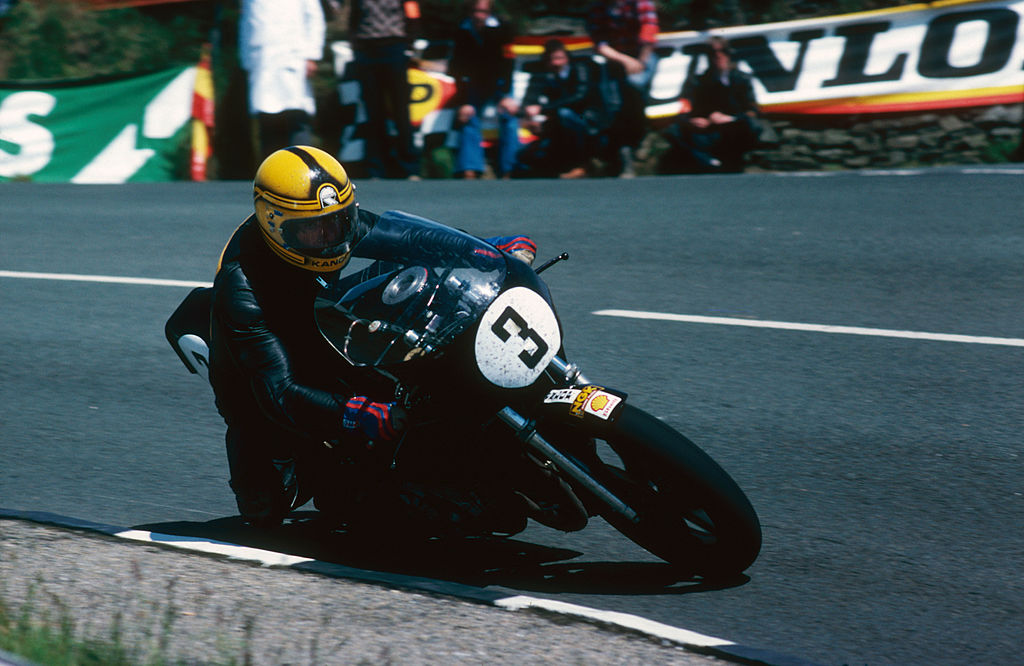
“One is apt to think of the TT as a sporting event that the trade happens to find worthwhile to patronize. But it is more accurate to consider it a trade event that happens to be of a sporting character… The ultimate purpose of the meeting is to sell motorcycles.” Writing in 1951, motor journalist Francis Jones was clear on the role of the TT. The course was used to sell bikes, and to test them, a way of examining performance and reliability under the most severe of conditions. Bikes that succeeded in the TT would succeed with the sports-driven, risk-oriented, male customers that the industry identified as its core market. It was a mindset built up over decades, decades within which British bikes stood supreme across global markets. Right up until the Sixties, the TT was a showplace of British manufacturing prowess. Matchless motorbikes dominated the years before the First World War, and between 1926 and 1939, at least one Solihull-made Norton finished in the top three places of the Isle of Man TT.
Alongside the commercial ties were those of passion, for many of the UK’s leading firms were owned and operated by motorcycle hobbyists. Harry Collier, the son of the Matchless founder and later an MD of the company, raced semi-professionally and had a distinguished TT career. Across the industry, senior management would be almost obliged to make the annual pilgrimage to the Isle of Man. Employees also participated: at the AMC factory in Woolwich, employment preference was given to motorbike riders, TT results were broadcast over the public address system, and, on at least one occasion, the company gave leave to 200 staff so that they could travel to the TT.
This strength did not last. In 1939, a BMW won the Senior TT. Accompanied by billowing swastikas, it was an important prewar propaganda for victory for the Nazi state. In 1947, an Italian machine won the Lightweight TT race. British dominance in the Senior and Junior categories lasted into the mid Fifties, when the Italian Gilera and Moto Guzzi teams started to win prizes. From 1956, Norton and AMC announced they would no longer run official race teams. Honda won its first race in 1961; within a few years, Japanese bikes dominated Honda alone has since won over 250 TT races, followed by Yamaha and Kawasaki. By 1992, when first asked to ride upon a British-made Norton, Steve Hislop laughed; no-one had won on a British bike in 30 years. In the end, he did win — but that remains the last time a British bike triumphed in the TT’s biggest competition.
The British motorcycling industry failed for three reasons. Believing in craftsmanship, postwar managers failed to adopt new assembly line technology, thus damaging their ability to scale, and to maintain quality control. Focused on sport, and upon a masculine ethos of competition, they missed the female market. Above all, British firms failed adequately to recognize and meet demand for “economy” bikes: cheap, stylish, easy to use vehicles for the non-technical commuter. By doing so, they laid the ground for their eventual failure in sport as well.
British motorcycling is a case study of “segment retreat”. Category by category, Britain’s postwar motorcycle manufacturers withdrew before the advance of their Italian and Japanese rivals. First, they sacrificed the home market, focusing instead on exports of motorbikes to North America. Focused on heavy bikes, they then sacrificed the economy, light, and medium-weight sectors; by 1975, the British industry produced nothing smaller than machines in the 500cc displacement class. Backed by a superior manufacturing base, better factories, the revenues and the scale they gained in other segments, Japanese firms soon beat them there as well. With nowhere left to retreat, the British industry collapsed; its decades-long position as the world leader had vanished. The TT rewarded courage and mechanical brilliance, but the postwar motorcycle market increasingly rewarded a different kind of genius: the ability to make motorcycling ordinary and scalable.
For motorcycling, we can read Britain as a whole. For decades, our story has been one of retreat. Retreat from empire, retreat from ship-building, from steel and energy production; retreat from textiles, railways, and electronics, from aerospace, car-building, and telecoms. Retreat too, if blind complacency has its way, from the existence of the United Kingdom itself. At each stage, British elites have trusted in something to rescue us: the global service economy, the European Community, the transatlantic alliance, the prestige of our laws, the global nature of our language. None of these can be trusted to endure. In a darkening world, Britain now stands exposed, adrift, and with nowhere left to retreat.
The question is what we do next. Unlike the Italians, Germans and Japanese of the postwar era, Britain’s elite still do not know they have been defeated, and so presume things can continue as they are. We must embrace both the TT spirit, its culture of risk-taking and victory against the odds, but at the same time we must embrace the humility of defeat. The defeated Axis power won the development of the postwar industry through discipline, creativity, and an emphasis on achieving scale; so too must the contemporary UK. Decline is a choice — a choice to retreat, a choice no longer to strive, a choice to abandon ambition. Above all, we must remember this truth: those who risk nothing, do nothing, achieve nothing, become nothing.