




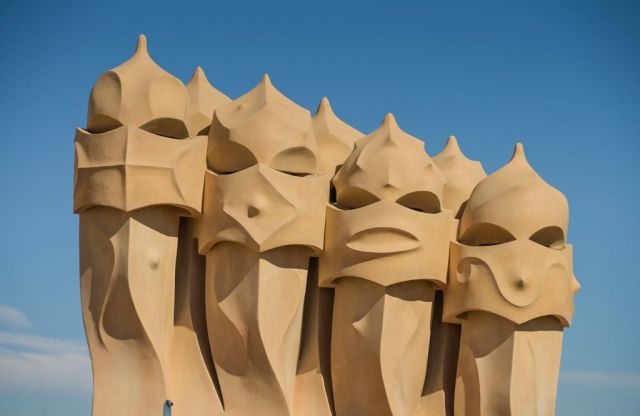
'Gaudí’s genius is exalted by a world he would have abhorred.' (Bildagentur-online/Schoening/Universal Images Group/Getty)





When asked why his masterpiece, the Sagrada Família church in Barcelona, was taking so long to complete, the architect Antoni Gaudí is said to have replied, “my client can wait”. That client, of course, was God. Today, on the hundredth anniversary of Gaudí’s death — and more than 140 years after the first stone of the immense church was laid — the wait is finally over. Numerous successors have worked to bring the building to completion, with its wealth of ornament, color and strange, mesmerizing forms. Now Pope Leo XIV will bless Gaudí’s greatest creation.
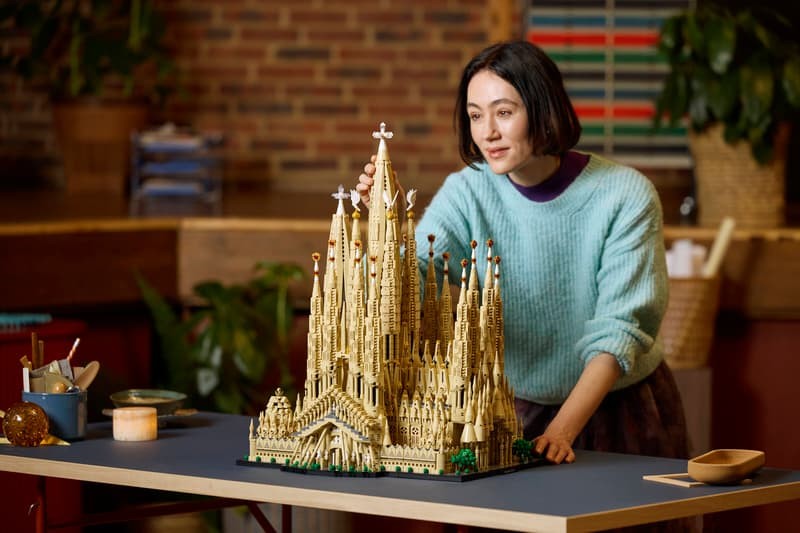
Yet this milestone comes with a bitter note. It is an achievement to have finished Gaudí’s great church, but we surely could not come up with anything like this today. It is simultaneously a work of soaring artistic ambition and a monument to the powers of mystical inspiration, neither of which seem very abundant in our banal and unimaginative culture. Commenting on the challenge that Gaudí poses to the blandness of modern architecture, the designer Thomas Heatherwick said that his own plan to put a “slight curve” along the top of a window caused a colleague to remark, “Wow, you’re brave”. The Sagrada Família is the antithesis to comfortable mediocrity, to the fleeting trend, and to algorithmic thinking. In November, Lego will release a 12,000-piece model of the church, its largest ever set. This is a charming tribute in its own way, but together with the rising numbers of “Afols” — adult fans of Lego — it makes for an unfortunate symbol of the meagerness of our cultural aspirations by comparison with those of the original.
What inspired the Sagrada Família, and what animates its every detail, is the intense spiritual devotion of its designer: to the Catholic faith, to the project of Catalan nationalism, and to the vocation of architecture. In the panoply of houses, churches, parks, and pavilions that Gaudí designed, these convictions provide a framework for an inexhaustible individuality. There are living artists of passion and profundity, but to behold Gaudí’s creations at large in Barcelona is to realize the extent to which we have cordoned-off genuine artistic and spiritual expression from the daily round of life, much as we confine sickness to hospitals.
During the Sixties, the philosopher Paul Ricoeur described the ambivalent effects of what he called “the phenomenon of universalisation”. For all that the world has benefited from the spread of science, technology, and modern forms of governance and commerce, the cost has been a “subtle destruction” of the “creative nucleus of great civilisations and great cultures”. Throughout the world, Ricoeur observed, “one finds the same bad movie, the same slot machines, the same plastic or aluminum atrocities, the same twisting of language by propaganda”, such that “it seems as if mankind, by approaching en masse a basic consumer culture, were also stopped en masse at a subcultural level”. The implied contrast is between cultures of the past, which had depth and distinctiveness, and those of a homogenous modernity; but the tantalizing prospect manifest in Gaudí is of a civilization that is both modern and rich in beauty and myth.
The irony of Gaudí’s legacy is that his genius is exalted by a world he would have abhorred. He was, at least from the midpoint of his life, every bit the otherworldly eccentric that one hopes a great artist to be: deeply conservative in his views (though defiant against the rule of Catalonia from Madrid), exuberantly original in his work, stubborn and fanatical in his temperament. He became so obsessed with self-denial and mortification that his physical comforts amounted to, as one biographer puts it, “sleeping in a cot with the windows open and eating nuts and lettuce dipped in milk”. During Lent in 1894, in the midst of a spiritual crisis, he fasted almost to death. When he was fatally injured by a tram in 1926, his bedraggled appearance led to him being mistaken for a tramp and taken to a pauper’s hospital. He died there after refusing to be transferred to a private clinic.
Yet Gaudí’s buildings, reduced like Nefertiti or the Mona Lisa to the status of t-shirt and keyring-fodder, have helped to turn the city he saw as the sacred heart of the Catalan nation into a tourist trap. The Sagrada Família, initially funded by the donations of the devout, was brought to completion with the revenues of the tourist industry.
Gaudí’s popularity shows that there is no shortage of people capable of appreciating great art; but that appreciation takes place within a culture of mass consumption which struggles to support creative expression of such richness and nonconformity. However deeply we feel the power of his work, as soon as we turn away we are back in a cultural universe centered on TikTok. Mark Burry, an architect who has been central to the completion of the Sagrada Família, has argued that Gaudí’s supple organic shapes anticipate Parametricism, a 21st-century computer-based school of architecture whose most famous practitioner was Zaha Hadid. It is a revealing parallel. Impressive though they are, Hadid’s buildings are pure spectacle and ambiance, anonymous expressions of engineering prowess to be plopped anywhere that can afford them. They possess none of the personality or conviction which radiates from Gaudí’s work.
Gaudí’s career offers some clues as to the sources of our predicament. One is patronage. Many of Gaudí’s greatest achievements — such as the Casa Batlló and the Casa Milà, houses of stunning boldness built in the early 20th century — were funded by the Catalan bourgeoisie with the proceeds of the region’s buoyant industrial capitalism. Of special importance was Gaudí’s relationship with the textile magnate Eusebi Güell, who discovered the architect as a young man and bankrolled him lavishly over a period of 40 years. Back then, great art was provided for by great inequality; so why have the enormous fortunes of our era not yielded such fruit?
The answer is that, as during the Italian Renaissance, a climate of patriotism and civic pride in Gaudí’s Barcelona motivated the wealthy to channel their craving for status into the Renaixença, a movement for Catalan rebirth. The super rich today, by contrast, tend to conceive of themselves as a caste apart, floating free from any particular context aboard their exquisitely designed yachts, seeking recognition largely from one another. They pour money into corporate architecture for elite institutions, or, at the behest of professional advisors, into a closeted art world which has come to function as another source of financial assets. Perhaps we should count ourselves lucky that they do not venture further: those who have committed themselves to public life, such as Donald Trump or Elon Musk, do so as proud philistines, purveyors of kitsch hotels and anime memes.
Patronage is partly responsible for another important aspect of Gaudí’s career: he had time and space to mature. By contrast with most of those who enter the cultural arena today, he did not experience a crushing pressure to be constantly relevant, up-to-date, and engaging with the world. No one demanded that he have a personal story to sell. In fact, he wrote down scarcely anything at all, and since he lived for most of his adult life with only his father and his niece, most of the words attributed to him are hearsay. His mature work is incredibly daring, even shocking, but it is not mere novelty or gesture. Instead, it is the product of a long gestation in which Gaudí consolidated various influences into a unique style. Tracing his development, you can see him experiment with Neo-Gothic, baroque, Art Nouveau, and the Mudéjar style of Islamic craftsmen in Spain. Since he was working on the Sagrada Família for most of his career, all of these elements are present in that church, synthesized under the guiding principle of his aesthetics: reverence for a natural world in which there is a bounty of colors and forms, but no straight lines or right-angles.
In this way, Gaudí demonstrates the irreplaceable value of unmediated human skill. Growing up in a family of copper-smiths, and coming under the early influence of the English Arts and Crafts movement, Gaudí marked his architecture with a close attention to materials, craftsmanship, and experimental modeling. Much of the lavish detail in his works owes to the artisans who provided their tiles, masonry, stained-glass windows, carpentry and ironwork, the latter being most wonderfully manifest in the seaweed-like balcony railings at the Casa Milà.
Today, however, I hear from design teachers that students have become “material agnostic”: accustomed to working with software, the physical and aesthetic qualities of materials are an afterthought. Even if it is possible to replicate Gaudí’s arches and vaults with engineering programs today, the hours which he and his team spent painstakingly modeling these structures were an indispensable part of their creative development. The uniqueness of Gaudi’s buildings reflects his improvisational approach, starting out with a rough idea and working through problems as they arose.
Of course, we cannot reduce Gaudí’s achievements to these practical factors, as though creating the conditions for artistic genius were itself an engineering problem. There is a deeper cultural dimension. Gaudí lived and worked at a time of radical feeling in Europe, taking radical in its true sense of being concerned with roots. It is no coincidence that so much of the modern culture we call great came from the century after 1850, whether it be the novels of Dostoyevsky and Joyce, the philosophy of Nietzsche and Freud, the poetry of Eliot and Yeats, or the paintings of Monet and Picasso. This was an age when the foundations of modern society and culture were being contested: a time of class warfare, of national independence struggles, of religion’s rearguard battle against secularism, and of philosophical reckoning with the pillars of Western thought going back to Athens and Jerusalem. This sense of playing for the highest stakes — of determining what the character of the modern world could be — generated nuclear levels of cultural energy on which the arts thrived.
For all its personal and regional distinctiveness, Gaudí’s architecture resonates with this time of conflict. He was a partisan in a battle for the future of Catalonia, taking the side of a mystical, Catholic reaction against the rise of liberalism and a workers’ movement inspired by anti-clerical anarchism. This was more than a culture war. The village he helped to design for Eusebi Güell’s factory workers, featuring a church crypt that is one of his most impressive works, was part of a project to relocate the business away from the dangers of insurrection in Barcelona. When that insurrection duly came during the “tragic week” of 1909, the rebels dumped the corpses of disinterred nuns outside the gates of Güell’s mansion, also designed by Gaudí. It tends to be discreetly overlooked today, but the Sagrada Família was conceived as an expiatory temple; that is, an offering to God to atone for the sins of modern Barcelona.
We too think of ourselves as living at a time of radicalism, and there is no denying the strength of feeling that bubbles away in our societies today. Yet the “universalization” which Ricoeur diagnosed remains in place: the circuits of money, commodities and media continue to exert their flattening pressure on the world’s cultures, even as the human interactions they encompass become more fractious. Given the horrors that unfolded in the 20th century, we shouldn’t rush to restart conflicts that penetrate to the very roots of our world. But we probably won’t see the likes of Gaudí again.
Wessie du Toit writes about culture, design and ideas. His Substack is The Pathos of Things.
 wessiedutoit