




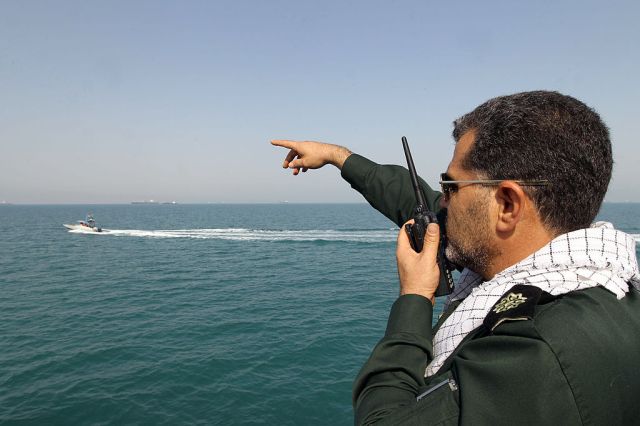
The new technology opens opportunity for nations like Iran and Ukraine to achieve naval supremacy. Credit: Getty





The Ukrainians have a lot to teach the United States and the Trump administration about naval warfare.
When Russia invaded four years ago, Ukraine was without a navy that could plausibly contest control of the Black Sea, and the Russian military was able to threaten it with amphibious landings behind its lines. Today, Ukraine’s fleet dominates the Black Sea and is almost entirely autonomous (unmanned). In four years, Ukraine has driven the Russian Black Sea Fleet from Sevastopol, sunk roughly a dozen warships, crippled the same number, and broken Russian command of this strategically vital body of water.
Elsewhere, a Russian liquid- natural- gas (LNG) carrier, the Arctic Metagaz, was hit near Malta in March by Ukrainian unmanned surface vehicles controlled from Libya. The ship then spent two months as a floating burnt wreck, drifting through Italian and Maltese waters, before recently being secured off the Libyan coast.
All of this was achieved on a shoestring budget, without the need to build or man a conventional crewed Navy. Meanwhile, in order to close the Strait of Hormuz and restrict Iranian shipping, Team Trump puts multibillion-dollar US Navy vessels at risk. Using these ships and crews to reopen the strait to American and allied shipping remains too potentially costly, and so Hormuz remains closed except for the few commercial ships daring enough to run the blockades.
Chaos on the seas is rising, and unmanned naval warfare is transforming everything we thought we knew about maritime military strategy. Global shipping and global geopolitics are already being affected. How America adapts — or fails to adapt — to this technological threat will have implications for years to come.
Learning from the West’s Ukrainian allies is essential.
The pace of change has been extremely rapid. In 2022, Ukraine’s unmanned surface vehicles, or USVs, were single-use, ran fewer than 200 miles, and had very limited autonomy. The 2025 generation is much more capable: Ukraine’s Sea Baby drone can run almost 1,000 miles at nearly 50 knots on satellite comms (using satellite guidance) and carries up to two tons of payload, which can be rockets, guns, sensors, or explosives. The Ukrainian ministry of defense is beginning to operate such drones in coordinated swarms and has integrated autonomous targeting, allowing operations in communications-denied environments. The ministry’s Magura V7 USV has even used missiles to shoot down two Russian Su-30 fighter jets.
The central innovation is the USV. Unmanned naval surface weapons have a long history, from fireships, employed as early as the siege of Tyre in 332 BC, to Israeli inventions in the modern era. In 1948, Israel sunk the Emir Farouk, the flagship vessel of the Egyptian navy, by piloting small speedboats loaded with explosives into the hull, with the operators jumping out at the last minute. But the ability for modern USVs to operate autonomously, over thousands of miles of range, is new and revolutionary.
Throughout history, denying sea access to an enemy required one of two things: either a chokepoint, with mines or coastal batteries, which allowed a land power to dominate a small area of sea; or a blue-water navy, recently including submarines. This is why great naval powers have secured island fortresses near critical straits, in order to project power in the places where other powers might contest freedom of navigation: Singapore, Gibraltar, and Penang in Malaysia, for example.
Furthermore, as Alfred Thayer Mahan, the great American naval strategist, pointed out, a navy rests on a merchant service (commercial shipping traffic) and the maritime commercial society that supports both. Historically, it has been the case that without a commercial maritime society, a country’s claim to projecting power at sea was tenuous at best. Germany, for instance, tried to project sea power in both world wars, leveraging submarines, and failed both times. France tried during the Napoleonic Wars, and was largely unsuccessful. Examples of this abound.
With autonomous drones, maritime power projection no longer requires a chokepoint or a navy. Sea denial is now open to non-maritime powers, which will have serious commercial as well as military implications, thus undermining Mahan’s second condition for naval dominance. This is the most fundamental change in sea power strategy in centuries.
America’s current strategy of relying on aerial drones and cruise missiles can certainly sink ships, but effective anti-ship missiles are expensive and hard to build: a Naval Strike Missile, or NSM, is very capable and has stealth capabilities but costs about $2 million per missile, and delivers a 500-plus-pound payload with perhaps 180 miles of range. A new Tomahawk missile costs around $3 million, carries a heavier payload, and has a longer (1,500-mile) range but requires a large ship with vertical tubes for launch and lacks some of the stealth features of the NSM. By contrast, a modern autonomous drone boat costs a couple of hundred thousand dollars, delivers thousands of pounds of payload, and has perhaps a thousand miles of range, with range and payload being easy to trade off against each other. Plus, the drone boat can be launched by dropping it off the side of any merchant ship or launching it from any beach using a cargo trailer; the NSM and Tomahawk both require special launchers, which are in short supply.
Buoyancy is free. Lift is expensive.
Unmanned surface vehicles have another advantage as well. Sinking a large merchant ship is easiest with an explosive payload at the waterline, where seawater finishes the job; thus, the cheapest way to put a large shaped charge of explosive on target is from another surface vessel. To do the same work from the air costs orders of magnitude more. Even where defenders intercept most USV attacks — as in the Red Sea — the cost ratio still favors the attacker, especially when striking at large merchant ships.
And commercial shipping is especially vulnerable. Unlike naval vessels, which have weapons systems that can intercept surface vehicles, merchant ships generally don’t carry the systems that would be required to intercept even a single incoming drone boat. They are forbidden from being armed by international law and settled convention, and most ports will not let them dock, if they are armed. Their only defense, in effect, is speed, or an armed escort.
Washington, however, has been slow to adapt. The US naval blockade of the Islamic Republic since April 13, paired with the Project Freedom safe-passage operation launched May 4, illustrates the gap between Ukraine’s economics and Washington’s. Central Command has more than a dozen manned warships and “multi-domain unmanned platforms” deployed across the Strait of Hormuz, the Gulf of Oman, the Arabian Sea, and the Indian Ocean. By May 1, US forces had turned back 45 vessels bound for Iranian ports, some from as far away as the Bay of Bengal. The work is being done in large part by guided-missile destroyers at roughly $2.5 billion per hull. An Arleigh Burke destroyer, the workhorse of the US fleet, costs perhaps $80 million a year to operate.
There are cheaper, less risky ways to close the straits to adversaries and open them to allies, by leveraging unmanned vehicles much more heavily as pickets to protect specific stretches of water, and as escorts for merchant ships. This is the sort of thing that the Ukrainians can teach us.
For 80 years, the global merchant fleet has sailed under the protection of the US Navy. Yet countries that conducted commerce freely on that guarantee for decades are now building the cheap autonomous weapons that dissolve it. The proof is on the water: a Houthi drone boat struck the bulk goods carrier MV Tutor, a Liberian-flagged ship, in the Red Sea in June 2024, the first successful modern USV strike on a commercial ship.
The effects on commerce will be systemic. The supertanker and the ultra-large container vessel exist because the seas were assumed safe; now such vessels have become concentrated, slow, defenseless targets. Supertankers move at about 16 knots or 17 knots, and carry cargoes worth $200 million or more. Their turn radius measures in miles. Ultra-large container vessels often carry cargoes of more than 24,000 standard containers, with a value of around $1 billion. These are soft targets, ferrying cargoes around the world with tiny, unarmed crews of only around 20 people. Their ability to fight fires or repair damage is extremely limited.
War-risk premiums have begun to adjust, and are now pegged to identity, not just route: Dominick Donald, an advisor to the Lloyd’s maritime insurance market, told UnHerd that underwriters now look beyond a vessel’s hull and waterway to its flag, owner, and operator — because the Houthis and Iranians do the same. Insurance for ships is now, in effect, priced by their politics.
The merchant fleet is now compelled to relearn habits that the safety and security once guaranteed by the US Navy has allowed it to forget. Convoys — last seen at scale in the late 1980s, when the US Navy provided escorts for Kuwaiti tankers, and later increasingly formed as part of the counter-piracy effort off the Horn of Africa — will proliferate. Shipping lines will need to deploy autonomous escorts of their own — USV escorts running ahead of tankers through contested chokepoints and aerial drones on the bridge wing for over-the-horizon awareness. Owners will be forced to install defensive systems and will press port states to permit them. The 18th-century pattern — privateers, armed merchantmen, convoys, prize courts — is returning, with 21st-century tools.
Washington has a choice: embrace the transition and frame it as reinforcing freedom of the seas, or be surprised by it. Framing would mean clearer authorization for armed escort vessels under the US flag, activation of war-risk insurance by the US Maritime Administration on routes the Navy can no longer guarantee, and legal authorization for private vessels to operate against designated belligerents on those dangerous routes. This would be a modernized analog of the letters of marque the United States issued before 1815, and would involve establishing a US prize court to dispose of ships and their cargoes taken by private vessels.
Washington already has these capabilities, if only it would use them. Article I, Section 8, Clause 11 of the US Constitution empowers Uncle Sam to issue letters of marque, as was standard practice from the Quasi-War (1798–1800) with the French through the War of 1812. The customary-law standard reflected in Hague Convention VII (1907), requires state-licensed armed vessels to be commanded by commissioned officers under military discipline, but it was never ratified by the United States and is clearly inadequate for modern threats.
The Lee-Burchett bill, the most serious modern privateering bill, proposed by Sen. Mike Lee (R-Utah) and Rep. Tim Burchett (R-Tenn.) in 2025, was aimed at authorizing private firms to attack cartels. But it was not designed or intended to deal with these global threats, and anyway, the bill hasn’t passed.
The alternative to Uncle Sam taking the lead is private maritime security building itself ad hoc, ship by ship, under flags of convenience and armed civilians without rules of engagement. That will virtually guarantee capricious port-seizures, varying by country, and chaotic insurance markets.
At the moment, thousands of merchant ships are trapped in the Persian Gulf with their crews. Every day they sit idle is a day that someone — an owner, an insurance company, a lessor — is facing depreciation on the hull, losing money on the cargo, and paying the crew. With a few exceptions who are willing to risk being sanctioned by the United States, their owners can’t pay passage fees to the Iranians, and mostly don’t have the will or armaments to run the strait. The European and American navies aren’t prepared to provide escorts. The Iranians are winning this fight, as they have been planning for decades.
Naval warfare strategist Mahan argued that commerce raiding — the guerre de course — could never decide a war by itself; only concentrated battle fleets could win command of the sea. Nevertheless, interfering with commerce can be decisive in the long run in shaping the outcome of a war and reshaping the geo-economic balance of power. And maritime denial is a huge cost to endure for maritime commercial powers like the United States, or even an amphibious power like China.
Mahan assumed that only maritime powers could field the sort of navies that win wars. Cheap autonomous craft are already falsifying that assumption in the Black Sea, the Mediterranean, and the Red Sea. The instruments of disruption are now vastly cheaper than the instruments of commerce and order, and they will proliferate. The United States cannot prevent that. What it can decide is whether the next century of merchant traffic moves under American rules — or under no rules at all.
Michael Hochberg is a physicist, semiconductor entrepreneur, and a visiting scholar at the Center for Geopolitics at Cambridge University.
 TheHochberg