




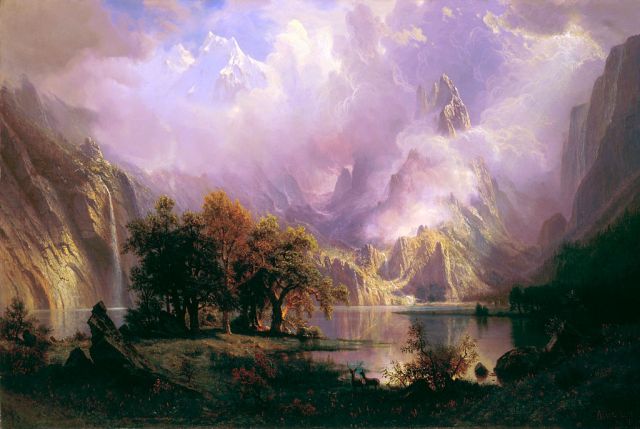
The Rocky Mountains were symbols of American greatness. (Credit: VCG Wilson/Corbis/Getty)






In the summer of 1776, just a few weeks after the Thirteen Colonies had declared their independence, George Washington was in New York, preparing for the first and biggest fight of the Revolutionary War. His army was about to face more than 30,000 British troops — the largest enemy fleet ever to reach American shores. He inspected fortifications, monitored British movements on Staten Island, and rallied his men. But, on 19 August, as New York braced itself for battle, Washington put aside his military maps and turned his attention to Mount Vernon, his plantation in Virginia.
That evening, he wrote a long letter to his estate manager, instructing him to design a new garden filled with trees and shrubs from the American forest. With the chaos of cannons and blood looming, the commander-in-chief thought of soaring white pines and tulip trees, alabaster dogwood and stately red cedars. Only American native species should be used, he insisted. As the young nation faced its first military confrontation in the name of liberty, Washington decided that Mount Vernon was to be an American garden where English trees were not allowed to claw their roots in the soil. It was Washington’s horticultural declaration of independence.
This week, the United States celebrates its 250th birthday. There will be flyovers, airshows, historical re-enactments, military parades, concerts, exhibitions and street parties. The Founding Fathers will be quoted, misinterpreted and used for political gain — as they have been for decades. Yet amid the celebrations, there is a very important aspect of these men, in particular the first four presidents, that has largely been forgotten: their love for the natural world.
As Washington’s letter so vividly implies, he grasped the importance of nature for the country’s identity and future. Certainly not everything the Founders did was great — not least given their fields and gardens were tended and cultivated by enslaved workers — but if American conservatives wish to invoke their writings and legacy, they might benefit from taking a broader view of their beliefs.
The Founding Fathers’ vegetable plots, ornamental plants, landscapes and forests played a crucial role in America’s struggle for national identity. Golden cornfields and endless rows of cotton became symbols of America’s economic independence from Britain; towering trees became a reflection of a strong and vigorous nation; native species were imbued with patriotism and proudly planted in gardens. Even political language drew on the natural world: with the Tree of Liberty the most potent example. Indeed, George Washington, John Adams, Thomas Jefferson and James Madison all agreed that agriculture should be the foundation of the new republic. In 1787, Jefferson wrote that “our governments will remain virtuous for many centuries; as long as they are chiefly agricultural”, while Washington dreamed of an agrarian society where “our Swords and Spears have given place to the plough share and pruning hook”. Madison thought agriculture the “surest basis of our national happiness, dignity and independence”, quipping that they were “worshippers of Ceres”, the Roman goddess of agriculture.
These were not abstract ideas; the Founders eagerly experimented with crop rotation, soil improvement and new farming methods. Jefferson famously designed the mold board of a plow and with the help of his enslaved workers grew 125 different varieties of fruit trees and 330 varieties of vegetables and herbs, constantly testing new varieties. “The greatest service which can be rendered any country,” he wrote, “is to add an useful plant to its culture.” And today it is almost unimaginable that Washington refused a third presidential term because he wished to return to his fields and gardens. Most Americans expected him to remain in office for life. Instead, he demurred, longing for Mount Vernon’s fields and gardens. Washington was also the first to collect farm dung in a specifically designed building. They were all, in fact, obsessed with manure. Adams experimented extensively, mixing dung with mud, lime and seaweed — and when he was the American minister in London, he even visited a manure heap on the outskirts of the city. While other diplomats rushed powdered and bejeweled through the corridors of St James’s Palace, Adams carefully poked through the stinking pile and clearly didn’t mind the muck on his hands. He noted its ingredients, and triumphantly concluded that it was “not equal to mine”.
To modern readers, this might seem an odd obsession. But it was key to a larger political vision. While agriculture provided the livelihood for most Americans, the Founding Fathers also believed that independent farmers with small self-sufficient farms would be the guardians of liberty. Seemingly mundane tasks such as collecting manure, planting seeds, plowing and improving soils were therefore political acts and elemental parts of nation-building. The more prosperous farmers there were, Madison argued, “the more free, the more independent, and the more happy must be the society itself”.
But there was a geopolitical element to their obsession with nature, too — reaching beyond their shores and freighted with the idea of national identity. Jefferson, in particular, was motivated by this as he took umbrage against what was known as the “degeneracy theory”. Most famously advanced by the French naturalist Comte du Buffon, this theory posited that the New World was inferior to the Old World: American plants, animals and even people were believed to be smaller, weaker and less vigorous than their European counterparts.
They all “shrink and diminish under a niggardly sky & unprolific land”, Buffon claimed. As these theories spread, the natural world of the United States became a metaphor for its political and cultural significance — or insignificance — depending on your viewpoint. Jefferson, naturally, was irked. And if size was Buffon’s measure of superiority, then Jefferson reasoned he only needed to prove that everything was larger and stronger in the New World. He immersed himself in natural history books, collected measurements of American wildlife, and asked correspondents across the country to provide data on the largest specimens they could find.
As part of his campaign to debunk the idea of American degeneracy, he arrived in Paris, in 1784, bearing an “uncommonly large panther skin” in his luggage. He likewise boasted to Buffon that the Scandinavian reindeer “could walk under the belly of our moose” and eventually arranged for an enormous moose from Vermont to be shipped across the Atlantic to prove his point. America’s flora and fauna were enlisted in a patriotic campaign to demonstrate the strength of the republic. Later, as president, Jefferson even briefly kept two live grizzly bears on the grounds of the White House. Under the banner of “the-bigger-the-better”, Jefferson used the size of animals and trees to prove his point — perhaps the one measure of greatness that President Trump would agree with. Yet where Jefferson sought grandeur in forests, wildlife and landscapes, Trump prefers monumental architecture, gold leaf and spectacle.
Following the end of the War of Independence, in 1783, the former colonies had to mature from being a war alliance to being a united nation. The Constitution bound them together politically and legally, but nature provided a transcendent feeling of nationhood, a shared sense of belonging. What previous generations had regarded as a hostile wilderness gradually became an object of national pride. The vast forests, expansive rivers and dramatic mountains became expressions of a singularly American character. The continent’s scale suggested strength and possibility; its wildness was the embodiment of a nation that had freed itself from the shackles of tyranny. Landscape had a political value. And in 1791, Jefferson asked the artist John Trumbull to paint Virginia’s Natural Bridge, so that he could present “to the world this singular landscape, which otherwise some bungling European will misrepresent”.
The return of Meriwether Lewis and William Clark from their expedition across the continent to the Pacific coast in 1806 reinforced these ideas. Primeval forests, vast plains, spectacular waterfalls — all became symbols of national greatness. Americans were convinced that the Rockies were more commanding than the Alps and that the Potomac rivaled the Rhine. John Adams dismissed the Thames as “but a rivulet” compared with the majestic Hudson, while Abigail Adams believed that nature possessed “greater magnificence and sublimity in America than in any part of Europe”.
Besides, America’s landscapes were untainted by centuries of monarchy and despotism. Where Europe’s antiquity became associated with tyranny and corruption, the American wilderness represented freedom and renewal. Why should they admire “the temples which Roman robbers have reared”, wrote the poet Charles Fenno Hoffman, when America’s nature was untouched by the blood of tyrants? This connection between patriotism and nature remains visible in America’s national mythology. The nation’s hearts are filled with pride as they sing the songs of their beloved landscapes. As “America the Beautiful” describes it: the “amber waves of grain, / For purple mountain majesties / Above the fruited plain!” Or “From the mountains, to the prairies, / To the oceans, white with foam”, in “God Bless America”.
It is ironic, then, that the Trump administration, a fervent advocate of bigger-is-better politics, is introducing environmental policies which include major rollbacks of federal regulations, withdrawal from the Paris Agreement, and proposed draconian cuts to the National Park Service. While Republicans frequently refer to the Founders in defense of limited government or gun control, they rarely acknowledge that one of them is also the forgotten father of American environmentalism: James Madison. In 1818, Madison delivered a widely published speech to the Albemarle Agricultural Society, which places him at the vanguard of American forest and soil conservation. In this speech, Madison warned about the destructive effect of deforestation and large-scale tobacco cultivation on the environment, challenging the assumption that nature “can be made subservient to the use of man”. At Montpelier, his plantation in Virginia, he even protected a part of the woodlands: the first American politician to preserve a forest.
Though Madison’s speech is largely forgotten today, it deserves recognition as one of the founding documents of the United States. It offers a reminder, as America celebrates its 250th birthday, that the Founders’ vision extended beyond political institutions and the Constitution. They believed that the republic depended not only on laws and liberty — but also on healthy soils, productive farms, thriving forests, and a respect for the natural world. Jefferson held this deeply, expressing it in a letter to Madison in 1789. “The earth,” he wrote, “belongs in usufruct to the living”. No generation possesses the right to exhaust or permanently diminish what it has inherited, and each receives the Earth from its predecessors and holds it in trust for those who follow. “The dead have neither powers nor rights over it”, Jefferson explained, “the earth belongs to each of these generations, during its course, fully, and in their own right. The 2d. generation receives it clear of the debts and incumberances [sic] of the 1st. the 3d of the 2d. and so on.” It is an idea that resonates as strongly today as it did at the founding of the republic, whatever the sitting president might claim.
Andrea Wulf is a historian and author. Her latest book is The Traveller: The Revolutionary Life of George Forster and His Search for Humanity.
 andrea_wulf