




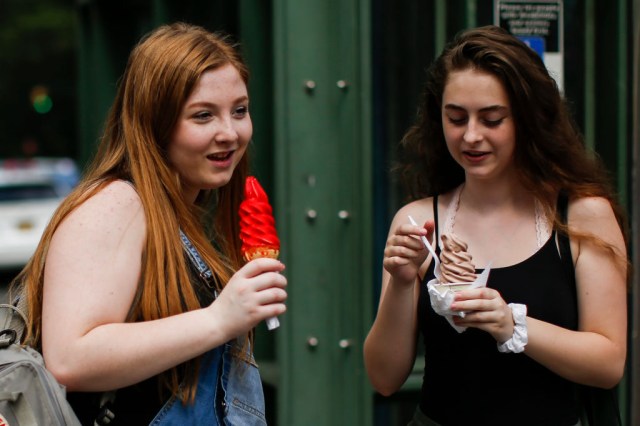
Lines have proliferated around New York City this summer for Instagram-worthy drinks and desserts. Credit: Getty





New Yorkers have always waited in line for culture-defining memories and trinkets — admissions to nightclubs, fashion scores from sample sales, Sex and the City cupcakes, or an “I Voted” sticker for the #resistance. But the new lines lengthening and proliferating across the Big Apple are confoundingly lackluster, due both to the fashion of the people waiting in them and to the grotesque, sugar-bomb goodies Gen Z is desperate to score.
The mostly women queuing obediently around Manhattan for cult hits like Soft Swerve and HeyTea are displaying sartorial choices as sweet, shapeless, frothy and generic as the products they’re waiting to consume. Soft Swerve, for the uninitiated, is a New York-based chain serving kiddie-colored soft-serve ice cream in Asian flavors, topped with whimsical, nostalgic items such as mochi or Fruity Pebbles. HeyTea is a blended-tea-drink chain launched in China that brands itself as distinctive by using real fruits and juices instead of powders. And while millennial restaurateur David Chang and his pastry chef Christina Tosi deserve credit for the soft-serve revival in the aughts — their “cereal milk” flavor tapped into millennial nostalgia for adult-free Saturday mornings bingeing cartoons — at least Team Chang did so with a healthy dose of kitsch and camp to add some acid. Gen Z goes the same route with earnest sensitivity. The trend, it seems, is self-infantilization.
The “West Village girl” uniform on display in these lines is amorphous, unisex and pre-sexual: white tank-top and figure-obscuring, light blue, baggy denim. Each young woman wears exactly the same thing as her friends, and as everyone around her. This look’s stylistic predecessor, “mom jeans,” wasn’t very sexy, but it was more grown-up, accommodating a postpartum midsection and tapering down the leg in a last-ditch nod to the feminine silhouette. The new West Village cozy-chic barrel cut is so voluminous and unstructured below the knee, it resembles a pair of surplus-store jogging pants.
The Zoomer mood board deserves the label “self-infantilization chic,” or “toddlercore.” The generation is defined by historically high sugar consumption, the choice of lifestyle over fashion, aversion to sex and vice, diligent consumption of media, and dutiful consumerism. At the center of the board should sit a single analog hack many Zoomers have probably never heard of — the sugar tit.
The sugar tit was a staple in the South for poorer families, especially during the Great Depression, and is essentially a makeshift pacifier. To make one, mothers whipped softened butter and sugar into a creamy emulsion, then wrapped it in cheesecloth for babies to suck as they explored the world, wearing a flour sack fashioned into a onesie. Thus ensconced in a cocoon and suckling on mommy’s teat, they could enjoy a carefree existence while mainlining sweet cream.
Ejection from this paradise is the existential gripe of the character Rue, the lead in HBO’s Gen Z-defining television series Euphoria. The show identifies the basic fact of eviction from the womb as the origin of Rue’s outsized anxiety and ensuing opioid addiction. Anesthetizing drugs offer Rue the closest simulation she can achieve to this amniotic sanctuary, until her tragic almost-reunion with mommy in the finale.
A cozy, safe place in an IG-worthy line makes the same promise as Rue’s drug addiction: a second-best return to the creature comforts of early childhood, when a diet of already-masticated foods is spoon-fed for easy digestion and quick endorphins, and while the conflict between baby and mommy, self and object, male and female linger on the horizon.
Soft Swerve offers a checklist of exotic flavors — ube, saffron, halva — but the essence of the pleasure is mouth feel and texture, or lack thereof. These chilled, aerated puddings are a toddler’s fever dream. Like the sugar tit, they combine ice cream and baby food, and even the self-definition of a deliberate scoop isn’t required. A concoction that is neither liquid nor solid splooges out from a teat-like apparatus to the queuing masses.
In late May, the soft-serve lines were eclipsed by the grand opening of a HeyTea Tea Bar on the Upper East Side. The city already had more than a dozen locations of the Chinese chain, the heir to the boba craze, but the UES outlet is the first in New York to offer sit-down service. Drinks such as the Coconut Mango Boom, Supreme Brown Sugar Bobo Milk Tea, and King Jasmine Guava start at approximately 400 calories. The signature “Cloud” line is topped with a “cheese cloud,” a “pillowy foam” of condensed milk, cheese, and cream — in other words, a sugar tit. And the chain’s marketing copy is correspondingly banal and unthreatening. The IG feed for its United States locations promises that the product “never gets old … milk aroma. Easy on the palate, easy to love….” Just what the toddlers ordered.
Gen Z’s culinary fixation also extends to savory mushy foods, though to a lesser degree. That soggy midday snack, Tater Tots, is “no longer just for kids,” as the Nickelodeon slogan once promised. Fried blobs of mashed potatoes have appeared on gastropub and upscale menus, satisfying the desire for the toothless enjoyment of soft edges. Lacking the confident crisp of frites or chips, each tot-morsel pays off with a creamy reward at the center.
Clout, in this form of consumption, is communicated not just by imbibing the decadent, excessively sweet novelty du jour, but by displaying the supposedly insider knowledge and expertise to be there in the first place — never mind that thousands of other insiders are there with you; it’s better that way, there is safety in crowds. Documenting the endless wait under the blazing sun for a mere trifle (a mass-humiliation ritual, really) transcends the banality of it all. A lick off a finally attained matcha-colored cone or a sip of the last liquified-mango-custard of the day is an act of valor. And the “mukbang,” internet slang for a video of a person eating, completes the consumerist burlesque. Contrary to the obvious sexual potential, this Zoomer dessert-porn signals the chaste pleasure of wholesome childhood favorites.
On the rare occasions Zoomers prioritize lining up and paying for fashion over food, for example the April 3, 2026, grand opening of Uniqlo Union Square (USQ), it is usually for items characterized by ultra-relaxed, voluminous silhouettes for men and women alike. Clothing popular with Gen Z comes in various neutral shades of white, beige, and pale blue. With the exception of the occasional animal motif, Uniqlo’s best-selling adult garments are interchangeable with its children’s collections. The sizing is mass market, the fit is relaxed, and the leisurewear for men and women could easily function as jammies. There is even a resurgence from denim mainstays Levi’s and Gap, not just of overalls, but of baggy, hygge overalls, once again, channeling the onesie. Perhaps snap-crotches will be next for an easy diaper change.
Fashion these days is focused on comfort at the expense of sexy provocation or a visionary reconfiguration of the human form. In fact, fashion is hardly prevalent at all, with Zoomers obsessing over easier, less distinctive options such as skincare and accessories. The post-Covid focus on grooming is supposedly a self-care revolution, but it really seems more like a self-erasure. The ubiquity of “clean girl” and “glass skin” aesthetics, and the preference for “blush blindness” — essentially pristine, bouncy, baby skin with an innocent pink flush on the cheeks and barely rouged, moist lips — opts for a common, innocent face for the masses.
If any fashion choice sums up this generation, it is that Gen Z icon and avatar: the Labubu. Though the trend has waned, at its peak, Labubu, a mid-teens Pop Mart creation, drew long lines and sold millions, all through the appeal of childhood-stuffed-animal attachment. There were collaborations with brands as storied as Coca-Cola and Art Basel. Labubus hung from key chains and dangled from designer statement bags, and the larger and more demonic-looking, they were, the better.
Ugliness, in fact, was the essence of the Labubu appeal. The bubble heads, distended bellies, and pudgy legs revealed the underbelly of all that Zoomer optimism and perfect skin. These coveted plushies were the scowling talismans of the hangry toddler. They are what happens when the owner can’t get their way: an Oscar-worthy tantrum that only ends with another sweet, gummy treat, a mouth plugged with a sugar tit.
Zoomer men are little better. They also display the pre-sexual signifiers of self-infantilization — potato sack silhouettes, Tater Tots cravings, and jolie-laide plushies — with one distinctive touch of their own: the “broccoli cut.” This hairstyle is a closely shorn fade on the back and sides of the head, which is supposed to be read as ultra-masculine, referencing the sharp, clean-cut geometry of alt-Right aesthetics. But the front, in nearly schizoid dissonance, is often curled or even permed into loose, tousled tendrils, with a light touch of wispy bang. Like the softly billowing flesh of the Renaissance putti, broccoli hair is reminiscent of the pre-verbal intimacy between mother and son; it is a last frolic in the feminine cocoon before being wrenched from mommy’s nip and inducted into the world of men and masculinity.
It’s quite the self-own that Clavicular, proselytizer of jutting edges and hard exteriors, has adopted this hairstyle. What a waste of bone-smashing and steroidmaxxing to adopt the romantic coif of a cherub, and to accidentally acknowledge that the eternal feminine perfects the eternal masculine. Manosphere stars routinely fall for this trap. HSTikkyTokky, the main subject of Louis Theroux: Inside the Manosphere, is also a broccoli-cut mannequin, though it is more forgivable on textured, ethnic hair. In the closing sequences of the film, he perhaps realizes that there is no honor in the combative machismo he projects, and he brings his mother into it — we suspect to humanize and defend him. In a climactic scene, she offers him a juice bar to calm his nerves while she does damage control. To save face, he protests to the camera, “but mom, I don’t want a juice bar….” Except that we know he really does. He’s even willing to stand in line for it.
Gesha-Marie Bland is New York-based screenwriter and beauty editor. Her writing has previously appeared in Vanity Fair, IndieWire, and the Journal of Free Black Thought.
 gmgeiko