









June 27 2026 - 4:00pm
On Thursday, US Vice President JD Vance claimed that “the Deep State took down Richard Nixon” to an applauding audience at the Nixon Presidential Library and Museum. This wasn’t a gaffe, nor was Vance being particularly provocative. He had read the room well, for Nixon has become a lodestar for 21st-century Right-wing counterculture.
When Nixon resigned in August 1974, he bore the brunt of America’s collective rage over the Watergate scandal. But as time goes on, Watergate looks less like the story of an imperial president and more like the story of a leader who lost control of the institutions surrounding him. The national security bureaucracy spied on the president. The Watergate Special Prosecution Task Force was hunting for scalps with the goal of getting Nixon “at all cost”. Coupled with the homogeneous TV media environment of the Seventies — three channels that alternated coverage of the Watergate hearings to keep the public’s attention focused on Nixon — he didn’t stand much of a chance once the scandal got into motion.
Americans of the early Seventies generally trusted their spies, lawyers, and journalists. That’s not true of 21st-century voters. Watergate connects with the younger American Right because the institutions involved in the scandal are the same ones that have become discredited during the last decade: military and intelligence agencies, the legal profession, and the legacy media. All these institutions are implicated in the post-2016 lawfare that sought to remove a duly elected president from office. Watergate now looks like a dress rehearsal for what happened to Donald Trump during his first term. Nixon helps us understand the true character of the American regime, where the mythology of an imperial president hides the reality of presidents who struggle to take control of their own government.
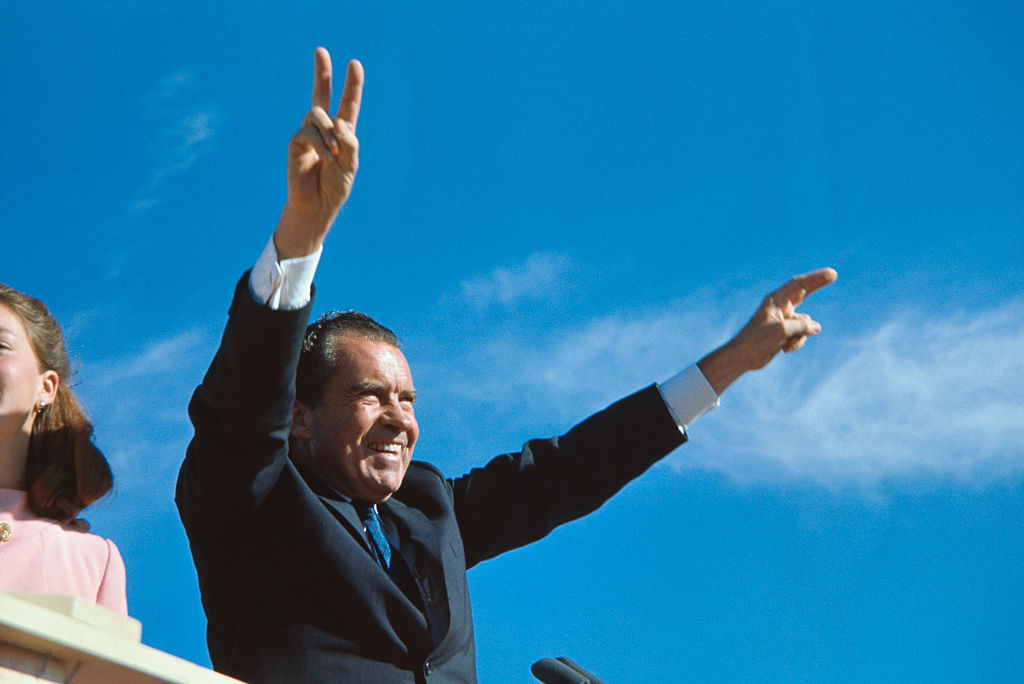
But with Nixon, it’s the vibes that matter. These days on the American Right, a Nixon clip and a colorful quote from the tapes is more likely to go viral than an elegantly delivered, carefully crafted phrase from Ronald Reagan, who looks like the first act in the age of politics that placed communication before substance. By contrast, Nixon’s frankness, awkwardness and brass-knuckle politics are embraced by a younger generation as a revolt against the age of manufactured consent that found mediocrity less risky than glory.
After Watergate, Boomers became uncomfortable with that imagery, which suggested an inexorable lust for power. The scandal became a pivotal event in a cautionary tale. Nixon’s rough edges also stand as a repudiation of the cookie-cutter politics of civic discourse that the Boomer generation embraced. Politicians such as Barack Obama stood at the apex of this, embodying exquisite rhetoric that mesmerized conservative and progressive intellectuals alike, even though his speeches cynically divided the electorate up into friends and enemies (“that’s not who we are”). In this environment, Nixon’s lists of friends and foes — “Professors are the enemy. Write that on the blackboard 100 times and never forget it” — seem more honest and accurate.
What’s more, young Right-wingers arguably have a better sense of America’s limitations and vulnerabilities than older generations. The “Morning in America” mindset that asserted optimism as the solution to all the country’s problems — and condemned those who did not feel it — is losing its power. In its place is an intuition that for the US to survive and avoid further humiliations, its leaders must negotiate from a position of comparative weakness. Not only does this give a new relevance to Nixon’s foreign policy, it also allows younger people to grasp the tragic part of human life better than the Boomers did. In that environment, Nixon himself looks like a tragic hero, brought down by more powerful forces. Behind every Instagram video and retweet is an admiration for those who struggle and fight for great things, even if they don’t win.
