




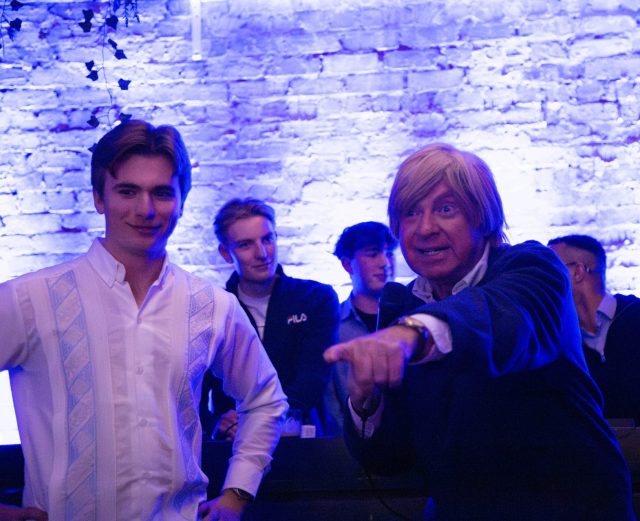
Hugo Rasenberg stands next to Sir Michael Fabricant. (Young Conservatives)





Sir Michael Fabricant assures me that he isn’t “a teddy bear fetishist”. I glance around the former Conservative MP’s living room at the multiplicity of ursine plushies, each comatosely slouched as if in the aftermath of a particularly raucous picnic.
The biggest, Fabricant tells me, gesturing to a dark brown bear, is named “Howard” after an old friend of his. Fabricant tells me that he spotted “Howard” — Howard the Bear, that is — while shopping in the Milton Keynes branch of John Lewis. The store was managed at the time by Fabricant’s life partner, Andy Street, former managing director of the John Lewis Partnership, and Mayor for the West Midlands 2018-24. Anyway, Fabricant had to have Howard. And now Howard is reclining in an armchair, staring at a fireplace that’s obscured by dusty flowers. The flowers are artificial and yet they still seem to be wilting.
Like Pooh hunting his Heffalump, I had set out on the trail of a rare and possibly non-existent creature: the Tory of the Future. Fabricant was the VIP guest at an exclusive event hosted by the Young Conservatives (YC’s) in Birmingham, where my £25 ticket had promised the chance to spend “20.00-Late” with the party leadership of tomorrow. The event’s organizer was Hugo Rasenberg, 21, a protegé of Fabricant and Street, then campaigning for a seat on Birmingham City Council. When Rasenberg told Fabricant that I was a journalist, Fabricant immediately proposed the three of us go for a curry — and so we find ourselves dissecting the future of Conservatism over aperitifs in his sitting room.
When I began my search, it wasn’t entirely clear to me that such a future exists. In 2024, after 14 years of Tory rule, the most successful electoral machine in the Western world abruptly collapsed in on itself: Fabricant and Street both lost their jobs; disenfranchised voters were seduced to either Reform, the Lib Dems, Labour, or the hypnotic Greens. Subsequently, party membership reached an all-time low: Conservative Home predicted in October that the numbers would soon fall below 100,000 – fewer than half the Green Party’s March 2026 figures. Somewhat overlooked amid Labour’s dire local election results last month were a still more hopeless set of results for Kemi Badenoch, notwithstanding a few isolated triumphs.
It’s therefore not difficult to see why the party would wish to chase a younger demographic. The difficulty is that the vast majority of young people absolutely detest the Conservative Party. Even in 2019, when Boris Johnson won the biggest majority since 1987, Ipsos Mori’s final poll estimated Labour to be 26 points more popular than the Tories among 18-to-34 year olds. Given that the Conservative Party appeared to be actively hostile to young people throughout its 14 years in power — imposing austerity, trebling tuition fees, presiding over a dysfunctional housing market, and orchestrating Brexit (which around 75% of young people voted against) — it is perhaps unsurprising that the party now struggles to articulate what it actually offers us.
The event where Rasenberg first introduced me to Fabricant did, however, offer a few clues. Once I had scanned my QR code and squeezed past two young men fervently kissing, I was surprised to see at least 100 young Tories in the main bar.
The first person I spoke to was a teenager with an accent I couldn’t quite place. “I have some views on immigration”, he spat into my ear. “Even if you need to put a gun to a foreign person’s head to get them to leave the country, then that’s just the way it is.” He then told me he was from Spain.
We were immediately approached by a man of about 19 in a tweed blazer. “I’ve got a story for you,” he said, before revealing that the Conservatives have the highest number of young members compared with other parties. This would not be the last time I heard this baseless claim as the night progressed. I did, though, speak to two teenage smokers who became party members owing to what one described as “current political instability”. The other saw the Tories as “a safe bet”. Another pair seemed to have inherited Toryism from their respective parents, in the same way one might inherit Tottenham Hotspur or a tendency for gout.
I quickly moved on to a crowd which included Jay Chan, 20. If social media numbers were currency in this room, Chan was coining it in with his 40,000 Instagram followers. Identifying as Chinese but a “Tory through and through”, he wore his everyday attire: an immaculate suit with braces and a blue plaid tie. He was only two sentences into a monologue when I realized I had seen this performance before: his mode of delivery was remarkably similar to Boris Johnson’s, a blustering enthusiasm punctuated with over-emphasized plosive phonics and jargon. On Chan’s Instagram is a photo of him in a blond wig, cosplaying as his political hero for school Leavers Day. Chan emigrated to the UK from Hong Kong aged 15, joined the Conservative Party less than a year later, and claims he perfected his English by watching Johnson’s televised Covid conferences.
A troop of supporters clustered around him as he charged a pint of Guinness in the air. “What do we say of Labour?” he bellowed. “Shit”, the group chorused. “What do we say of shit?” he asked. “Labour!” came the reply as Jay downed the pint in one to delighted cheers. He immediately did this again, this time to more muted acclamation, and a third time, by which time several of the onlookers had ebbed away.
When we came to discuss the present Tory leadership, Jay Chan had a clear point of difference with Badenoch on the issue of social media. Chan credited the internet with introducing young people to politics — a prospect particularly important when considering Labour’s People Bill, which will allow 16-year olds to vote. In a predominantly male Right-wing room, I was expecting an attempted indoctrination into the manosphere, but instead Chan was one of several young men who volunteered his homosexuality as a talking point. Politics, he suggested, is a natural domain for men who aren’t interested in the football and Formula 1 that their algorithms complacently serve them: “Gay men aren’t typically socialized by the media they consume,” he said. “When you don’t get along with your straight classmates you also don’t fully get along with girls talking about makeup, dating, fashion… you begin to find yourself into things like politics. That’s my theory.”
A study from March 2026 by King’s College, London revealed that social media does indeed play a “huge role” in promoting traditional gender views. Politics, Chan suggested, consequently function as the “center ground” for young gay men — a space they supposedly gravitate toward on account of being unable to fully inhabit either side of the divide. He notes how a fellow YC believes “everyone in politics is secretly bisexual”. While clarifying that he doesn’t necessarily agree, he then catalogs the identities of various colleagues: “Bisexual, gay, gay, bisexual, transgender” (he pronounced it trarns-gender), before referring to the Liberal Democrats as the “Liberal Femboy-crats”. After all: “The femboy is the essence of liberalism”.

By 9pm the room was packed, predominantly with young men. Their clean-shaven faces were crowned with modest hairstyles. Pastel-hued shirts and cerulean jumpers jostled against each other. Familiar hands wandered across shoulders and upper arms. A young civil servant carouselled around the dancefloor, propelling his tie above his head like a helicopter rotor as he failed to instigate a conga line. It was finally time for the star of the evening: a man who once filmed himself cycling nude around a public park, and whose YouTube channel shows him spanking a clothed man on the buttocks with a shoe horn. He also appeared on Channel 4’s Celebrity First Dates — where he came out as bisexual — and in April 2025, had a short stay in the Celebrity Big Brother house: Sir Michael Fabricant.
Fabricant entered with a small entourage, but by the time he reached the stage he was surrounded by swooning young Tories. Their role model grabbed the microphone amidst cheers and hollering. His opening gambit was to celebrate the (then-recent) killing of Iranian leader Ali Hosseini Khamenei. The crowd chanted “USA, USA, USA!” as their luminary punched the air.
Although the room was broadly pro-Trump, the crowd was decidedly less enamored with his British tribute act, Nigel Farage. Earlier in the night I’d detected a disgust for Reform UK and its leader, even from those who had been vocally anti-immigration. But Fabricant, surprisingly, encouraged the crowd to vote for Reform UK. This, he suggested, was the best course of action in constituencies where the Conservatives were destined to lose. In the crowd, there was an exchange of side-glances and murmurs.
As his 10-minute speech and subsequent audience questions — “on any subject except my hair” — drew to a close, someone interrupted the proceedings to call for those running in local elections to raise a hand. A Spartacist collective of arms surged above the crowd. The blazered young man from earlier materialized next to my ear: “Do you not feel roused?” he whispered. I informed him that I remain un-roused. “Would it be different if we were at war?”
Before the evening ended with slow dancing, mumbled apologies for drunkenness, and me having to assist in the rescue of a teenage Tory who was lying unconscious on the pavement, Rasenberg introduced me to Fabricant.
Subsequently, a fortnight later, I am in Fabricant’s living room with Rasenberg and Howard the Bear. We are drinking red wine — wine, Fabricant informs me, that he recently won in a raffle. For now, Fabricant is less keen on formulating a theory as to how the Conservative party can renew itself in an age of populism and soundbites — and more keen to spill the tea on various Tory colleagues and donors: who fancies whom, who is secretly gay, and who recently surprised him by marrying a woman. He refers to homosexual men as “gay boys”, and tells us that age-related hormone changes haven’t stopped him from “cranking away”.
I ask him why he thinks young people aren’t engaging with the Conservative party. Fabricant proposes it’s because they are incapable of looking beyond the immediate past. “And the immediate past to them is the handling of Covid.” It’s a convenient theory: that youth disaffection is a failure of perspective. Even if young people could see past Covid — including the 23,000 additional deaths resulting from Tory complacency — it would offer little comfort. Many of the policies that shaped young people’s lives were enacted when today’s teenagers were toddlers: the scrapping of the Educational Maintenance Allowance in 2010 (a weekly payment that supported 16-19 year olds to remain in education); the closure of Connexions (a £200m a year, government-funded agency that provided teenagers with career advice, training, and personal support); the denial of the chance to go and live and work abroad, thanks to Brexit. Fabricant “totally stands” by Brexit.
Rasenberg offers an alternate theory. He says the Tories are a party for those who are “reading and thinking” as opposed to those who only have “vibes-based” political affiliations. “We’ve been robbed of what our parents and grandparents had,” he says with reference to the property ladder. He isn’t wrong — but I also ask whether the Conservative Party is to blame. Under the last Labour government, a household earning the median income could afford to buy an average priced home in England. According to the ONS, by 2022 only 10% of the property market was affordable to the same demographic.
Fabricant steers the conversation away before Rasenberg can reply. After some back and forth, he returns to the prevalence of “gays” in politics. Rasenberg says that, as a straight man in the Conservative Party, he does “sometimes feel like a minority” — and I get the impression he wants his sexuality on the record. Fabricant, a longstanding campaigner for gay rights, claims the Tory’s gay culture is nothing new: he recalls how a former Chief Whip once asked him if there was a “huge gay undercurrent in the Parliamentary party”. Fabricant claims that gay people “like Catholics” stick together. He then tells me how “flattered” he once was to have his “bottom” grabbed by a senior politician in the Strangers’ bar in the House of Commons.
Rasenberg leans into my dictaphone: “I’ll be honest. Sexual harassment culture I want to expunge, that needs to be gone”. In February, Birmingham Live reported claims that a Labour candidate sexually harassed Rasenberg at an election count. “Twink”, “eye-candy” and accusations that Mayor Andy Street only hired Rasenberg because he was “nice to look at’” are just a few examples of the “intentional, weaponized [and] aggressive” comments Rasenberg allegedly received.
Regarding sexual harassment between men, Fabricant proposes the preventative measure that “one bloke can always thump another bloke”, before clarifying that “of course [sexual harassment culture] is wrong. And I’ve never done that and nobody’s ever accused me of doing that”. In 2017, Fabricant’s name was redacted on a list of MPs accused of inappropriate sexual behavior — an accusation he staunchly denied. In 2022, he was accused of “making light” of rape allegations against a Commons colleague. Of Rasenberg’s experience, he declares that if “somebody had called me a twink, I’d have loved it.”
It’s time for our curry. Leaving via the garden gate (our host makes a back-passage joke) we venture to his Indian restaurant of choice. “What shall we do?” he asks with innocent delight as we settle into its cushioned benches. Fabricant speaks about his childhood with fondness, and at one disconcerting point, he and Rasenberg start conversing in German — giggling at something they have no intention of translating. Fabricant regales us (auf Englisch) with anecdotes: triumphs, scandals, sexcapades, famous politicians and near-misses of varying plausibility. Rasenberg seems impressed. I’m not sure how much I believe.
While on the last train back from Lichfield, it struck me that despite the eclectic conversation and his position of stewardship, Fabricant was unable to land on what the Conservative Party might offer the younger generation. Instead the former party Vice-Chairman blamed cognitive barriers, recalled anecdotes of sexual harassment, and endorsed a rival party to a room full of Tory youth. Edward Gibbon, chronicling the fall of Rome, observed that empires do not typically collapse from external assault but from a slow, self-administered erosion. The Tories, it seems, have been remarkably diligent in this regard.
Still, from what I’ve seen, the Conservative Party is not dying but metamorphosing into something previously inconceivable: a right-wing, queer social club. A Tory source recently informed the Independent that “Kemi [Badenoch] is urging people to be patient behind the scenes” and I get the impression Rasenberg believes he is buying the dip. But I didn’t see anything that convinced me this is indeed a “safe bet”.
Weeks later, Rasenberg will fail his bid to gain a seat on Birmingham City Council, losing out to a Green and an ex-Labour Independent. Others I met fare no better in their respective constituencies. “Que sera sera”, Rasenberg will write, responding to the defeat on Instagram. Whatever will be, will be.