




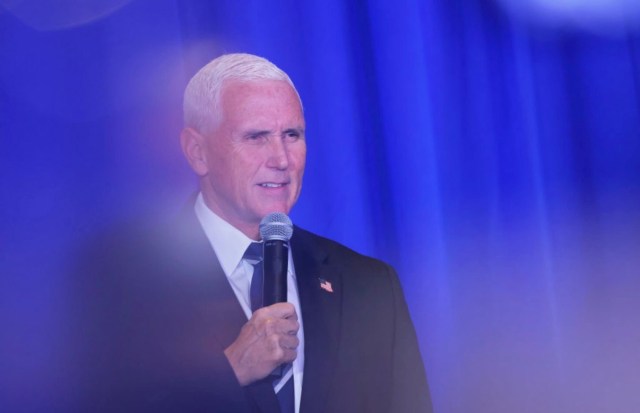
Former Vice President Mike Pence cannot explain the rise of populism. Credit: Getty





It’s 2001, and a young Mike Pence is listening to George W. Bush deliver his first major speech to Congress. The Indiana representative has waited a long time for a Republican president, but something is wrong. Bush is talking about not only expanding the size of the Department of Education — a Jimmy Carter creation — but growing its power, too. Wasn’t Bush supposed to be a Republican? Why, then, was he arguing for a bigger federal government?
It was here that Pence resolved to cling to “tried-and-true” conservatism, he explains in What Conservatives Believe, his new book, published Tuesday. In doing so, he broke with his party’s leadership to vote against Bush’s flagship education reform, the No Child Left Behind Act. That moment would harden into a governing conviction: that Republican orthodoxy had been compromised, and that it was his calling to restore it.
In these benighted times, as the “siren song of populism” grows ever louder, the former vice president still dreams of that restoration: a nation that rises up and lives out the true meaning of its creed — low taxes, limited government, and unwavering support for Israel, America’s “most cherished ally.”
That this dream is shared by approximately 16 other Americans, the vast majority of whom constitute Pence’s extended family, hasn’t stopped him. This is an exaggeration, but only slightly. The truth is, that brand of conservatism — it used to be called fusionism, for combining free-market orthodoxy, free-policy hawkism, and “traditional values” — is quite literally dying along with the subscriber base of National Review.
What Conservatives Believe, Pence’s third book since leaving the White House in 2020, is yet another long-winded attempt at vindication. The book is framed as a statement of principles, rather than autobiography. It offers no insight into the internal machinations of the Trump White House, nor does it attempt a psychological portrait of the most powerful man in the country. It does not even advance a new or original critique of MAGA populism or progressivism — ostensibly the book’s central purpose. Instead, readers are treated to nostalgia politics and a catalog of policy prescriptions that would have seemed dated in the Bush era, let alone this one.
The new book does serve one important purpose, however. For all its denunciations of populism, Pence’s work is a powerful reminder of why Trump emerged in the first place. Before 2016, fusionism was the GOP’s governing philosophy. Its true believers — the likes of Paul Ryan, Eric Cantor, and Kevin McCarthy — were seen as the future. Likewise, Jeb Bush, Mike Huckabee, and John Kasich were all serious contenders for the presidency. It was hardly a golden age — and yet, this is the world that Pence seems to want to return to.
Trump may be an (extremely) imperfect vessel for working-class America, but he at least recognized that something was rotten in the old order. Pence, by contrast, refuses to grapple with that failure. If What Conservatives Believe reveals anything, it is that Pence still mistakes the consensus that produced Trump for the one that can succeed him.
There is something almost endearing about Mike Pence. A conservative “proudly out of sync” with the times, he is one of the rare few who practice what they preach. A devout Christian married for 41 years, the lifelong Hoosier has lived such a scandal-free life that his biggest “controversy” was converting from Catholicism to evangelical Christianity as a college student. To this day, he never eats alone with a woman unless it’s his wife, and he refuses to attend events involving alcohol without her by his side. (In the post-#MeToo era, many other politicians might have wished they’d adopted a similar approach.)
This rigidity also extends to Pence’s politics. Despite growing up in a Democratic household in which John F. Kennedy (a fellow Irish Catholic) was the poster boy, Pence began flirting with the GOP during that same period, and the opinions he adopted early haven’t changed. In What Conservatives Believe, he describes Barry Goldwater, the Arizona senator and proto-Reagan, as his intellectual hero. The young Pence found The Conscience of a Conservative, Goldwater’s statement of principles, “stirring and compelling.”
“Stirring” and “compelling” are not words that immediately spring to mind when reading The Conscience of a Conservative. Its didactic style, however, is clearly something Pence seeks to emulate in his own writing. He writes that conservatives “must begin with moral clarity”; they “must find commonsense solutions”; “they must have faith”; and, most important, they “must never forsake our constitutional principles.” It’s the kind of message that might have had some purchase 50 years ago, but in the age of Trump’s “weave” and rambling Truth Social posts, it struggles to register.
Unlike most other anti-Trump books, Pence’s work is different in that he is willing to take on his own side, even if his attacks on the president remain restrained.
In Pence’s telling, the specter haunting America is the unholy alliance of progressives and Right-wing populists. He argues that the latter peddle “progressivism in disguise,” warning that they are “fellow travelers on the road to ruin.” Both dream of a collapse in the America-led international order, and seek to enlarge the state to such a degree that it crushes the economic freedom of Americans. No one is spared from Pence’s withering attacks — not even Marco Rubio, whose “common-good capitalism” is dismissed as a “warmed-over version of big-government Republicanism.”
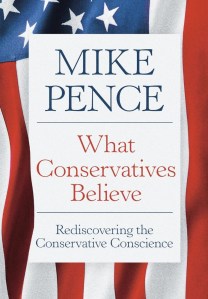 For Pence, the only answer to the problems of capitalism is more capitalism. He shows little willingness to consider that the system itself may have helped create the very populism he condemns. Across 264 pages, Pence devotes just one paragraph to the causes of the populist revolt in 2016, while Barry Goldwater earns 36 mentions. Though he concedes that globalization “left behind” some regions of the country, he blames big government — rather than trade, deindustrialization, or immigration — as the source of America’s ills. Beyond that, readers are served a steady diet of folksy maxims about how “populism is like a gust of wind” and hollow aphorisms such as: “Populists follow urges, not principle.”
Perhaps we should not expect much more from a man who once described himself as Rush Limbaugh on decaf. Pence’s role during the first Trump administration was largely ceremonial; he was the inscrutable mute who nodded, smiled, and applauded on cue, but rarely spoke out of turn. Unlike JD Vance, who has carved out a far more visible role in foreign policy and other issues, Pence left office without a signature policy achievement to call his own. He surfed the populist wave all the way to the Number One Observatory Circle and never seemed quite sure what to do once he got there.
This is Pence in a nutshell. He was content to ride on Trump’s coattails, claiming the administration’s successes as his own, until the president turned on him on Jan. 6. Crucially, Pence mistook his elevated status in the White House for evidence that he represented a constituency that was loyal to him, rather than the president. In doing so, he misunderstood the movement itself: MAGA was never a coalition awaiting conservative stewardship, but a personal following organized around Trump alone. Pence’s failed presidential campaign in 2024, lasting fewer than five months, proved as much.
If there is an heir to Trump, that person will not be a bible-thumping Christian who preaches a return to civility and fiscal conservatism. More likely, it will be a figure who best channels the values Trump claimed to represent: ending foreign wars, draining the swamp, and reviving America’s industrial heartlands. Trump may have failed in some of these promises, but he at least forced a reckoning on them. That his coalition grew, rather than shrunk, over three elections shows he had a far greater sense than Pence — or any Republican for that matter — of where the country was headed.
Pence, by contrast, believes the problems facing 21st-century America can be found in the 20th century, with the “provable” ideas of Ronald Reagan guiding the way. So how would the former vice president address the very modern problems of social atomization, the breakdown of communities, and the infiltration of technology into everyday life? Pence answers these thorny questions with grandfatherly wisdom: “social media often can feel like antisocial media,” “iPhones transform into what I call ‘iFOMOs’ because users suffer from a ‘fear of missing out,’” and the suggestion that the Founding Fathers might have prefaced the Tenth Amendment with “ICYMI.”
These sparkling insights may read more like a church newsletter than a political diagnosis, but they point to a broader truth. The world that produced Reagan — and the Republican consensus he embodied — has long since disappeared, replaced by economic dislocation, cultural fragmentation, and a crisis of institutional trust that Reaganite platitudes are poorly equipped to address. The tragedy of Pence is not merely that he was eclipsed by Trump, but that he still cannot see why Trump emerged in the first place. The world has moved on from Pence and his ideology; only Pence seems determined to remain behind.
